Menu design for terraces and outdoor seating: glare, wind and weather
How to design a menu that works outdoors: matte paper against sun glare, weight and holders against wind, materials that survive rain, and type sizes for bright light.
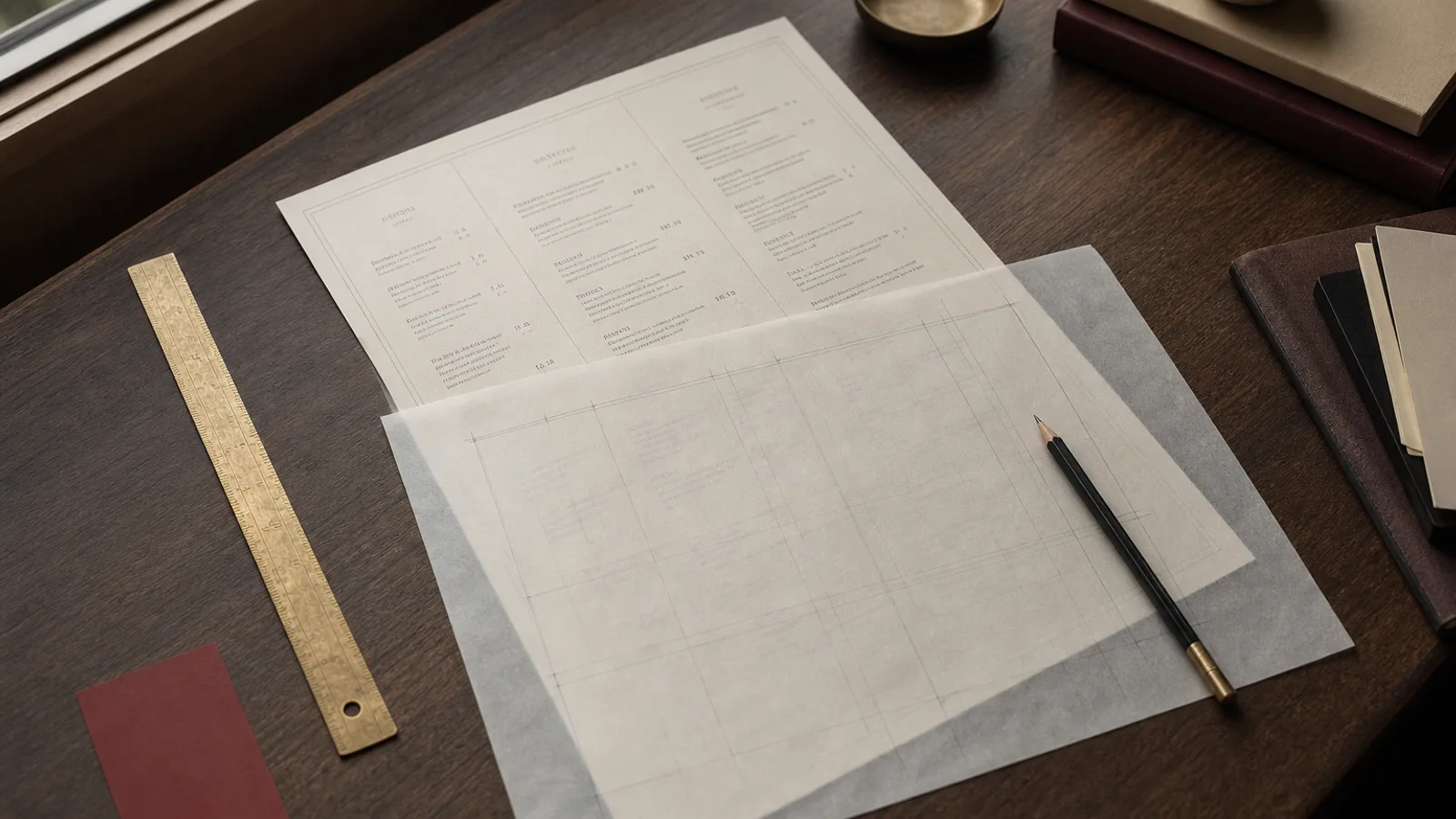
A menu that looks perfect in the dining room can be unreadable two metres away on the terrace. Sunlight turns a gloss laminate into a mirror, a gust takes a 170 g sheet into the neighbour's coffee, and a summer shower makes uncoated board swell like a sponge. Terraces often account for half of a restaurant's covers between May and September, so the outdoor menu deserves its own thinking. Here is what changes when the menu leaves the building: surface, weight, size, type, colour and the small hardware that keeps it on the table.
Glare: the surface matters more than the design
Direct sunlight on a terrace reaches 50,000 to 100,000 lux, roughly two hundred times the light in a dining room. Any glossy surface, a laminate, a UV varnish, a coated board, reflects it straight into the guest's eyes, and they end up tilting the card to find an angle where they can see the words. The fix is a matte surface: uncoated board, a matte or soft-touch laminate, or a matte synthetic paper. Matte laminate still reflects a little, so if the terrace faces south, uncoated or soft-touch is the safer choice.
Paper colour helps too. Pure bright white in full sun is dazzling; a warm white or a light cream around 5 percent yellow cuts the glare without hurting contrast. Very dark papers do the opposite: black board in the sun absorbs heat and the text, usually reversed in white or gold, disappears in the reflections.
Wind: weight, format and something to hold it down
Wind is the terrace's most underrated enemy. A single A4 sheet of 170 g paper lifts at about 15 km/h, a light breeze. Three approaches work, and most terraces combine two of them.
- Weight and stiffness: 350 to 400 g board, or a synthetic sheet of 300 microns, stays put in light wind and does not flap. Bifolds are more stable than single sheets because they stand slightly open and present less flat area.
- Smaller format: an A5 card has half the surface of an A4 and catches half the wind. A DL strip at 99 × 210 mm is lighter still and fits between the glasses.
- Anchoring: a clipboard with a spring clip, a slot in a wooden block, a weighted acrylic stand or a clip on the table number. Even a simple heavy holder on each table reduces the number of menus lost to the pavement to almost none.
Avoid the classic laminated A4 in a plastic sleeve; the sleeve adds glare and the whole thing sails better than a kite. And keep the drinks list on the same card as the food, so guests are not juggling two sheets in a breeze.
Rain, spills and sun cream
Outdoors, the menu gets wet more often than indoors: rain, condensation from the carafe, a knocked-over Aperol. It also collects sun cream from hands, which stains uncoated board permanently within a week. Three material options, in increasing order of durability and cost.
- Uncoated 350 g board with a matte finish, reprinted often. Cheapest per copy, around 1.50 to 3 €, looks and feels best, but plan on replacing it every three to four weeks in high season. Fine for a short seasonal terrace menu.
- Matte laminated board. Wipes clean, resists a shower, lasts a season. Costs 1 to 2 € more per copy. Edges can lift and trap dirt if the laminate is cut flush; ask for a sealed edge.
- Synthetic paper, polypropylene or polyester at 250 to 350 microns, printed directly. Completely waterproof, tear-proof, wipes with any cloth, lasts a year or more. Costs 3 to 6 € per copy in small runs and feels slightly plastic in the hand, so it is the right choice for beach clubs and busy terraces, less so for a fine dining garden.
Type and colour for bright light
Readers outdoors are squinting, wearing sunglasses and sitting in dappled shade. Thin type, light grey text and low-contrast colour pairings that work at 200 lux inside fail at 50,000 lux outside. Body text of 11 pt is the minimum indoors; on a terrace, go to 12 pt, use a regular or medium weight, and set text in near-black on light paper. Polarised sunglasses also darken some printed colours unpredictably, so keep essential information, dish names and prices, in black rather than in a brand colour.
UV fades ink. A menu that sits in the sun for a season loses saturation in reds and yellows first; blues and blacks hold longer. If the design leans on a warm brand colour, expect it to shift, and either reprint in mid-season or choose a printing process with UV-resistant inks for synthetic stock.
A shorter card for a different service
Terrace guests order differently: more drinks, more sharing plates, faster turnover, more people who wandered in without a booking. The terrace card can be a shorter version of the dining room card, with the drinks list given as much space as the food, sharing plates first, and allergen codes with the legend clearly printed, since Regulation 1169/2011 applies outside as much as inside. A single A5 double-sided card, food on one side and drinks on the other, covers most terraces and fits any holder.
Print the terrace card in slightly larger quantities than the number of tables; losses to wind, spills and souvenir-taking are higher outside. Fifty percent extra is a reasonable margin for a season.
Same design, terrace edition
The terrace menu should look like it belongs to the same restaurant as the indoor card, in the same style and typeface, but adapted in format, size and stock. Design it once, then derive the outdoor version: fewer items, larger type, matte stock, a stiffer board, a holder on each table. In Menu Atelier that derivation is quick: duplicate the indoor design, switch from A4 to A5 double-sided in one click, raise the body size, check the fit in 3D and export a print-ready PDF with bleed and crop marks. If you order printing from us, the standard stock is 350 g matte board with a soft-touch finish, which is exactly the low-glare, stiff, pleasant-to-hold surface a terrace needs; for synthetic waterproof stock, take the PDF to a local printer who handles polypropylene.