First and last: the position effects inside a menu section
How first and last positions inside a menu section change what guests order: primacy, recency, the middle that disappears, and when to break the pattern.
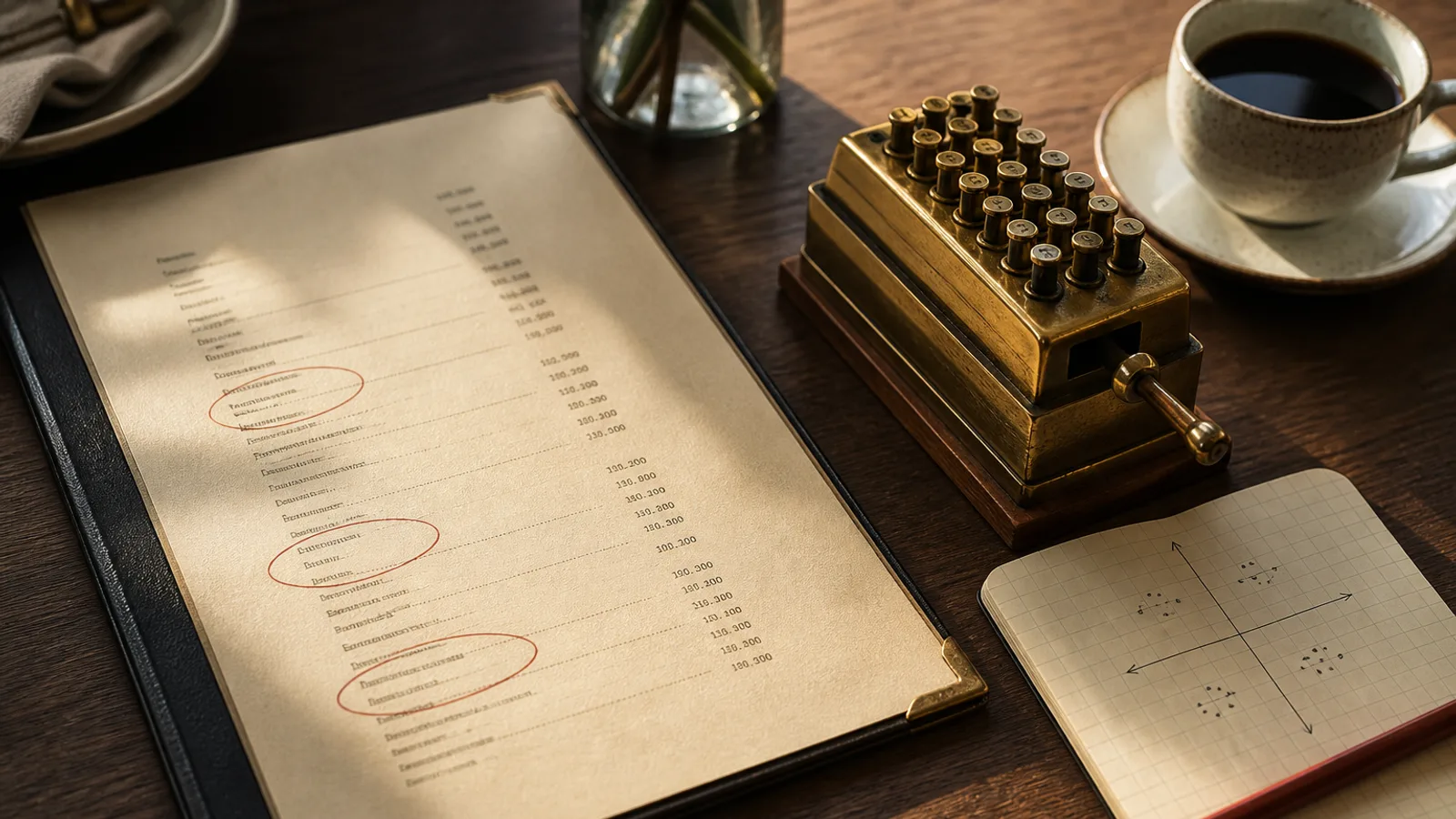
Inside a section, the first dish and the last dish do more work than the ones in the middle. Guests who are tired, translating, or choosing for a table of four will read the opener, skim, and land on the closer. That is not a law of nature, but it is reliable enough that you should stop treating the sequence as the order the chef wrote in a notebook. Put the dishes you want to sell — high contribution, proud cooking, enough mise en place — at the edges, and use the middle for the lines that sell themselves.
Primacy: the first line sets the price of the section
The first dish teaches the guest what this heading means and what a plate costs here. If the opener is the cheapest, everything below looks like an upgrade. If the opener is the most expensive, everything below looks like a relief. Neither is automatically wrong. A bistro that opens starters with a 9 € soup is telling the room the section is everyday. A room that opens with a 28 € tartare is telling the room the section is a treat. Choose the lesson, then put a dish there that the kitchen can fire all night.
Do not open with a joke name or a dish that needs a paragraph. The first line is read fastest and remembered longest. A clear protein, a clear method, a price that belongs to the section: that is an opener. “The captain’s whim” is a closed door at the top of the page.
Recency: the last line is the second chance
The last dish in a section is the one the eye hits when the guest decides they have seen enough. It is a good home for a high-margin plate that is not the house signature, or for the vegetarian line you do not want buried. It is a bad home for a dish you are ashamed of, because shame at the end of a list is what people quote. If you have a daily fish, the last line can change; the rest of the section can stay still.
On a bifold, the last line of a column is also the last line before a fold or a turn. Guests often stop there. Treat the bottom of the left inside page as a closer, not as overflow for “and also pizza”.
The middle is where dishes go to sleep
Items three through six in a list of eight are read less completely. That is useful. Put the dishes that already have a following — the carbonara, the steak-frites, the tiramisu — in the middle if you need the edges for engineering. Put a new dish in the middle only if you are willing to have the waiter sell it. A quiet middle is not a failure of design; it is how lists are read. Fighting it with boxes, badges and “chef’s pick” on every other line trains the guest to ignore all of them.
- Five to seven dishes per section; beyond that, first and last still work and the middle becomes a fog.
- One highlighted dish per section at most, and not always the first.
- Keep the sequence stable from reprint to reprint so regulars can find last month’s favourite.
- Never sort only by price ascending; that turns the closer into the luxury and the opener into the apology.
When to break the pattern
A tasting menu is already an order: do not reshuffle courses for margin. A sharing card should follow the way the table eats — bread, cold, hot, sweet — even if the highest contribution sits in the middle. A tourist-area bilingual card should keep the same sequence in both languages, or you will train one language to order differently from the other. And if the kitchen has two pans and one grill, the edges should be dishes you can actually fire when the first six tables sit down together.
Sequence is a tool, not a trick
Use the first line to set the section, the last line to catch the skim, and the middle for what does not need help. Check the contribution and the mise en place, not a blog post about “menus that make millions”. When the edges are honest dishes the kitchen is proud of, the position effect looks like good hospitality. When they are the two plates you are trying to unload, it looks like a trick, and regulars learn to start on line three.
In Menu Atelier you drag dishes inside a section and see the card in 3D before you print; switching from a single A4 to an A5 bifold will move which line sits at a fold, so check first and last again after you change format.