Square menus: when an unusual format is worth the trimming cost
When a square restaurant menu is worth the extra trim: which lists fit, how to set type on a square, paper waste, and the formats that usually serve you better.
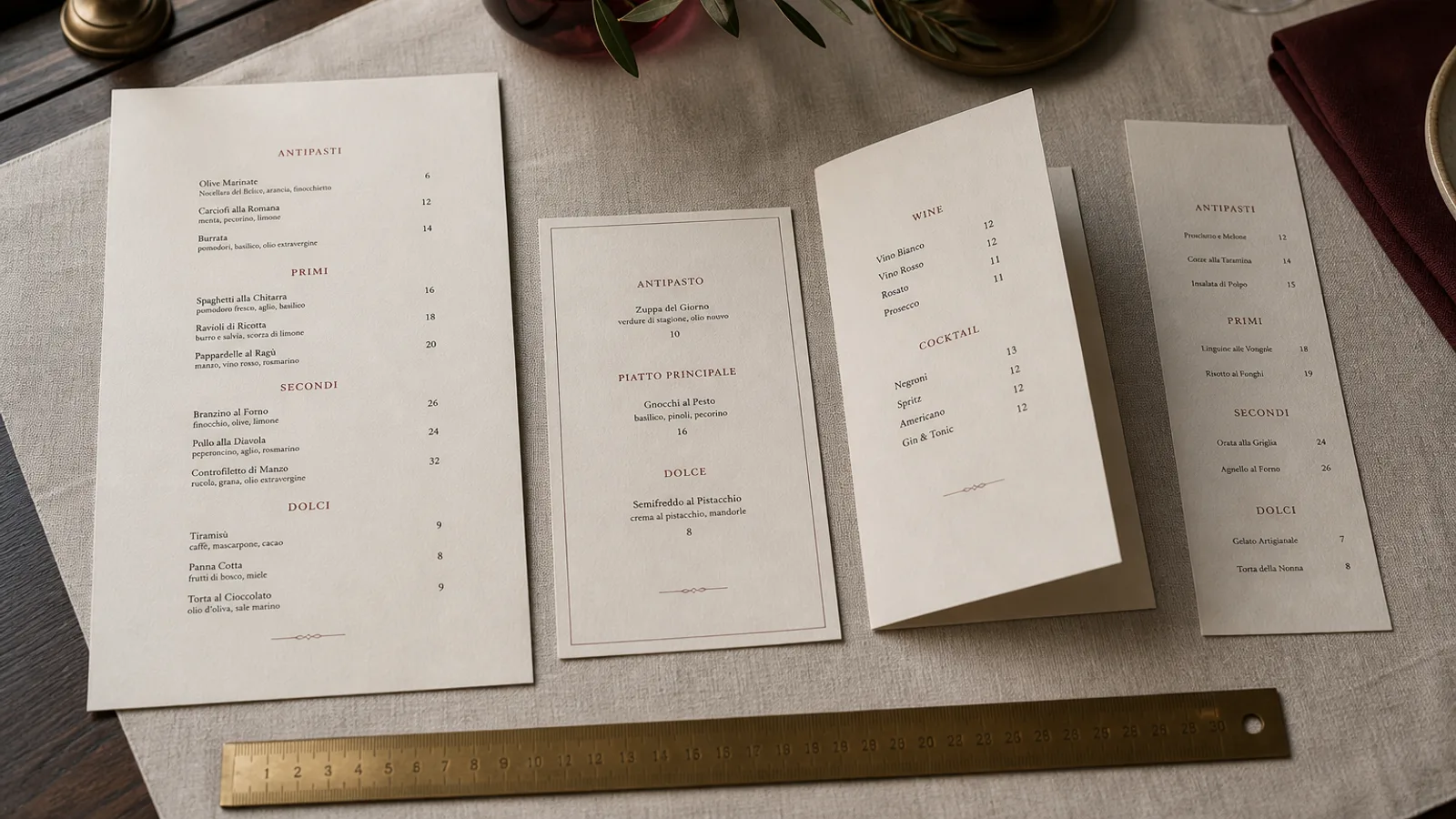
A square card looks decisive on a cocktail table and expensive in the quote. It is cut from a rectangular sheet, so you pay for the offcuts, and it rarely sits in a standard holder. That is fine when the list is short and the object is the point — a bar, a tasting, a dessert card. It is a vanity when you are forcing thirty mains onto a 210 mm square and then wondering why the type collapsed. Choose the square because the content is square-shaped, not because a mood board said so.
What actually fits a square
A useful square is 180 to 210 mm. Smaller becomes a coaster; larger becomes a tray. On 210 × 210 mm you have a comfortable single column of 12 to 18 lines at 10 or 11 pt, or two short columns if you accept a narrow gutter and no long descriptions. A drinks list, a tasting of six, a brunch of ten plates: those are square lists. A trattoria card with antipasti, primi, secondi and a wine page is a rectangle pretending to be fashionable.
Squares like a centred or lightly offset axis and hate dotted leaders that run twenty centimetres. Keep prices close to the names, or under them in a second line. A wide empty field around a short list is the luxury the format can buy. Filling that field with a watermark of the logo is how you spend the luxury on noise.
Trim, waste and the holder problem
ISO 216 is built on the A-series rectangle. There is no A-square. A 210 mm square is cut from A4 (210 × 297 mm), so you throw away 87 mm of height on every sheet, plus bleed. A 180 mm square wastes more unless you gang several on a larger press sheet. On a short run that waste is a few euros. On a reprint every month it is a habit. Ask whether the object is doing enough work to justify leaving a third of the sheet on the floor.
Holders are the silent cost. Most leather covers, aluminium stands and wooden boards are made for A5 or A4. A square slips, spins or needs a custom pocket. If you already bought covers last year, measure the pocket before you fall in love with 200 × 200. A card that will not sit in the stand you own is not a format; it is a drawer of leftovers.
- Use a square for lists under twenty lines, or for a single-course tasting card.
- Keep 12 mm margins and 3 mm bleed; squares show a tight trim more than a bifold does.
- 350 g matte holds the geometry; thin stock buckles into a diamond on the table.
- Skip a fold on a square unless you have a real second list; a square bifold is a clumsy book.
Type and photography on an even page
The eye has no long edge to follow. Headings need more space above than on an A5, or they float. A single photograph in a square bleeds toward postcard; a grid of four dishes can work if each image is cropped hard and the names sit outside the pictures, not on them. Fine Dining Editorial and Art Deco Cocktail tolerate a square. Café Chalk and a long wine list do not.
US Letter (8.5 × 11 in) rooms sometimes cut 8.5 in squares. The same rules apply, with more waste. If you serve both tourists and a local lunch, a square that cannot take a formule block without shrinking to 8 pt is the wrong souvenir.
When A5 still wins
If the list might grow, if you need a fold, if you already own A5 covers, or if you reprint from a digital file that also has to become a website page, stay on ISO 216. You can always set a square composition inside an A5 and live with the margins. You cannot cheaply turn a custom square back into a holder you already paid for.
Pay for the offcuts only when the list is short
A square is a good menu when the offer is already a square: few lines, one mood, an object people will pick up. It is a bad menu when it is a cropped A4. Count the lines, measure the holder, price the waste, and if any of those three protests, print an A5 bifold and spend the money on paper weight instead of geometry.
In Menu Atelier the working formats are A4 and A5, single sheet or bifold, which you can turn in 3D and export with 3 mm bleed; if you truly need a square, design the list as a single face and crop the exported PNG or PDF to the trim you will cut, knowing the print-and-ship path is built for the ISO sizes.