A4 or A5 menu? Choosing a size for your tables and your dish count
A practical way to choose between A4 and A5 for a restaurant menu: table size, number of dishes, type size that stays readable, folds, and what each format costs to print.
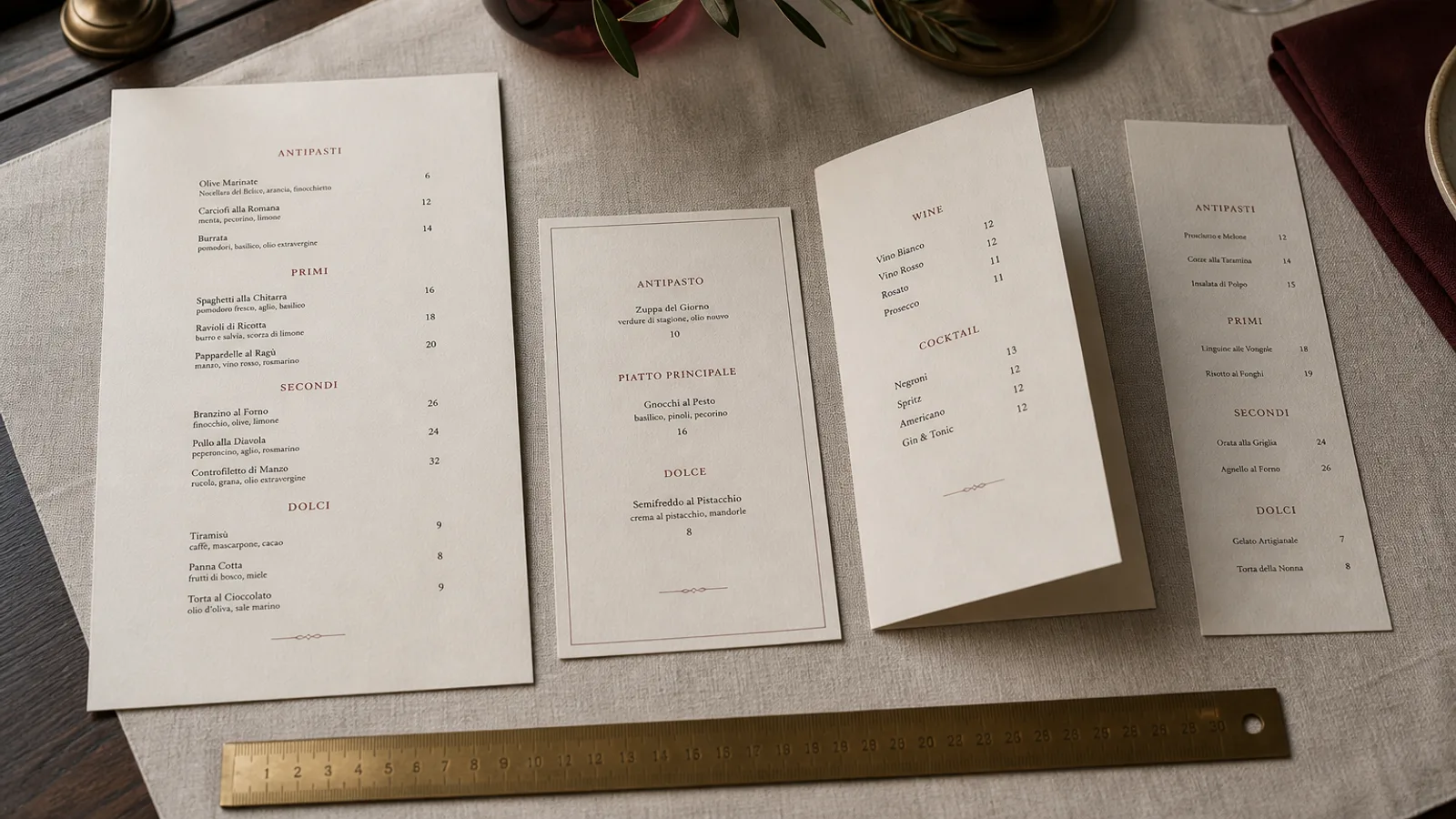
Two numbers decide this question before any aesthetic preference does: the width of your tables and the number of lines your menu has to carry. An A4 sheet is 210 × 297 mm, an A5 is 148 × 210 mm, exactly half. That halving matters more than it sounds, because an A5 menu holds roughly 40 % of the readable text of an A4 at the same type size, not 50 %, once margins are taken out. Here is how to work through the choice with your own table and your own dish list.
Start with the table, not the design
An open A4 bifold measures 420 × 297 mm. On a 60 cm square two-top with two glasses, a carafe and a bread basket, it does not fit, so guests hold it in the air or fold it back, and half your layout disappears. An A5 bifold opens to 297 × 210 mm, an A4 landscape, and sits flat with room to spare. The rule is simple: measure the free surface after glassware and bread, and the open menu should occupy no more than 60 % of it.
Tables of 70 cm and wider, four-tops, banquettes and counters with a ledge take an A4 comfortably. Terraces with small bistro rounds of 50 to 60 cm, tight bar seating and shared tables are A5 territory. If your room mixes both, design for the smallest table, because that is where a menu that does not fit gets noticed.
Count lines, not dishes
A dish is rarely one line. With a name, a two-line description and a price you are at three lines, and a section heading with space above and below adds another three. Use these capacities as a starting point for body text set at 10 to 11 pt with comfortable leading, which is the minimum for a dining room lit at dinner level.
- A5 face, single column: about 28 to 32 lines, so 8 to 10 dishes with short descriptions, or 12 to 14 with name and price only.
- A4 face, single column: about 45 to 50 lines, so 14 to 16 described dishes; two columns push it to 24 to 28 short items, but descriptions suffer.
- A5 bifold (four faces, two usable inside plus a back): 20 to 28 described dishes, which covers most bistros and trattorias.
- A4 bifold: 40 to 55 described dishes, which is too many for any kitchen that wants to sell what it cooks best.
If your list fits on an A5 bifold at 10.5 pt with descriptions, choose A5. If you have to drop to 9 pt or cut descriptions to make it fit, you have an A4 menu or too many dishes, and the second is more often true. Cornell's menu research is consistent on this point: shorter menus with clear sections sell more of the dishes you want to sell.
Readability at arm's length
Guests read a menu at 40 to 50 cm, often under 100 lux or less. At that distance and light, a serif body under 10 pt becomes work for anyone over 45, which is a large part of most dining rooms. An A5 menu tempts you to shrink type to make things fit; resist it. A5 works when the type stays at 10 pt or above and the content is trimmed to match, not when everything is scaled down by 70 % from an A4 layout.
The opposite failure exists too. An A4 menu with 12 dishes at 11 pt and 40 mm margins looks empty and cheap unless the white space is deliberate and the paper is heavy. If your list is short, A5 will look considered and A4 will look unfinished.
Folds, hands and paper
An A4 single sheet is the format that curls, gets held with two hands and blocks the view across the table. On a heavy 350 g board it stays flat but feels like a placard. A4 folded once to A5 is the classic that works almost everywhere: closed, it is the size of a paperback; open, it gives you two facing pages plus a cover for the brand and a back for allergens and hours.
A5 single sheets on 300 g board are excellent for menus that change weekly, dessert cards and drinks lists. A5 folded to A6 is small enough to feel like a wine bar's cocktail card and too small for a full menu. Whatever the fold, remember that heavier boards want a crease before folding, and that the fold line needs a 6 mm clear zone.
What each format costs
Paper cost scales with area, so an A5 menu uses half the board of an A4 and a printer pays half the sheet cost. But the fixed part of a print job (setup, cutting, folding, packing) does not shrink with the format, so on a run of 30 to 50 menus the difference between A4 and A5 is small, typically 10 to 20 % on the total. Choose the size that suits the table and the list; the savings from going smaller are not worth a menu that is hard to read.
Deciding in ten minutes
- Measure your smallest table's free surface with glasses and bread in place.
- Count your lines: dishes × 3, plus 3 per section heading, plus 6 for a footer with allergen key.
- Set body text at 10.5 pt and see which format holds those lines without going to two columns.
- If both fit, choose A5 for intimate rooms and short lists, A4 bifold for larger tables and menus with photographs or a story to tell.
This decision does not have to be final. In Menu Atelier the same design can be switched from A4 to A5, single sheet to bifold, with one click, and the layout reflows so you can compare both in 3D on a virtual table before you print a single copy. Many owners start in A4, see the A5 bifold next to it and realise their list fits with room to breathe.