Menu inserts and daily specials: updating without reprinting
How to update a restaurant menu with inserts and daily specials: sizes that fit a bifold, dating, allergens, and when a slip is cleaner than a reprint.
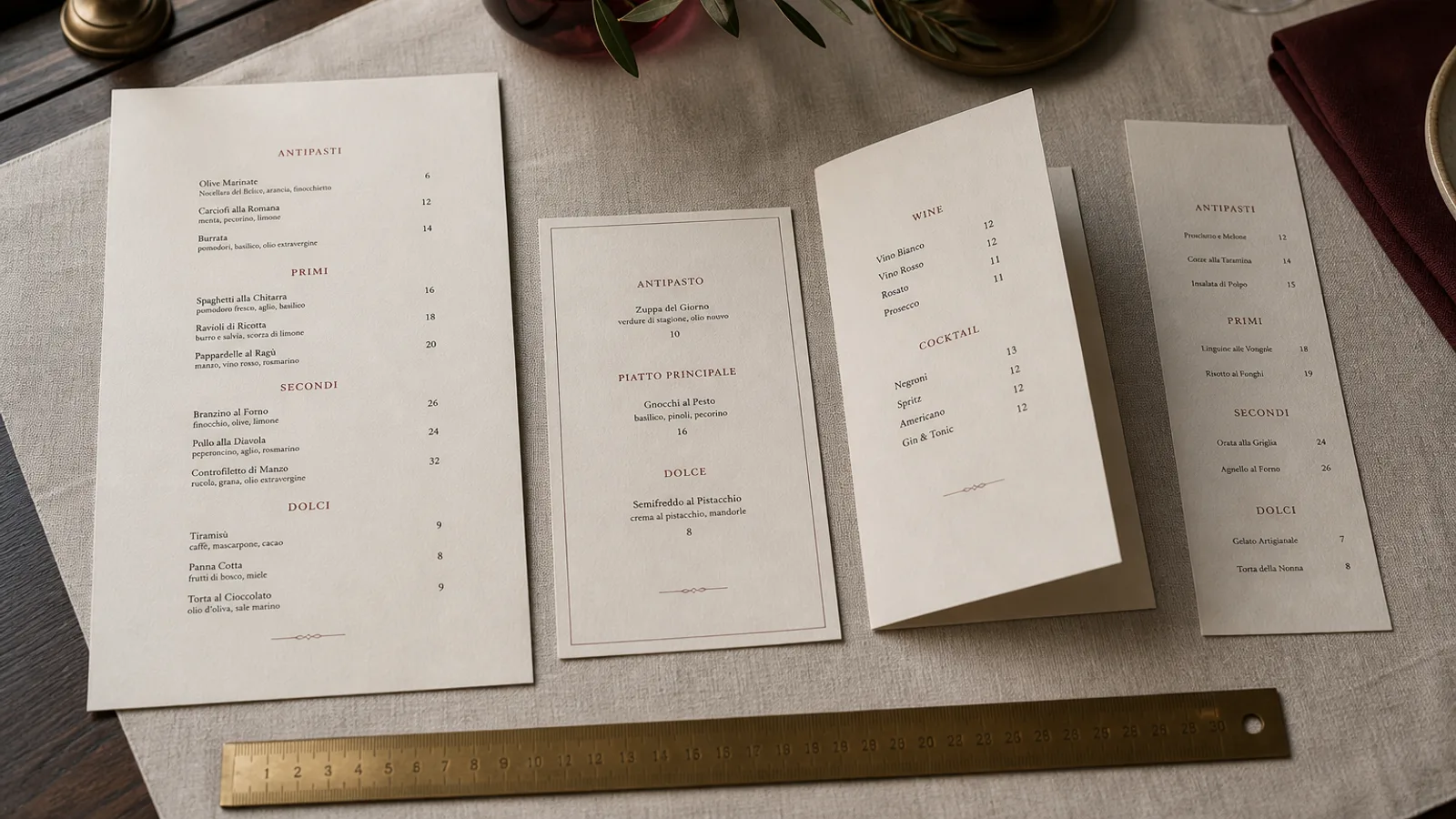
The soup changed. The fish is off. A grower you like just delivered twelve bottles. None of those events is a reason to reprint sixty bifolds on 350 g board. They are a reason to have a home for a slip of paper that looks as if it belongs. Most rooms fail the belonging: a photocopied A4 folded twice, a till receipt taped inside, a chalkboard the guest cannot read from the two-top. An insert is a designed object that is allowed to die tomorrow. Give it a size, a type, a date, and a place on the carte.
Give the slip a hole in the layout
Design the dinner carte as if an insert will sometimes sit on it. A bifold with 10 mm inner margins can take a 90 × 210 mm slip along the fold, or a 100 × 148 mm card in the centre of a panel, without covering a price. A single A4 with type to the edge cannot. If you already printed the carte tight, the insert will always look taped on. The hole is a margin, a quiet band, or a printed line that says today's board.
Clips, a corner slot, a thin ribbon, a menu cover with a pocket: pick one and stay with it. Staff will not invent a tidy habit at 12:40. A paperclip on the top edge is honest if the slip is the same width as the panel. A sticker on the face of the carte is not an insert; it is a defacement.
Do not insert a full A4 into an A5 bifold and call it a specials list. The guest is now holding two objects that fight. Match the short side of the carte, or go smaller. A6 is enough for three lines and a date.
What belongs on the slip, and what does not
Daily or weekly: soup, a fish, a cut of meat, a dessert the pastry chef is testing, a wine by the glass that is not on the list, a sold-out line you would rather replace than cross out. Seasonal but stable (the autumn game, the tomato formule) belongs on the reprinted carte, not on a slip you will still be clipping in February.
Prices and allergens belong on the slip as surely as on the carte. Regulation 1169/2011 does not care that the dish will be gone tomorrow. If the slip is the only written source for that dish, it must carry the allergen information or point to a key the guest is already holding. A pretty card that says market fish and nothing else is a legal hole.
Date the slip, even in 7 pt at the foot. Wednesday's fish must not survive into Friday. Dating also stops the drawer filling with last week's paper. Print the day, or the week number, and throw the rest.
- Size: match a panel of the carte, or go smaller (90 × 210 mm, A6, 100 × 148 mm).
- Content: the volatile lines only; prices and allergens on the slip.
- Date: day or week, small, at the foot; destroy yesterday's stack.
- Home: a designed margin, a clip, a pocket; never a sticker on the face.
Print the slip like a relative, not like a flyer
Same type family as the carte, same mark or a smaller one, same way of sitting the price. 170 g is enough; 90 g copy paper is how the room drops a register. You can laser a dated slip in the office if the file is already set with the right margins and the house type. Do not invent a new layout in Word at noon. Keep a one-page template and change three lines.
Colour: one ink, or the same two as the carte. A neon specials sheet next to a soft-touch bifold is two restaurants again. If the carte is ivory, the slip should be ivory or a close cousin, not fluorescent yellow.
Quantity: covers plus a few, dated, reprinted tomorrow. A stack of 200 undated specials is a second dead carte in the making. Digital short-run or an office laser on 170 g, 40 copies, is the honest run.
When the insert is lying to you
If more than a third of what the guest needs to order lives on the slip, you are overdue a reprint. The insert is a patch, not a second menu. I have seen rooms whose dinner bifold was a cover letter for four inserts: lunch leftover, dessert, wine glasses, today's board. That is a format that has given up. Reprint the carte, or split the objects (food, wine, dessert) and let each die on its own clock.
A chalkboard can sit beside a slip, not instead of one, if the board is the theatre and the slip is the written source. Guests at the window table cannot read a board behind the bar. Do not make them ask.
Build the habit, then the paper
Write the insert into the morning prep: kitchen confirms the three lines, someone sets the template, forty copies, date, clip. Ten minutes. The carte you paid to print in 350 g stays clean, and the guest still gets today's fish in writing.
In Menu Atelier you design the durable carte once, switch A4 to A5 or single to bifold in a click, and see where a slip would sit in the 3D view. Export that file at 300 dpi with 3 mm bleed for the object that lasts, and keep a matching one-page face for the office laser. When the season actually changes, order the short run on 350 g matt board with a soft-touch finish, 99 € plus 10 € a copy, and throw the winter inserts out with the winter soup.