Takeaway menu design: flyers, folds and the counter card
How to design a takeaway restaurant menu: flyer vs fold vs counter card, type that survives a bag, QR codes, and why the dining-room carte should not be shrunk to A6.
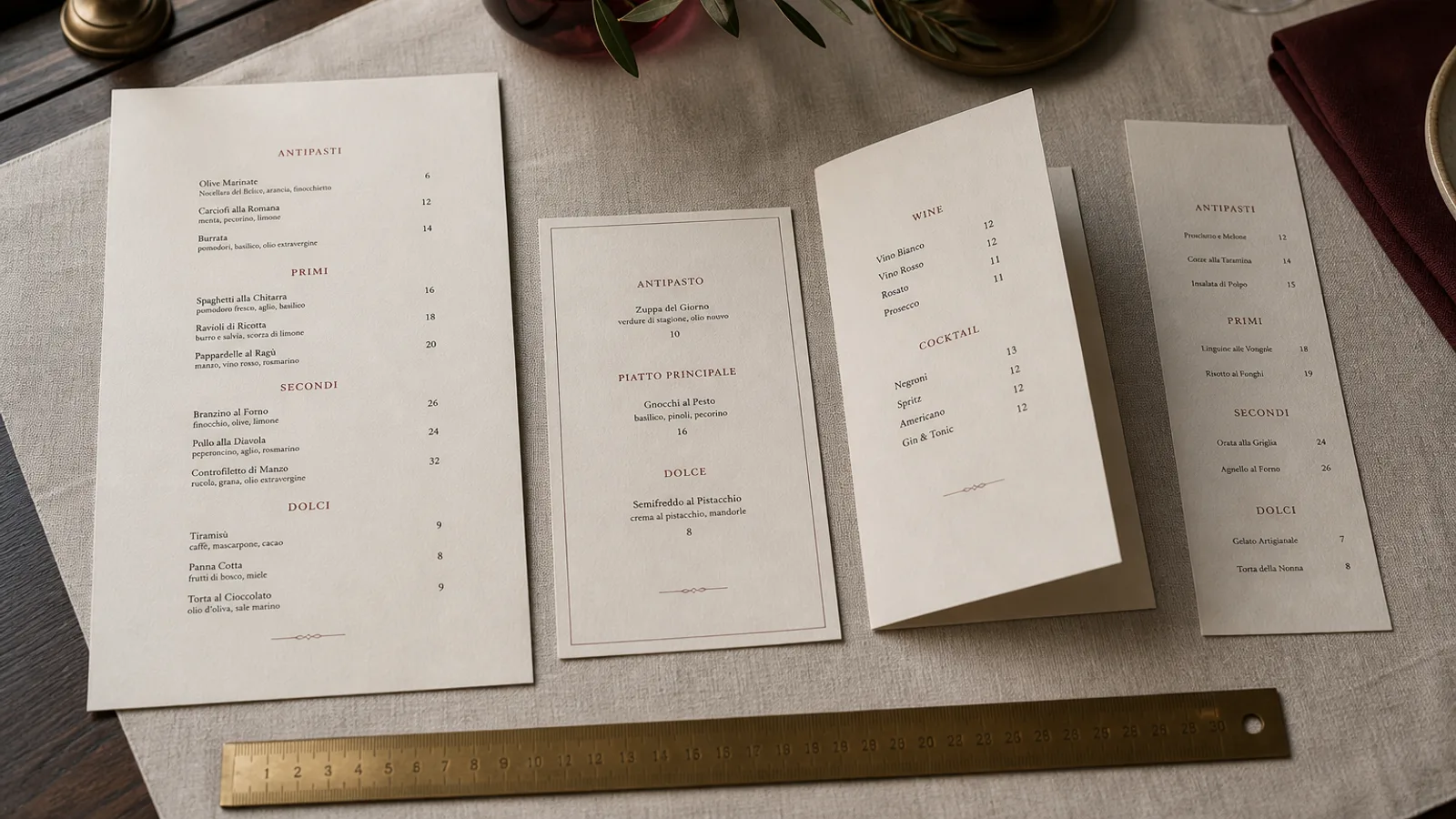
A takeaway menu lives in a bag, a pocket, a drawer under a magnet, and sometimes in the rain between the door and the car. It is not a smaller dinner carte. Shrinking the bifold to A6, keeping the 9 pt descriptions and the tasting sequence, is how you get a leaflet nobody reads and a bag of paper you paid 350 g prices for. Takeaway is a finding tool plus a reminder to come back. Three objects do that job well: a cheap flyer they can throw away, a small fold that sits in a wallet, and a counter card they never take home. Pick the one that matches how people actually leave your room.
Flyer, fold, counter: three jobs
The flyer is A5 or A6, 135 to 170 g silk, one or two faces, printed in hundreds because it dies. It lists the dishes people actually order to go (the burger, the roast chicken, the six rolls), a phone or a QR to the order page, hours, and the mark. It does not list the tasting menu. It does not need 3 mm of poetry under every line. Unit cost at 500 copies on a digital gang is often well under 0.40 €. Treat it as packaging, not as a keepsake.
The fold is a DL (99 × 210 mm) or a small A6 bifold, still on flyer stock, that holds a little more: sections, a few prices, an allergen key. It is what you hand to a hotel concierge or put in a letterbox if you still do that. Score it if the stock is over 170 g. Do not print it on 350 g soft-touch; you will hate the waste the first time the offer changes.
The counter card stays on your side of the glass. A5 or A4, 350 g, maybe with a small easel, listing today's takeaway or the delivery hours. This one can share a finish with the dining-room carte because it does not leave. Guests photograph it. That is fine; design the type large enough for a phone camera at a metre.
Type and structure that survive a bag
Body at 9 to 11 pt, section heads at 12 to 14, prices aligned, few descriptions. A takeaway guest is standing up or sitting in a car. They need the name, the price, and whether it contains nuts. Save the burnt leek elderflower line for the dinner card. If you must describe, six words.
A QR is useful if it goes to a page that takes the order, not to the homepage carousel. Print it at least 20 mm, with a quiet margin, as a vector, not as a screenshot. Test it in the doorway, not only on your desk. A QR that fails in the street is worse than a phone number in 12 pt.
Allergens still apply. Regulation 1169/2011 does not stop at the door. If the flyer is the written source for a guest who never sits down, the 14 allergens must be on it or the QR must land on a page that lists them before checkout. A pretty fold that says ask us is not enough for a sealed box leaving the building.
- Flyer A5/A6, 135–170 g: the disposable list, hundreds at a time, dishes people actually take away.
- DL or A6 fold: concierge and pocket, still cheap stock, scored if thick.
- Counter card 350 g: stays in the room, large type, photographable.
- QR to the order page, 20 mm minimum, plus a phone number that a human answers.
Do not clone the dinner carte
The dinner bifold is designed to be held at a table for twenty minutes. The takeaway object is designed to be decided in forty seconds. Different dishes will win. A côte de boeuf for two does not travel; a sauce-heavy pasta often does not either. Build the takeaway list from what the kitchen will stand behind after 20 minutes in a box, then design that list. Copying the evening grid and deleting a few lines leaves you with empty space and the wrong hierarchy.
Mark and colour can match the room so the bag still feels like you. Paper weight should not. A guest who finds a 350 g carte in the bag will think you are confused, or they will use it as a chopping board. Soft-touch in a greasy bag also scuffs in one trip.
If you run delivery through an app, the printed flyer is still a reminder of the room, not a duplicate of the app grid. Put the dishes the app buries (the soup, the family tray) on the paper. Let the app do the 80-item catalogue.
Print runs and the offer that moves
Takeaway lists move with the kitchen and with the weather. Print what you will hand out before the next rewrite: 200 to 500 flyers is a real number for a busy corner; 40 counter cards is plenty. Date the flyer in 7 pt if the offer is weekly. Throwing away 80 cheap A6s is sane. Throwing away 80 dinner bifolds is not.
Bleed and crop marks still matter on a flyer if the colour hits the edge. 3 mm, 300 dpi for any photograph of food you insist on using. I would rather see a strong mark and no photograph than a muddy 72 dpi burger. Your own printer will gang these with other jobs; that is why they are cheap. Do not ask for a scored 350 g bifold at flyer prices.
Let each object do one job
The dining-room carte stays in the dining room. The flyer leaves. The counter card stays on your side of the glass. When those three objects share a mark and a type but not a paper, the room still feels like one place, and you are not reprinting the evening list because the dumpling sold out.
Menu Atelier is built for the dining-room object, A4 or A5, single or bifold, which you can preview in 3D and export at 300 dpi with 3 mm bleed. Use that file as the type and mark source for a simpler takeaway face you print cheap and often. Order the 350 g soft-touch run, 99 € plus 10 € a copy, for the cartes that stay on the table; let the bag have a flyer that is allowed to die.