Bakery and pâtisserie menu design: the price board and the counter card
A practical guide to bakery menu design: the wall price board, small counter cards, per-piece and per-kilo pricing, allergen labelling and the paper that survives flour.
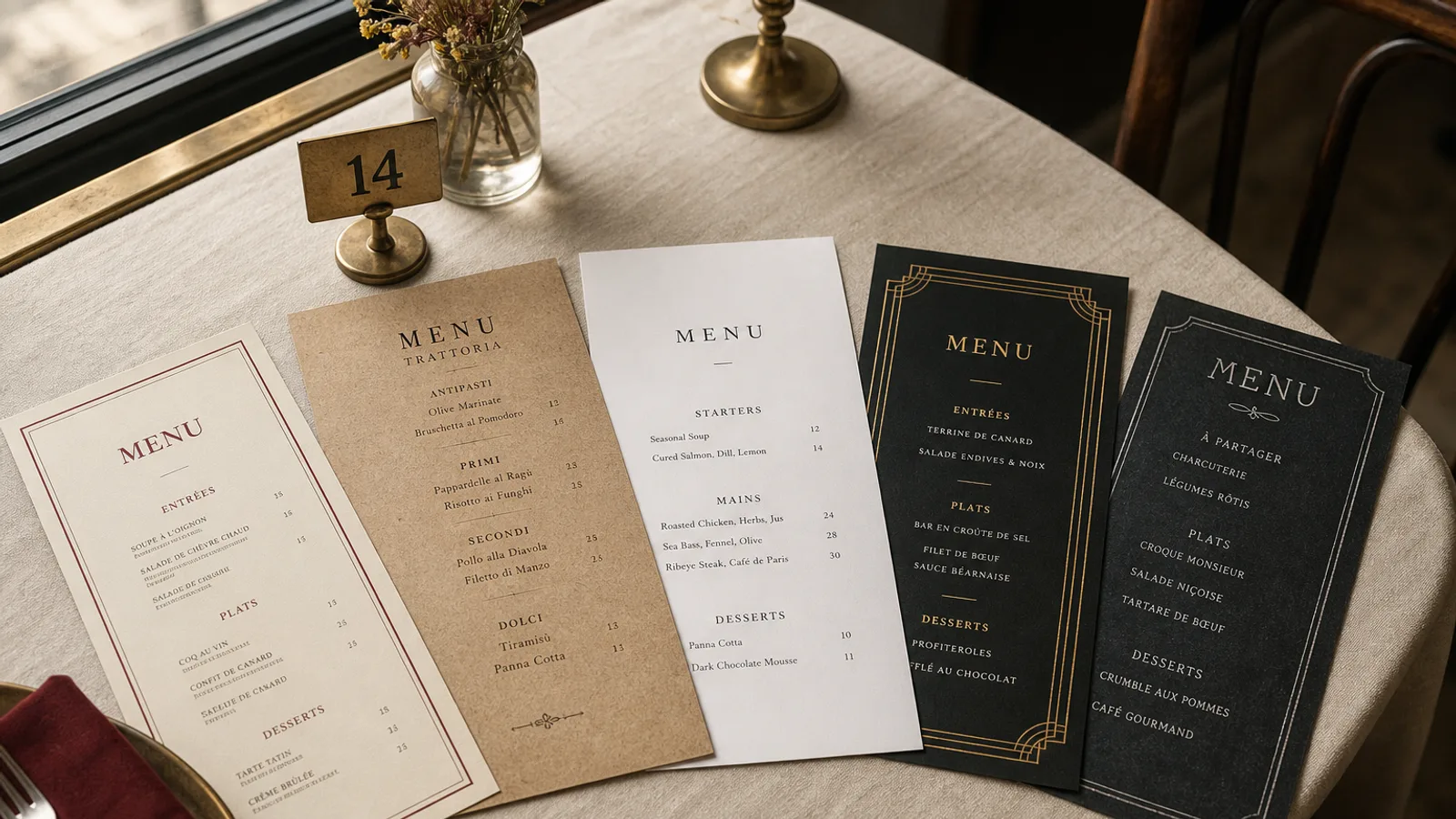
A bakery does not have a menu in the restaurant sense. It has two documents that do the same job from different distances: a price board on the wall, read from two metres while the customer waits in line, and small counter cards read from forty centimetres while the pastry is right there behind the glass. Most bakeries design one and improvise the other. This article shows how to build both on a single system, price by piece and by weight without confusing anyone, and stay on the right side of allergen rules.
Two reading distances, one visual family
The wall board is read by someone standing in a queue. The rule of thumb for legibility is roughly 1 cm of cap height for every 3 metres of distance, so a board read from 2 to 3 metres needs product names at 30 to 36 pt minimum and prices slightly larger, not smaller. Anything under 24 pt on a wall board is decoration.
The counter card is read at arm's length and can go down to 10 or 11 pt for the product name with a 12 to 14 pt price. What ties the two together is not size but family: the same typeface, the same colour for prices, the same way of writing a weight. If the board says "Pain de campagne 500 g 4.20 €" the card in front of the loaf must say exactly that, in the same order.
Ordering the board like the counter is laid out
Customers scan the board while their eyes wander to the display. If the board lists viennoiserie first but the display puts bread on the left, the two documents fight. Arrange the board sections to mirror the physical flow of the counter from left to right, or from the entrance to the till. In most bakeries that gives:
- Breads, sorted by size then by flour, with weight on every line.
- Viennoiserie: croissants, pains au chocolat, brioches, always priced per piece.
- Pâtisserie: individual pastries first, then entremets by size (4, 6, 8 persons).
- Savoury: quiches, sandwiches, the lunch formula.
- Drinks, in a tight block near the till.
Keep the board to 40 lines at most. A bakery with 120 products does not need all of them on the wall; the wall carries the core range and the counter cards carry the rest.
Per piece, per kilo, per person: pricing that reads instantly
Bakeries mix three pricing units, and mixing them on one line is what produces the customer who asks "is that for one or for the whole tart". Adopt a fixed notation and never break it. Piece prices carry no unit: "Croissant 1.40 €". Weight prices carry the weight of the standard piece and, if you sell by cut, the kilo price in smaller type underneath: "Tourte de seigle 900 g 7.60 €, 8.45 €/kg". Entremets carry the number of persons: "Fraisier 6 pers. 32 €".
Align prices in a column only on the board, where the customer compares across products. On counter cards, put the price right under the name, centred, large. A counter card is a single product; there is nothing to compare, so the column logic does not apply.
Old-style numerals and the decimal comma
Prices on a bakery board are the most-read text in the shop, so the numerals matter. Lining numerals (all the same height) read fastest at distance; old-style numerals look lovely on a counter card but blur on a wall. Write decimals the way the country writes them (comma in France, Italy and Spain; point in Ireland and the UK) and drop the trailing zeros only if every price on the board can drop them.
Allergens on a counter card
Regulation 1169/2011 applies to non-prepacked food sold over the counter, and bakery products hit several of the 14 allergens at once: gluten, eggs, milk, nuts, soy, sesame. The most reliable system is a numbered or pictogram key. On each counter card, a small line of numbers under the price, 7 pt in a light grey; on the wall, one legend explaining the 14 numbers. Staff must be able to point to the legend, and the legend must be readable without asking.
Avoid the temptation to write "may contain traces of everything". It is legally weak and commercially damaging: a customer with a nut allergy who cannot buy a plain baguette from you will buy all their bread elsewhere.
Materials: flour, butter and forty cards a day
Counter cards live in a hostile environment. Butter fingerprints, flour dust, condensation from the display and daily handling destroy a 250 g card in a week. Print counter cards on 350 g board with a matte finish, cut to a fixed size (a business card at 85 × 55 mm or a slightly larger 100 × 70 mm both work), and keep a blank stock so a new product on Saturday morning gets a card that matches. Never hand-write on a printed card; print a blank version of the layout and write on that instead.
- Wall board: printed on rigid board or foam, or a digital screen if prices change weekly. Chalk boards look charming and are illegible from three metres unless letters are very large.
- Counter cards: 350 g matte board, one card per product, price and allergen numbers on every card.
- Seasonal cards: a different accent colour for the same layout, so the Galette des rois or the panettone card stands out without breaking the family.
A system you can extend to the lunch trade
Once the board and the cards share a family, the sandwich and lunch formula fit in naturally: an A5 card on the counter or a small standing menu near the till, same typeface, same price notation, same allergen key. This is where many bakeries recover their margin, and a formula written as "Sandwich + drink + pastry 9.90 €" outsells three separate lines by a wide margin because the customer does not have to add anything up.
In Menu Atelier, the Café Chalk style was built with exactly this kind of counter in mind; you can lay out the lunch card in A5, check it in 3D, and export print-ready PDFs at 300 dpi with the 3 mm bleed and crop marks already applied, so the same typography carries from the counter card to the lunch menu.