Booklet menus: when a multi-page menu makes sense
When a restaurant menu should be a booklet instead of a sheet or bifold: page count, binding, wine lists, and the rooms where extra pages slow the order down.
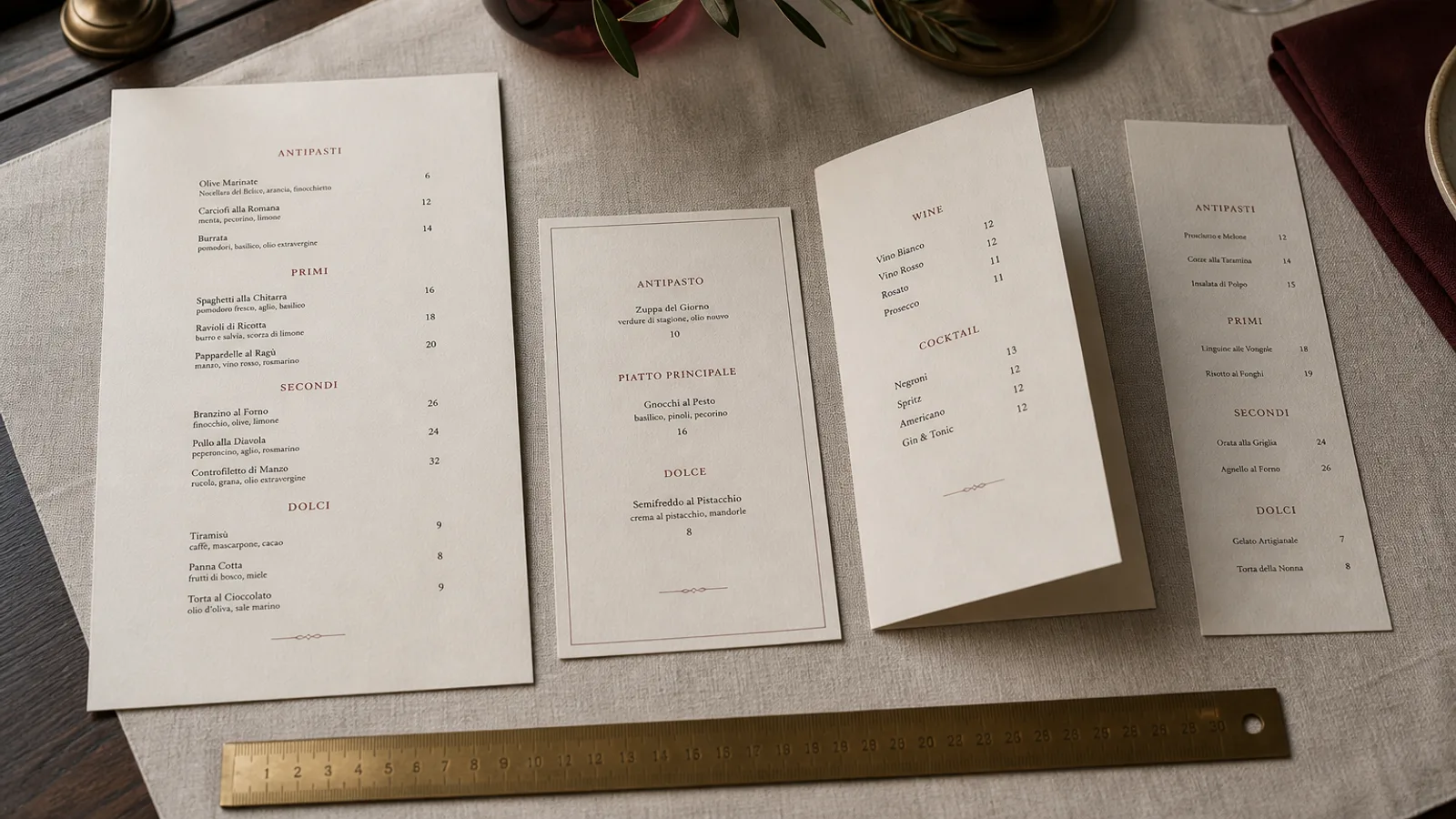
A booklet is a promise that there is more to read than a single opening. Sometimes that promise is earned: a wine list with two hundred bins, a hotel breakfast-to-dinner book, a tasting narrative that needs a title page. Sometimes it is vanity. I have sat in 32-cover rooms holding an eight-page saddle-stitched carte whose middle four pages were a history of the building and a photograph of a cow. Guests flipped, stalled, and ordered the same three dishes they would have ordered from an A5 bifold. Use a booklet when the content has a sequence or a volume that a sheet cannot hold. Do not use one to look serious.
What a booklet is, mechanically
A booklet is a multiple of four pages, printed on sheets that are folded and bound through the spine. The cheapest honest bind is saddle stitch: two staples on the fold, 8 to 24 pages, 130 to 170 g inners, a slightly heavier cover if you like. Above 24 pages, or on 250 g throughout, the spine starts to fight the staples and you want a square-back or a short-run perfect bind. Wire-o (the metal loop) lies flat on the table, which wine service likes, and looks like a notebook, which fine dining often does not.
Page size is usually A5 or a custom 150 × 210 mm, sometimes a square. A4 booklets exist in hotels and banquet rooms; they feel institutional on a two-top. Imposition matters: page 8 and page 1 live on the same sheet. A last-minute swap of one dish can force a reprint of a whole signature. That is the first reason not to put a weekly special in a booklet.
Bleed is still 3 mm on the untrimmed sheets. The inner margin must be larger than on a single card: 12 to 15 mm at the spine, or type disappears into the stitch. Designers who treat a booklet as four A5 cards taped together always lose a word in the gutter.
When the extra pages earn their keep
Wine. A list over 60 bins wants sections, a contents line, and room for vintage and producer without 8 pt type. A 12 or 16-page A5 booklet, 170 g inners, 300 g cover, is the object sommeliers already know how to hold. Pair it with a one-page food carte so the table is not two books.
A hotel or a resort that serves breakfast, lunch, dinner and room service from one object can justify a book, provided each section starts on a right-hand page and the guest can find dinner without reading porridge. Number the sections. Put a thin contents on the inside cover. Do not write an essay about the founder on page 3 unless the founder is why people booked.
A tasting menu that is also a keepsake, a wedding supper, a once-a-year hunt dinner: here the booklet is a souvenir, printed in a short run on 170 g, sometimes with a name and a date. That is a different job from the nightly carte, and it should look like one.
- Wine list over 60 bins: booklet, A5, saddle stitch, contents on the inside cover.
- Hotel all-day book: booklet only if sections start on right-hand pages and dinner is findable in five seconds.
- Keepsake tasting or wedding: short-run booklet, lighter stock, dated; not the Tuesday carte.
- Neighbourhood bistro under 40 dishes: sheet or bifold. A booklet will slow the order.
When a booklet slows the room
Time-to-order is a real number. Cornell's menu work, and every waiter who has stood through a silent four minutes, agrees: more pages mean more hunting. A 40-cover bistro that turns 1.6 times does not want a guest lost on page 5 of a history. If the food list is under 40 lines, an A5 bifold or a single A4 is faster and cheaper to reprint when the turbot comes off.
Booklets also age in pieces. Page 3 is still true; page 7 is last month's cheese. You cannot reprint page 7 alone on a saddle stitch. Inserts help (a dated slip for the board, a by-the-glass card) but if you find yourself slipping something into every copy every week, you chose the wrong object. Print a stable book for wine and a cheap food sheet for the kitchen's mood.
Cost follows the bind. A digital 16-page A5 on 170 g with a 300 g cover, run of 40, is often 6 to 12 € a copy once stitching is in. The same content forced onto a 350 g bifold is 3 to 8 € and can be reprinted in a week. Spend the booklet money where the list is actually long.
Designing the sequence, not just the pages
Open on a quiet right-hand page: the mark, one line, maybe the evening's menu title. Page 2 can be a short about or the allergen key, not a wall of type. Food, if it lives in the book, should occupy a single opening where possible so the guest does not flip to compare starters and mains. Wine can run longer; people expect to hunt a bottle.
Keep type at 9.5 to 11 pt on food, 8.5 to 10 pt on wine if the leading is honest. Old-style figures help long columns of prices sit still. Number the pages in the footer, small, and repeat the section name in the header so a sommelier can say page 11 without describing the paper.
Photograph one opening, not every plate. A booklet that is half pictures is a catalogue, and catalogues are shopped, not ordered from. One well-printed landscape at the centre fold is plenty.
Choose the object for the list you have
Count the lines that must be on paper tonight, not the lines you might write next year. Under 40 food lines: sheet or bifold. Wine over 60 bins: booklet. Everything else is a hybrid: a durable wine book and a food card that can die on Friday. That hybrid is how good rooms stay reprintable.
Menu Atelier is built for the card and the bifold, A4 or A5, which you switch in one click and preview in 3D; that is the right object for most dining-room food cartes. If you later need a wine booklet, export the food design as a 300 dpi PDF with 3 mm bleed and take the type styles into the book so the two objects still look related. Do not stretch a bifold into eight pages to fill a stapler. Fill a stapler only when the list is already too long for two faces.