Eco-friendly menu printing: recycled stock, inks and smart quantities
How to print restaurant menus with a lighter footprint: recycled and FSC papers, ink choices, laminate-free finishes and, above all, ordering the right quantity.
Most of the environmental cost of a printed menu is not the paper or the ink. It is the box of 200 menus that went straight to the bin when the chef changed three dishes in October. If you want a greener menu, the order of priorities is quantity first, finish second, paper third and ink a distant fourth. This guide walks through each of those in the order that actually matters, with the numbers you need to make decisions.
Print fewer menus, more often
A restaurant with 40 covers rarely needs more than 25 to 30 menus on the floor at once, plus a small reserve for coffee stains and torn corners. Yet the standard reflex is to order 100 or 200 because the unit price drops. Offset printing rewards volume; the second hundred costs a fraction of the first. But if your menu changes every two months, 150 of those copies never touch a table.
Digital printing has quietly removed the reason for that reflex. A run of 30 A4 bifolds on 350 g board costs roughly the same per copy whether you order 30 or 60, and reprinting when the menu changes is a matter of days, not weeks. Count your tables, multiply by 1.2, add ten spares, and stop there. That single habit removes more waste than any paper choice.
Skip the laminate, choose a finish you can recycle
Plastic lamination is the one menu decision that turns paper into non-recyclable waste. A laminated A4 sheet cannot go in the paper stream in most EU municipalities, and the film also makes the menu look cheaper than the design deserves. Owners choose it for wipeability, which is a real concern, but there are better answers.
A heavy board, 300 to 350 g, resists handling far better than 170 g paper ever will, laminated or not. Aqueous or water-based coatings add a wipeable surface and stay in the recycling stream. A soft-touch varnish gives a velvety hand and hides fingerprints without a plastic film. If you truly need a menu that survives sauce, consider a synthetic paper that is at least mono-material and recyclable, rather than paper sandwiched in PET.
Paper: what the labels actually mean
Paper certifications are confusing on purpose, so here is the short version. FSC and PEFC certify the forestry behind virgin fibre; they say nothing about recycled content. The Blue Angel and EU Ecolabel cover the whole production process, including chemicals and energy. A paper can carry an FSC label and be 0 % recycled, or be 100 % recycled and carry no label at all because the mill never paid for certification.
- FSC Recycled: the fibre is 100 % post-consumer recycled. The strongest claim for a menu.
- FSC Mix: a blend of certified virgin fibre, recycled fibre and controlled wood. The most common label in commercial printing.
- PCW percentage: the share of post-consumer waste, printed on the datasheet. 30 % is common, 100 % exists in uncoated stocks.
- Chlorine-free (TCF or PCF): relevant for bright white stocks, since bleaching is where the nasty chemistry sits.
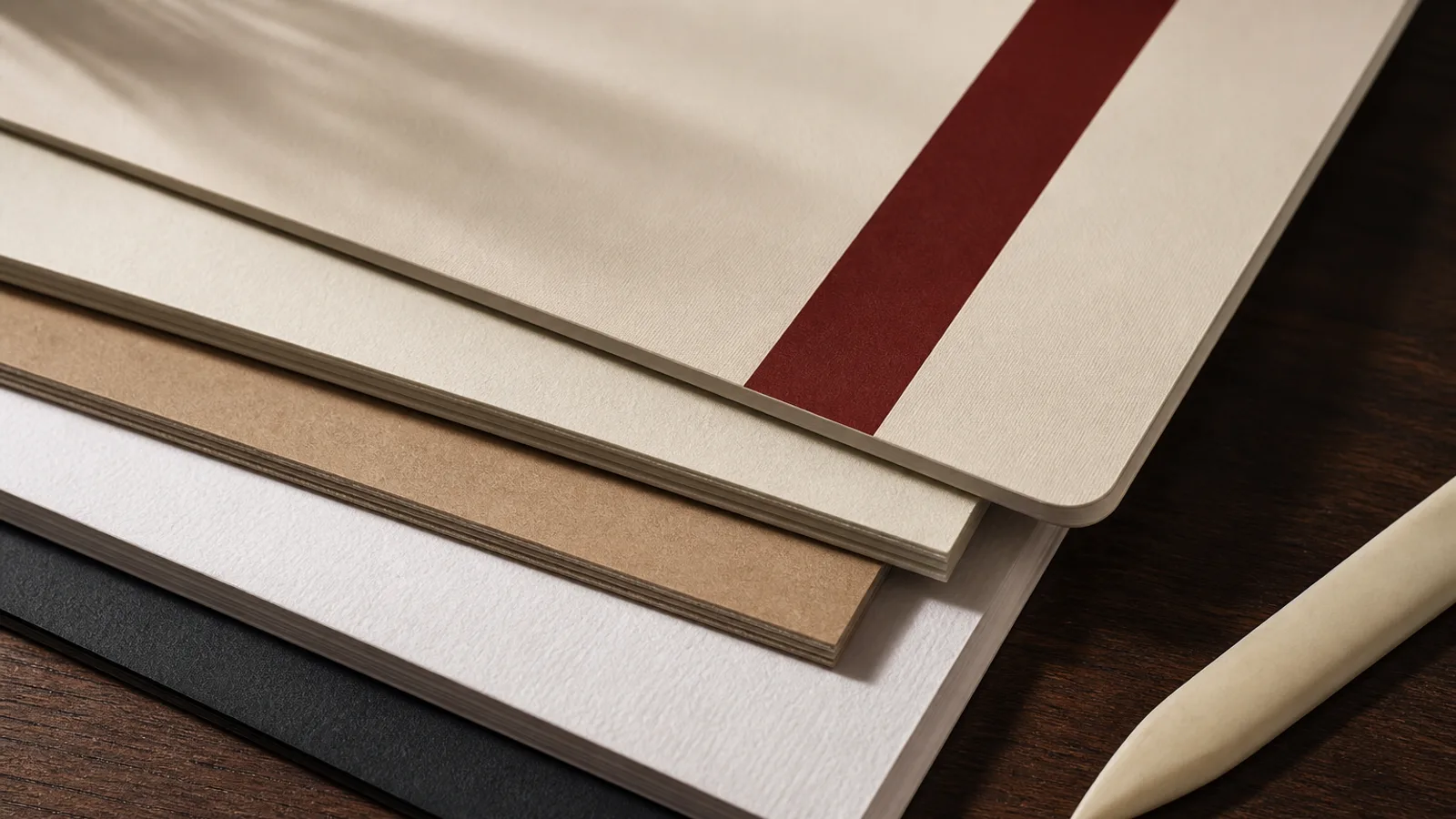
For menus specifically, recycled uncoated boards are the natural choice. They come in warm off-whites that flatter food photography less but suit typography beautifully, and their slight tooth reads as intentional rather than cheap. Expect a recycled 300 g uncoated board to cost 10 to 25 % more than a standard coated equivalent, which on a run of 30 menus is a few euros.
Ink: soy, vegetable and the honest truth
Vegetable-based inks replace the mineral oil carrier in conventional offset inks with soy or linseed oil. They de-ink more easily in recycling and emit fewer volatile compounds. Most European offset printers already use them by default, so asking is worth a sentence, not a campaign. Digital presses use toner or liquid ink where the vegetable question does not apply at all.
What you can control on the design side is ink coverage. A menu with a full-bleed dark background uses several times the ink of one set on white, and it also shows every scratch. Restricting heavy solids to the cover of a bifold and keeping the inside spread mostly white is both a design improvement and a material saving. Rich black builds (C60 M40 Y40 K100) should be limited to large areas that need them; body text stays 100 % K.
Design so the menu lives longer
The greenest menu is the one you do not have to reprint. A few layout decisions extend the life of a print run without freezing your kitchen.
- Keep prices off the fixed pages when you can, or group price-sensitive items on one face that is cheap to reprint alone.
- Use a stable bifold cover and back for brand, story, allergen key and opening hours, and treat the inside spread as the changeable part.
- Add a slot or a clip for a single-sheet insert of specials rather than reprinting the whole card for a seasonal dish.
- Choose a board and finish that survive 8 to 12 weeks of service, so the menu retires when the food changes, not before.
Getting the count right before you press print
Sustainability in menu printing is mostly arithmetic. Order the number of menus your dining room actually uses, print on a 300 to 350 g board with a recyclable coating instead of a plastic laminate, pick a recycled or FSC stock when the look suits your brand, and keep heavy ink coverage where it earns its place. Everything else is marginal.
In Menu Atelier, printed menus come on 350 g matte board with a soft-touch finish, no laminate, and you set the quantity yourself at 10 € per menu, so a run of 30 for a 40-cover room is a normal order rather than a compromise. When the menu changes, you edit the design, re-export, and print only what you need again.