Foil, embossing and spot colours: premium menu finishes and when they pay off
What hot foil, blind embossing, spot UV and Pantone spot colours cost on a restaurant menu, how they are set up in the file, and which venues actually get a return on them.
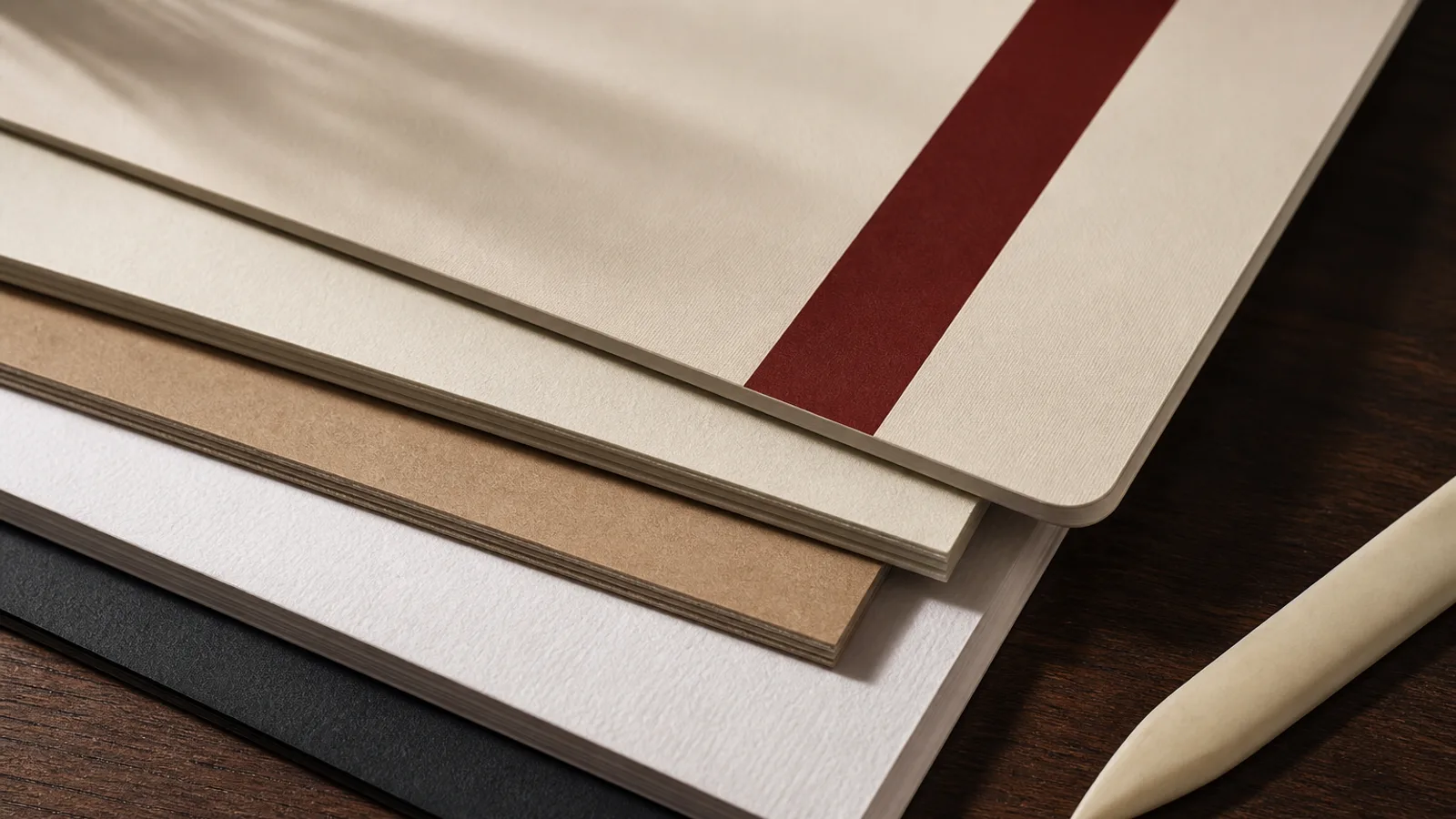
A gold foil logo on a dark board is the single most requested upgrade when a restaurant decides its menu should feel expensive. It is also the most misused, because it usually goes on a menu that will be reprinted in six weeks, and the die that made it will never be used again. Premium finishes are a tooling business: the setup cost is fixed and the unit cost is low, so they reward stable designs and long lives. This article lays out what each finish is, roughly what it costs in Europe, how to prepare the file, and where it makes sense on a menu.
Hot foil: the metallic that print cannot fake
Hot foil stamping presses a thin metallised film onto the board with a heated die, usually brass or magnesium. The result is a real reflective surface, which is why no CMYK gold, however well built, looks like foil. Foils come in gold, silver, copper, holographic and pigment colours, in gloss or matte, and a matte black foil on a black uncoated board is one of the quietest luxury effects available.
Costs are driven by the die and the make-ready. A magnesium die for an A5 logo runs roughly 40 to 90 €, a brass die two to three times that but it lasts for years. Add 60 to 150 € of make-ready per job, then a few cents per menu. On 30 menus the foil can double the print bill; on 300 it is a rounding error. Set the foil as a separate spot colour in your file, named clearly, 100 % solid, with no transparency, and keep line weights above 0.5 pt, because foil does not hold hairlines.
Embossing and debossing: texture without ink
Blind embossing raises the board from behind with a male and female die; debossing presses it down from the front. Neither uses ink, so the effect depends entirely on lighting and paper. It works beautifully on thick uncoated boards of 350 g and above, where the relief holds its shape, and poorly on thin or coated stock, where it flattens after a week in a warm dining room.
Registered embossing, where the relief lines up exactly with printed or foiled artwork, costs more than blind embossing because the die must match the print to a fraction of a millimetre. A combination die that foils and embosses in one pass is the cleanest way to do a raised gold logo, and it is priced accordingly: expect 150 to 300 € of tooling for a single A5 logo. Keep the embossed element on the cover only, away from the fold and at least 10 mm from the trim edge.
Spot UV: gloss where you want it
Spot UV is a clear high-gloss varnish printed in register on a matte surface, so a logo or pattern shines against a dull background. It is the cheapest of the premium finishes because it is printed, not tooled; on digital presses it may need no setup beyond a plate or screen. Prices sit around 30 to 80 € of setup plus a small per-sheet cost.
It has two weaknesses on a menu. Spot UV cracks at folds and scratches under fingernails, so it belongs on the cover of a menu that is handled gently, not on the inside faces of a bistro card. And it disappears under warm, low restaurant lighting, where there is nothing for the gloss to reflect. Preview it under a lamp at dinner brightness before committing. Set it up as a separate layer, black on white, named Spot UV, aligned to the artwork below.
Pantone spot colours: consistency over sparkle
A spot colour is a pre-mixed ink printed on its own plate, rather than built from CMYK. On offset it guarantees that your brand green is the same green on every reprint and matches your signage. It also unlocks colours CMYK cannot reach: bright oranges, deep blues, most pastels and all metallics. A single spot colour plate adds roughly 40 to 100 € to an offset job, which is nothing on 500 menus and a lot on 30.
- Digital presses do not run true spot inks; they simulate Pantone references in CMYK or an extended gamut. Ask for a printed proof if the match matters.
- Name the swatch exactly as the Pantone reference, for example PANTONE 3435 C, and set it as a spot, not process, in your layout software.
- For CMYK jobs, convert with the Fogra39 or ISO Coated v2 profile and check the result on a proof, because on-screen previews flatter every colour.
Where the finishes actually earn their keep
The economics point to a clear rule: put tooling on the part of the menu that does not change. A bifold cover with a foiled logo can live for years while the inside spread is reprinted every season on plain board. A single-sheet menu that changes weekly should never carry foil, because you pay the make-ready every time. Cocktail bars, hotel restaurants and fine dining rooms with a stable identity are the natural home for foil and embossing; a neighbourhood bistro with a chalkboard soul gains more from a beautiful uncoated board and good typography.
- Reprint interval under two months: no tooled finishes. Spend on board weight and a soft-touch varnish instead.
- Stable cover plus changing insert: foil or emboss the cover once, print inserts on demand.
- Menu printed at 200 copies or more, twice a year: any finish pays for itself, including a spot Pantone on offset.
Making a menu feel premium without a die
Most of what guests read as luxury comes from restraint rather than metal: a heavy matte board, generous margins, a single well-chosen typeface, ink that stops well short of the edges. A 350 g board with a soft-touch finish already has the velvety hand people associate with expensive stationery, and it costs the same on 30 menus as on 300. Add foil only when the design has settled and the reprint rhythm justifies the tooling.
Menu Atelier prints on exactly that kind of board, 350 g matte with a soft-touch finish, so the tactile side of premium is covered by default. The print bundle you download includes a layered, editable source file, which means that if you later decide to have the cover foiled, the logo is already isolated as its own element and can be exported as a solid black separation in a minute.