Menu holders and covers: protecting print without hiding it
A guide to menu covers, sleeves, clipboards and stands: which protect paper without adding glare, what they cost, how they change the format you print, and when to use none.
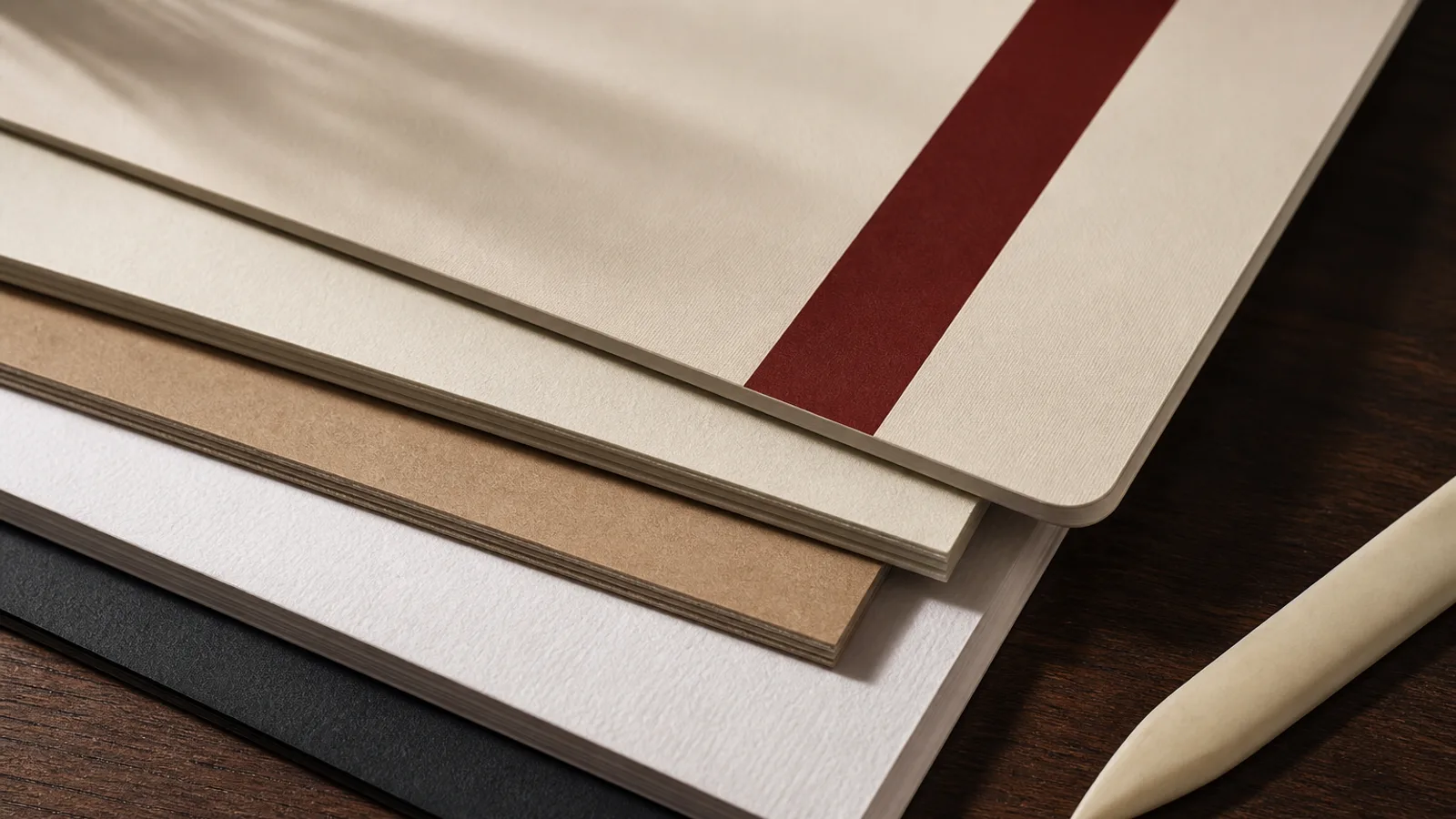
A restaurant spends real money on a printed menu, then slides it into a shiny plastic sleeve that reflects every lamp in the room and makes 350 g board feel like a photocopy. Or it buys padded leatherette covers with gold corners that say “hotel breakfast buffet” to guests who came for a modern bistro. The holder is part of the menu's design whether you choose it or not, and it changes three things: how the print looks, how long it lasts, and what size you can print. This is a tour of the options, with costs, and a clear view on when the best holder is no holder at all.
What a holder is actually for
Be honest about the job. A holder does one or more of four things: protects the paper from spills and fingers, extends its life from weeks to months, keeps several sheets together in order, and signals a level of formality. Each of those has a cost, and the cost is almost always paid in legibility and touch. A sleeve protects but adds glare; a heavy cover signals formality but hides the paper you chose; a clipboard keeps sheets together but looks casual.
The right question is not “which holder” but “how often do we reprint”. A menu reprinted every six weeks on 350 g board with a soft-touch finish needs no protection at all; it is replaced before it wears. A menu that must survive a year needs help. Reprint cadence decides the holder.
The main options, with numbers
- None. Bare board, 300 to 400 g, matte or soft-touch, single sheet or bifold. Best legibility, best feel, zero glare, cost of the print only. Lasts four to eight weeks in a busy room, longer in fine dining. The choice of most good restaurants today.
- Clear sleeve or pocket, PVC or polypropylene. 1 to 3 € each. Protects completely, wipes clean, but glossy PVC reflects everything and yellows within a year. Anti-glare matte polypropylene sleeves exist and are worth the extra 0.50 €; ask for them by name. Sleeves force you to print exactly A4 or A5 and make bifolds awkward.
- Clipboard or menu board with a clip. 4 to 15 € in wood, acrylic or metal. Holds one or two loose sheets, casual and honest, very good on terraces because of the weight. Print single-sided A4 or A5 and change the sheet as often as you like.
- Slip-in cover with corner mounts or clear pockets, in card, linen, leatherette or leather. 8 to 40 €. The classic restaurant menu cover. Protects edges, looks formal, allows two to eight pages. Corner mounts leave the paper bare and touchable; clear pockets add glare. Requires a fixed page size for the life of the cover.
- Wooden or acrylic table stand. 5 to 20 €. Holds an A5 or DL card upright; good for drinks lists and specials, wrong for a full menu that guests want to hold and share.
- Bound booklet with a printed cover. Saddle-stitched or wire-bound, 2 to 6 € per copy. The menu and its cover are the same object, printed together on 350 g board; the most coherent look for long menus, reprinted as one piece.
How the holder changes the print
Once you choose a holder, it dictates the print specification, so decide the holder before the design is finished. A sleeve takes exactly one trimmed sheet: a 210 × 297 mm A4 in a sleeve made for A4 fits with 1 or 2 mm of play, so any design that relies on a bleed to the edge will show a white line of sleeve. Corner-mount covers hide 8 to 15 mm at each corner, which must be free of text. Clear pockets in covers hold sheets 2 to 3 mm smaller than the pocket, so print at A4 for an A4 pocket and expect the paper to shift slightly.
Paper weight changes too. Inside a sleeve or pocket, 170 to 200 g is enough because the plastic provides the stiffness. Bare, you need 300 g minimum to keep the sheet flat in the hand. In a corner-mount cover, 250 to 300 g is right: stiff enough not to sag, thin enough to slide under the corners. Bifolds inside covers are pointless; the cover is the fold.
Glare, hygiene and touch
Glossy sleeves are the most common way to ruin a good menu. Under a spotlight, the reflection sits exactly where the guest is reading, and they tilt the menu to escape it. If you must use plastic, use matte anti-reflective polypropylene, and replace it as soon as it scratches. Laminating the menu itself is the same problem in a permanent form and is only right for a pool bar or a canteen.
Hygiene is the argument usually made for covers, and it is weaker than it sounds. A leatherette cover handled by a hundred people a day cannot be washed; a bare 350 g card gets replaced. Corner-mount covers can be wiped; clear pockets collect crumbs at the bottom. If cleanliness is the concern, frequent reprinting of bare board is cleaner than any cover.
Touch is what covers take away. A menu on uncoated board with a soft-touch finish is a small pleasure in the hand, and it communicates care before a word is read. Behind plastic, that pleasure is gone. Reserve covers for menus where the cover itself is beautiful: real leather, linen, a printed board cover with the restaurant's name blind-embossed.
Matching the holder to the room
The holder speaks the same language as the design. A Bistro Classic card wants bare board or a plain wooden clipboard. Trattoria Rustica sits well on a kraft board or in a simple card folder. Modern Minimal and Fine Dining Editorial are best bare, on heavy stock, single sheet or bifold. Art Deco Cocktail can justify a slim dark cover with a metallic corner. Café Chalk lives on a clipboard. Sushi Zen and Mediterranean both prefer bare paper, perhaps a folded A5 tied with a single cord for the tasting menu.
- Decide the reprint cadence first: monthly or faster means no holder.
- If a holder is needed, pick the least glossy option that does the job, and prefer corner mounts to pockets.
- Set the print specification to the holder: trim size, safe margins, paper weight.
- Order 20 percent more holders than tables; they break, walk off and get stained.
- Check the assembled menu under your actual lighting before ordering the full run.
The holder you do not need
For most restaurants in 2026, the answer is simpler than the catalogue suggests: print on 350 g matte board with a soft-touch finish, single sheet or bifold with a scored fold, replace it every four to eight weeks, and put nothing around it. The paper is the cover. In Menu Atelier that is the default print: every menu ordered through us ships on 350 g matte board with a soft-touch finish and a scored fold on bifolds, and because a reprint is a click on the same design, the cadence that makes covers unnecessary costs 10 € per copy rather than a redesign.