Hotel restaurant menus: breakfast, room service and the bar on one system
How to design hotel restaurant menus as one family: breakfast card, room service folder, bar list and dinner menu sharing a grid, a typeface and a price logic guests trust.
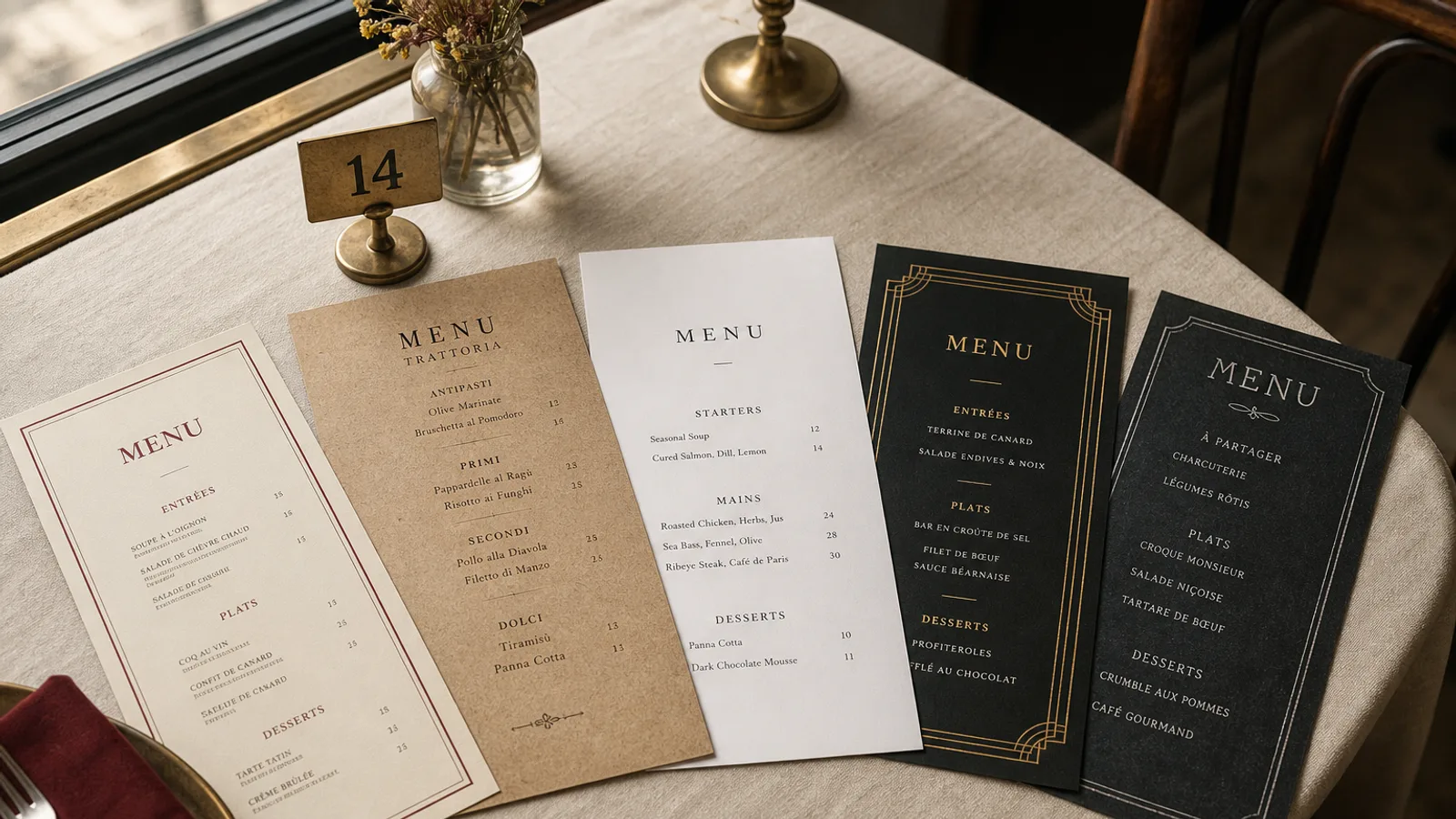
A hotel guest meets your menus more often than any restaurant guest ever will: at breakfast, at the bar at six, in the room at eleven, at dinner the next evening. Most hotels treat these as four separate documents made at four different times by four different people, and the guest notices. This article is about building them as one system, so the breakfast card, the room service folder, the bar list and the dinner menu look like they belong to the same house, and about the specific decisions each one needs.
One grid, one typeface pair, four documents
Begin with the format family. Hotels have historically loved oversized menus, but the practical set is A4 for dinner (single sheet or bifold), A5 for breakfast and the bar, and an A4 folder or A5 booklet for the room. All four share the same margins expressed as a proportion of the page (12 mm outer margins on A5 scale to about 17 mm on A4), the same typeface pair, the same colour for prices, the same way of writing a wine.
Choose a serif with a real italic for dish names and a compact sans for the practical text: room numbers, hours, allergen keys, service charges. Fine Dining Editorial and Bistro Classic are the two archetypes that translate across all four documents without strain. Avoid a script face for the hotel name unless the logo already uses one; the menu is not the place to introduce new branding.
Breakfast: the card guests see with one eye open
Hotel breakfast is read by people who have not had coffee. The card must be shorter and larger than any other menu in the building: 11 to 12 pt for items, generous leading, one face of A5 or one face of A4 folded once. If breakfast is included, say so on the first line in plain words, then list what is included and what carries a supplement with a clear price, because "supplement" without a number is the fastest way to a complaint at checkout.
- Lead with the cooked dishes that take longest, so the kitchen gets those orders first.
- Put the coffee and tea list in a strip at the top, with milk alternatives named rather than "available on request".
- Write times in 24-hour format and state the last order time; a guest who arrives at 10:28 for a 10:30 close will forgive the rush if the card warned them.
- Allergen key on the back, compliant with Regulation 1169/2011 and its 14 allergens, in the same place on every menu in the hotel.
Room service: a menu that is read lying down
In-room dining menus are read on a bed, in low light, often on a phone screen if you have a QR alternative. That drives the design: a larger size than the dinner menu (12 pt minimum), a light background rather than a dark one, and a much shorter list. Twelve to eighteen dishes is enough; a room service menu that mirrors the whole restaurant card floods the kitchen with orders it cannot plate at room temperature-safe speed.
Print room service menus on a heavier stock than anything else, 350 g board or a folder with replaceable inserts, because they live in a drawer for months and get handled by every guest. State the tray charge and the service hours on the front, not the back. Group by time of day (all-day, night menu after 23:00) rather than by course; a guest at midnight does not want to scroll past starters.
Numbers that reduce phone calls
Every room service dish gets a two-digit number in the margin. The guest reads the number over the phone, the order-taker does not have to spell out "the club sandwich without bacon", and the kitchen ticket is unambiguous. This is one of the few places in menu design where numbering dishes is correct.
The bar list: short, priced by the glass, no surprises
The hotel bar serves people who are alone, tired and about to charge it to the room. They want fast reassurance. Keep the bar list to one or two faces of A5: six signature cocktails at 14 to 18 €, a short classics section, four wines by the glass with the measure stated (12.5 cl or 15 cl), local beers, non-alcoholic options at a visible price. Print the measure next to the wine price: an unstated measure is the number one source of disputes on a hotel bill.
The bar list is also where the hotel can be less formal in tone than the dinner menu, but it must stay in the same typographic family. Same typeface, same price treatment, perhaps a darker background if the bar is darker than the restaurant.
Dinner: where the system earns its keep
The dinner menu is the flagship, and it is also the one that changes most often. Design it so the fixed elements (masthead, hours, service charge line, allergen note) live in a frame that never moves, and only the dish lines change. A4 bifold gives you a cover, two inner faces for food, and a back for a short wine selection or the set menu. Write prices with the guest in mind: hotel guests are already anchored on the room rate, so a 38 € main reads acceptably if the descriptors are specific and the layout is calm.
Set menus should be laid out as a block with a single price and the number of courses, not as a list with prices repeated. If you serve a half-board menu to package guests, print it as a separate insert in the same family, so the à la carte card never has to say "included for half-board guests" in the middle of a dish list.
Keeping four menus in step for a year
The system fails the day one menu is updated and the other three are not. Agree a reprint rhythm: breakfast and bar quarterly, room service twice a year, dinner as often as the chef needs, and update the shared elements on all four in the same week. Keep the editable source files together and note the paper for each: 350 g matte for everything a guest holds, 300 g or heavier for anything that goes in a folder.
In Menu Atelier you can build the four documents from the same style and brand assets, switch each one between A4 and A5, single sheet or bifold, in a click, review them side by side in 3D, and download print-ready PDFs with 3 mm bleed and crop marks for every face, or order them printed on 350 g matte board with a scored fold on the bifolds.