How many items should a menu have? Choice, measured
How many dishes a restaurant menu can carry before guests stall and the pass suffers: section limits, lunch versus dinner, and the type size you win back when you cut.
A long menu is rarely a sign of generosity. It is usually a sign that nobody has been allowed to cut. Guests take longer, they default to the two dishes they already know, and the kitchen keeps a fridge full of insurance. The useful question is not a universal number. It is how many lines a section can hold before the eye stops negotiating, and how many tickets a Saturday brigade can fire without lying. Those two ceilings, not a blog's lucky seven, should set the length of the card.
What “too many” looks like at the table
When a section crosses about seven or eight dishes, most guests stop reading and start hunting for a familiar word: chicken, pasta, steak, salad. The rest of the list becomes decoration. Schwartz's paradox of choice is over-quoted and under-measured in restaurants, but the operational version is plain. A 16-main card in a 40-seat room produces the same three tickets and a lot of prep that dies on Monday. The guest did not feel freer. They felt slower.
Count inside sections, not across the whole card. A wine list of forty labels is a different object. A dinner card with 6 starters, 8 mains and 5 desserts is already at the upper end for a room with one pass. Add a raw bar, a grill list and a “for the table” page and you have written a hotel menu for a staff you do not have.
Working ranges, not commandments
For an independent dining room that reprints twice a year, these ranges hold more often than they fail. Starters or antipasti: 4 to 6. Mains: 6 to 8. Sides if they are truly optional: 3 to 5. Desserts: 3 to 5, or a trolley plus two ices. A lunch formule can be 2 + 2 + 1 and a chalkboard. A wine-bar card that is mostly boards and a few hot dishes can be even shorter. A destination tasting menu is not a list; do not pad it with an à la carte of thirty lines “for flexibility”.
- If two dishes share a garnish and a story, they are one dish with a variant, not two lines.
- If a dish sells under 3 % of its section over eight weeks, it is a candidate to cut unless you can name its job in one sentence.
- If the waiter has to recite three unlisted specials for the card to feel complete, the card is the wrong length or the specials belong in print.
Trattorias often run long primi lists because the names are the product. Even then, twelve primi is a catalogue. Eight well-described ones, with a chalkboard for the soup and the special, will outsell the catalogue and cook cleaner. Tourist rooms keep long lists as a translation of fear. Cut anyway; visitors also stall.
The kitchen's number is the real ceiling
Ask how many distinct proteins, sauces and stations a Saturday requires. If four mains need the same plancha, you do not have four mains. You have a queue. A short card that still overloads one station is not short enough. Menu engineering is not only stars and dogs; it is a heat map of the line. The reprint should refuse to list a dish the pass cannot fire twice in ten minutes without stealing from the plough horse.
Labour hides in long cards. A puzzle that takes twenty minutes of a cook's time has a worse true margin than the spreadsheet shows. When you cut, cut the slow unloved dishes first, even if their food-cost percentage looks fine. The remaining list should make a busy service boring for the brigade. Boredom on the line is how you buy consistency.
What you win back in millimetres
Every line you cut is type size, margin and a chance to leave A4 bifold hell. A 42-item card forced onto one sheet is 9 pt with 8 mm margins. A 28-item card on the same sheet is 11 pt with 12 mm and a price column that does not wobble. Guests experience that as quality, not as fewer options. They will not write to thank you for the dishes you removed. They will order faster and send fewer plates back.
Format follows length. Under about 24 to 28 items, A5 or a short A5 bifold is enough. Between 28 and 40, a single-sided A4 or a light A4 bifold. Above 45 on one object, you are not designing, you are refusing to edit. ISO 216 sizes keep holders cheap; do not invent a square because the list is long. Shorten the list.
How to cut without a mutiny
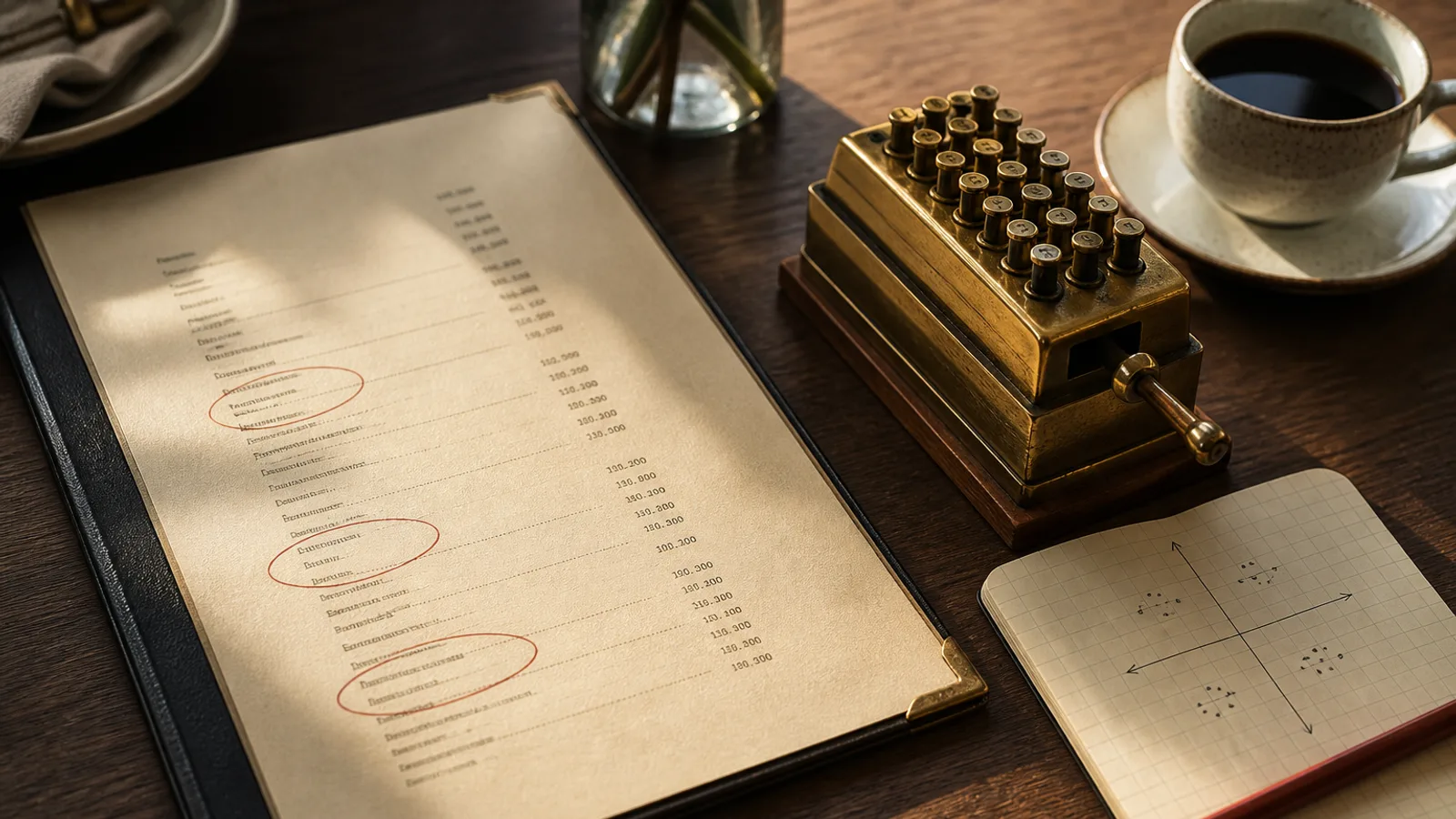
- Print the till for eight weeks. Mark dogs in red. Those go first, except one strategic vegetarian or child's plate you can name.
- Ask the kitchen for three dishes they would drop tomorrow. If those overlap the red, you have your reprint.
- Move two market dishes to a chalkboard or a lunch line instead of keeping them as ghosts on the dinner card.
- Reprint. Wait eight weeks. Do not add the dogs back because a regular asked once.
Tell the floor the story: fewer lines, larger type, plates that actually come out. Regulars who “always had the X” will survive if X was a plough horse; they will not notice a dog. If X was a star, you cut the wrong line.
A shorter card is a decision, not a style
There is no moral virtue in seven dishes. There is a practical virtue in a list the room can cook and the guest can finish reading before the bread is gone. Count, cut, grow the type, reprint. Then stop adding “just one more” because the season feels exciting. Excitement belongs on the chalkboard.
In Menu Atelier you paste the surviving list and see immediately whether it wants A5 or A4; switching format is one click, and the 3D view shows whether the type has room to sit at 11 pt on 350 g board before you spend on a run.