Raising menu prices without losing guests: design, timing and wording
How to raise menu prices when costs climb: which dishes to move first, how much, when to reprint, and the design choices that keep the increase from being the story.
When ingredient costs rise 10 % and your prices rise 0 %, your margin does not fall 10 %; on a dish with a 30 % food cost it falls by about a third. Every restaurant owner knows this and most still wait too long, because raising prices feels like a confrontation with the guest. It does not have to be. A price increase is mostly a design and timing problem, and handled as one it passes with almost no comment. What follows is the method: which prices to move, by how much, when to reprint, and how to lay out the new menu so that the increase is not the thing people notice.
Move prices by dish, not across the board
A flat 8 % increase on every line is the easiest to calculate and the worst to implement. It puts the biggest euro increase on your most expensive dishes, which are also the most compared, and it leaves cheap dishes with awkward prices like 7.56 €. Instead, go through the menu one dish at a time with the sales mix and margin in front of you.
- High volume, low margin dishes go first and furthest. These are the ones actually hurting; a 1 € rise on a dish that sells 300 times a month is 300 € of margin.
- Signature dishes and the cheapest item in each section move least, or not at all. Guests use them as reference points and remember their prices.
- Dishes whose cost has not moved stay put. A blanket increase on a dish made from ingredients that have not changed is the kind of thing regulars notice and resent.
- Anything you were planning to re-engineer anyway gets re-engineered now, with a new name and a new price, which avoids the comparison entirely.
The blended result across the menu should land where your costs need it, typically 5 to 8 % in a year of meaningful inflation, but the distribution is uneven by design.
Small and regular beats large and rare
A 0.50 € increase twice a year is almost invisible; a 2 € increase after three years of holding prices is a topic of conversation at every table for a month. Guests have a rough memory of a price, not an exact one, and increases inside that fuzziness pass unremarked. The threshold is roughly 5 to 7 % on any single dish; beyond that, people notice.
This argues for a fixed schedule: reprice in the first week of two set months, say March and September, tied to your seasonal menu changes. When the new prices arrive on a new menu with new dishes, they are read as part of the new season rather than as an increase. The same rise on an otherwise identical menu is read as exactly what it is.
Round to price points guests already accept
A dish moving from 16 € to 17.20 € looks like a calculation was made; a dish moving from 16 € to 17 € looks like a price. Choose your rounding convention by venue: whole euros in fine dining and most bistros, half euros where the menu is denser and cheaper, and avoid .90 and .95 endings entirely. They signal discount retail and they make the increase more visible because the guest has to parse the decimals.
Check the ladder within each section after repricing. If the mains used to run 16, 18, 19, 22 and now run 17, 18, 21, 23, the gaps have changed and one dish may have moved into a different mental price band. Keep the steps even, and keep at least one main under the psychological line for your market, often 15 € or 20 €.
Let the design carry the change
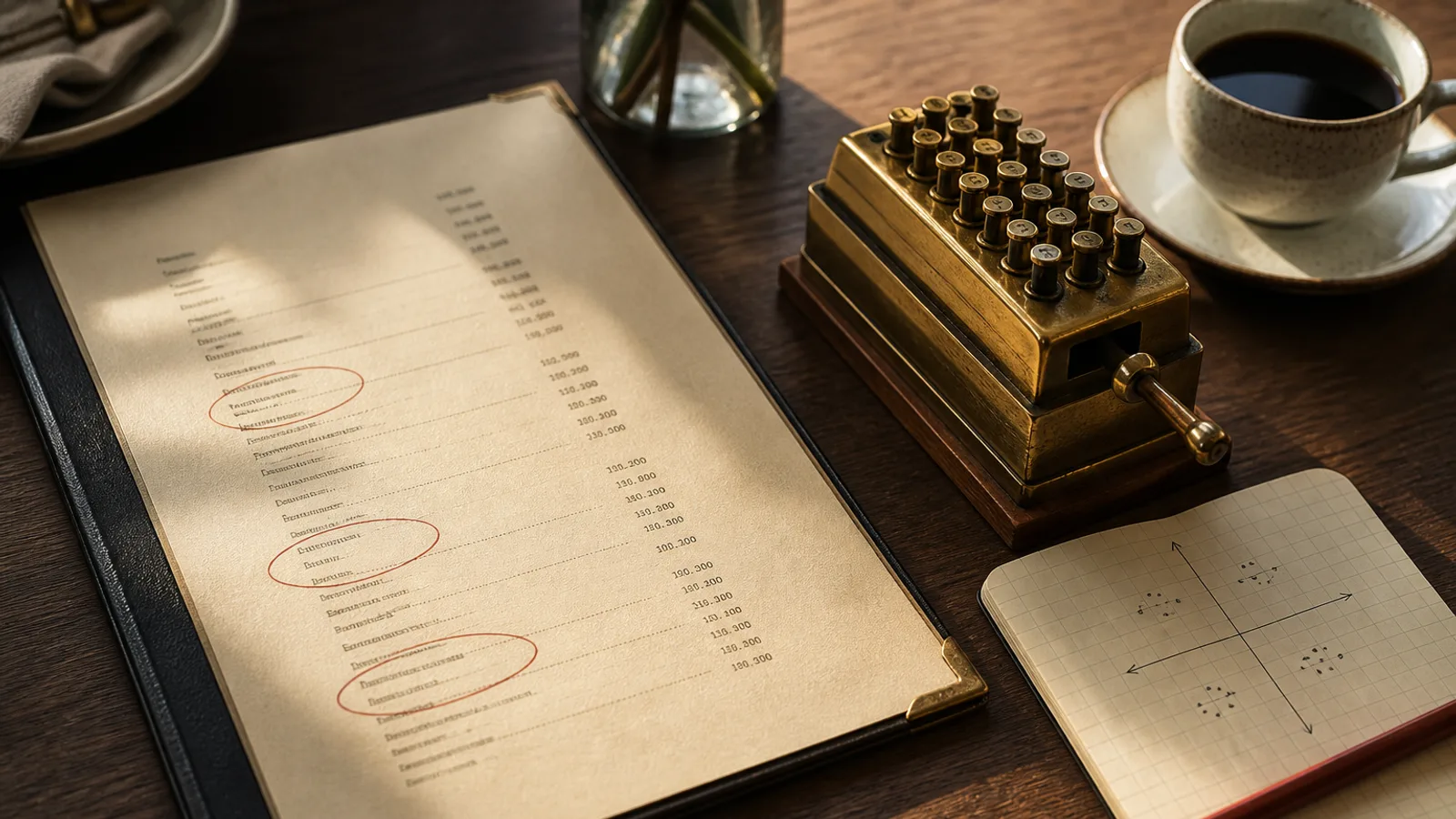
The new prices should arrive on a menu that has changed in other ways too, even slightly. Three moves reliably work. First, refresh at least a quarter of the descriptions, so the guest's eye is on new words rather than new numbers. Second, if the old menu had a price column with dotted leaders, drop it and place prices at the end of each description in the same weight as the text; the price stops being a column that can be scanned and compared. Third, change one visual element, an accent colour, the paper, the season label, so the object itself signals that this is a new menu, not a corrected one.
Never hand-correct prices on a printed menu. A sticker or a pen mark over a price says two things to the guest: the price went up, and the restaurant did not think it worth 10 € to reprint. Both are worse than the increase. Also avoid the temptation to remove prices altogether or to shrink them to 7 pt; guests read that as hiding, and hiding invites scrutiny.
Say less, and say it once
There is rarely a need to announce a price increase on the menu itself. A line apologising for rising costs draws attention to something most guests would not have registered, and it dates the menu. If your staff are asked, a single honest sentence is enough: our costs went up this year and we adjusted some prices in the spring menu. No apology, no lecture on inflation.
The exception is a structural change, such as introducing a cover charge, adding a service percentage or moving from bread included to bread charged. Those must be printed clearly on the first page, because a surprise on the bill does far more damage than the same amount on the menu.
Reprinting is the cheapest part of the increase
Owners sometimes delay a needed increase because the menus were printed six months ago and reprinting feels wasteful. Run the numbers: 40 menus at around 10 € each is 400 €, and a 0.80 € average increase across 3,000 covers a month recovers that in a week. The printed menu is not the constraint; the file is, if it lives with a designer who needs two weeks and an invoice.
In Menu Atelier, prices are fields on each dish, so a repricing pass is a few minutes of editing followed by a regeneration. You can change the accent colour or swap a photograph at the same time so the new menu reads as new, preview the result in 3D, and export a print-ready PDF or have the menus printed and shipped in 5 to 8 working days, which is quick enough to make the twice-yearly schedule a habit rather than a project.