Letter vs A4: menu sizes on both sides of the Atlantic
US Letter and ISO A4 are not the same sheet: millimetres, folds, holders and how to design a restaurant menu that still works if you ever print on the other size.
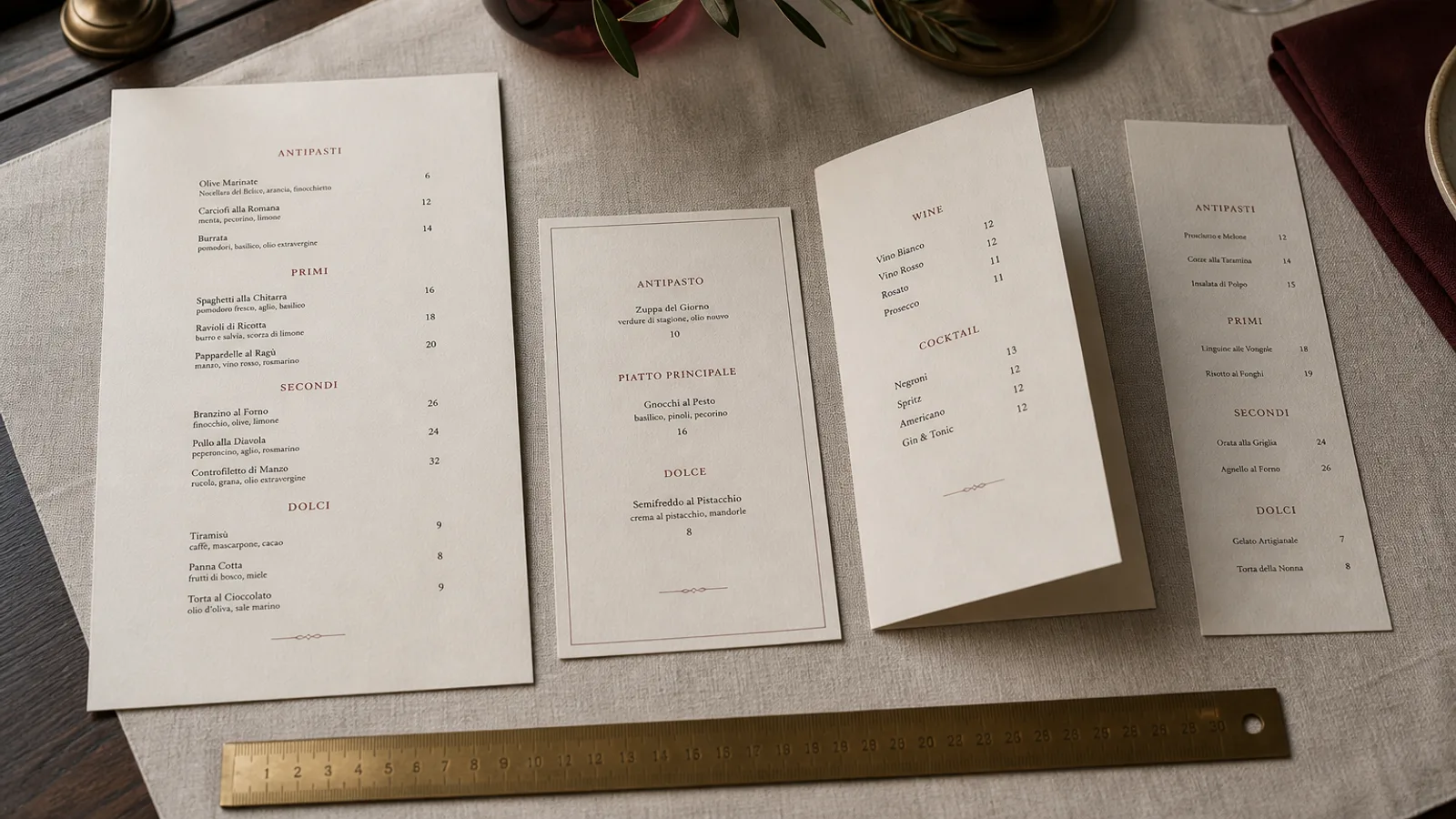
A4 is 210 × 297 mm. US Letter is 8.5 × 11 inches, which is 216 × 279 mm. That is 6 mm wider and 18 mm shorter. It does not sound like a design problem until you drop a Letter file onto a European press, or an A4 file into an American holder, and watch a strip of type vanish or a sea of margin appear. Restaurants that work both sides of the Atlantic, or that buy holders online without reading the millimetres, walk into this every season. Here is what each sheet actually is, what it does to a bifold and a single face, and how to keep one design from breaking when the paper changes.
Two standards, two habits
ISO 216, the A-series, is built on a single ratio: 1 to the square root of 2. Fold an A4 in half and you get A5 at 148 × 210 mm; fold again and you get A6. Every size shares the same proportions, which is why a European stationery drawer is a calm place. Menus live happily in that family: A4 single sheet, A4 bifold (which is an A3 sheet folded, 297 × 420 mm open), A5 single, A5 bifold (A4 folded).
Letter does not nest. Half of Letter is 5.5 × 8.5 inches, which is not a named size anyone stocks with the same ease. American rooms therefore tend to live on Letter singles, a slightly tall half-sheet, or custom cards. Tabloid (11 × 17 inches) is the closest cousin to A3 and is what a Letter bifold wants to print on. If you order holders from a US site for a Paris room, or the reverse, measure the pocket. A Letter holder will pinch A4; an A4 holder will leave Letter rattling.
Legal (8.5 × 14 inches) shows up in some American wine lists because the extra length holds more bins. It is a nightmare in a European drawer and in most covers. Do not pick Legal because a template offered it.
What those 18 millimetres do to a layout
A4 is a taller, slightly narrower column. Two columns of dishes with prices on the right sit comfortably with 10 mm outer margins and a 8 mm gutter. On Letter, the same two columns gain a little width and lose height: you fit fewer dishes before the footer, and the page looks squatter. Designers who copy an A4 grid onto Letter without redrawing the columns end up with a large empty band at the foot or with type that feels cramped in the last third.
A photograph sized to bleed off an A4 face will crop 18 mm of sky or tablecloth on Letter, or leave a white strip if you letterbox it. Logos placed 12 mm from the top edge on A4 sit in a different relationship to the first heading on Letter because the remaining live area is shorter. Recheck the first 40 mm of the page every time you change standard.
Type sizes do not need to change. 10 pt is 10 pt. What changes is how many lines you can afford above the allergen key. On Letter, I often drop a dish or tighten leading by 0.5 pt rather than shrink the body, which is how rooms end up with 8 pt that no one over forty will thank them for.
Bifolds and the sheet they print on
An A5 bifold is an A4 sheet, 210 × 297 mm, folded on the long edge, each panel 148 × 210 mm. A Letter bifold is usually 8.5 × 11 folded to 5.5 × 8.5, or an 11 × 17 sheet folded to Letter. Those panels are not A5. A design built as four A5 faces will not drop onto a Letter bifold without redrawing every margin and every column.
Bleed is still 3 mm on every side of the untrimmed sheet in Europe, whatever the finished size. American shops often ask for 0.125 inches, which is 3.2 mm: close enough that a 3 mm European file usually passes, but confirm. Crop marks follow the finished size, not the ISO name. An A4-with-bleed PDF is 216 × 303 mm; a Letter-with-bleed PDF is about 222 × 286 mm. Sending the wrong page size is the most common transatlantic mistake, and it is visible in the document properties before anyone prints.
- A4: 210 × 297 mm. A5: 148 × 210 mm. Family folds cleanly; European default.
- Letter: 216 × 279 mm. Wider, shorter; holders and trays are not interchangeable with A4.
- A5 bifold prints on A4. Letter bifold does not print on A4; it wants Letter or tabloid.
- Bleed: 3 mm (or 0.125 in). Check the PDF page size, not the filename.
Holders, printers and the drawer in the office
If the room already has leather covers, measure the pocket with a ruler, not with a product title. I have seen A4 covers labelled Letter on two continents. The pocket that is 2 mm too short will buckle 350 g board at the foot; the pocket that is 15 mm too tall will let the carte slide until the heading sits under the leather frame.
Your own local printer will have a default. In the EU it is A4 and A3, with A5 cut from A4. In the US it is Letter and tabloid. Asking a European shop for Letter is possible on a digital press and slightly wasteful; asking an American shop for A4 is the same story the other way. Neither is a reason to redesign the cooking. It is a reason to pick one standard for the room and stay there.
Shipping a file across the ocean without converting the page size is how you get a white strip or a cropped footer. Convert the document, reflow the columns, recheck the fold, then export. Do not scale the whole A4 by 94 percent to fit Letter: every margin, every logo, every 10 pt will shrink, and the carte will look like a photocopy of itself.
Pick a standard and stop mixing
A European dining room should live in ISO 216 unless it is a themed American diner that already bought Letter holders. An American room should live in Letter unless it is chasing a European look and is willing to buy A-series covers and pay for a slightly wasteful sheet. Mixing A4 food cartes and Letter wine lists in the same room looks like two jobs that never met.
Menu Atelier is built on A4 and A5, single sheet or bifold, because the product is European; you switch those formats in one click and see the object in 3D before you download a 300 dpi PDF with 3 mm bleed. If you later need a Letter run from a shop in New York, take the A4 design as a starting grid, rebuild the page at 216 × 279 mm, and reflow; do not squash. The dishes stay the same. The millimetres do not.