Lunch menu vs dinner menu: different formats for different services
Why lunch and dinner should not share one restaurant menu format: size, paper, set menus and how to keep both services looking like the same room.
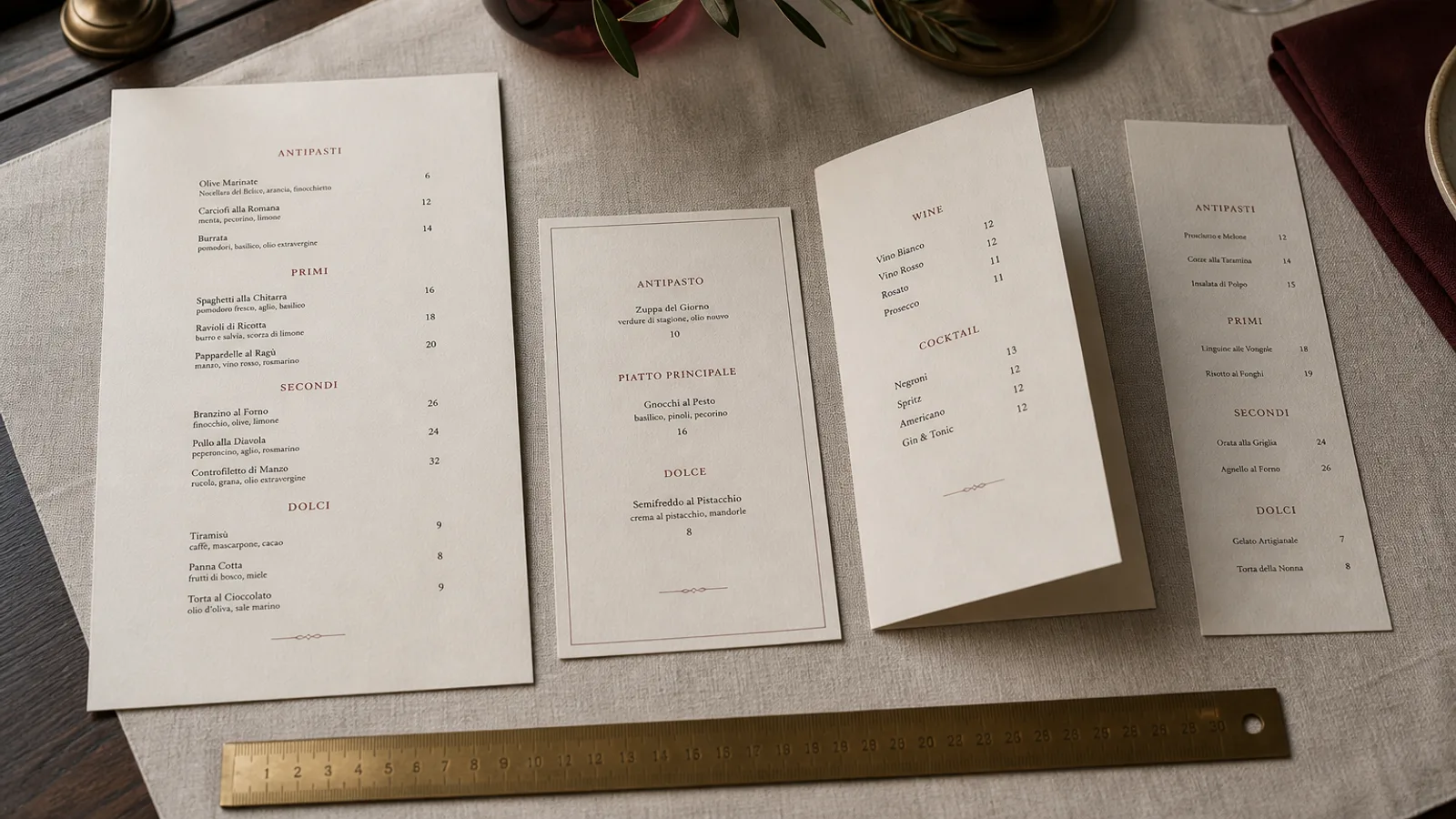
Noon is a different sport from eight o'clock. The guest has 45 minutes, a laptop sometimes, and a price in mind that is not the evening côte de boeuf. Handing them the dinner bifold, six sections and a tasting sequence, is how lunch tickets stall and the 13:30 table starts late. Handing dinner guests a photocopied lunch formule is how the room loses its evening register. Two services, two objects, one family. That is the job. This article is about the formats that actually survive a lunch turn, the ones that belong after dark, and the few shared rules that keep them from looking like two restaurants.
Lunch wants fewer decisions and a cheaper death
A weekday lunch carte should be readable in twenty seconds: a formule (starter plus main, or main plus dessert), two or three à la carte plates if you must, a glass list of six, a coffee line. That content fits on one A5 face or a tall half-sheet. It does not need 350 g board. It will change when the soup changes, which in a serious kitchen is often daily or two or three times a week. Print it on 170 to 250 g, or slip a dated insert into a durable cover, and throw it away without grief.
A4 is acceptable at lunch if the type is large and the sheet is not a wall of yesterday's dinner. I would rather see a clean A5 in the same type family as the evening carte than an A4 that still lists the tasting menu nobody is ordering at 12:40. If you use a chalkboard for the formule, put a paper card on the table anyway: allergens and prices have to exist in writing, and a board across the room is not writing in the guest's hand.
Price architecture is part of the format. Show the formule total once, clearly, not as a puzzle of supplements. If the evening côte is 42 €, do not put it on the lunch sheet next to an 18 € formule and expect the guest to feel welcomed. Leave the trophy dishes off the noon card.
Dinner can afford weight, not clutter
Evening is when the 350 g bifold earns its keep. Guests sit longer, they share, they want a wine list that is not six glasses. An A5 bifold or a single A4 in the same paper family as lunch, but heavier and finished, is the default for a 40-cover European room. Keep the number of food lines under 40 if you can; the format is not an excuse to list everything in the walk-in.
A tasting sequence at dinner can live on its own card, lighter stock, dated, sitting on top of the wine list. Do not bind the tasting into the dinner bifold unless it is stable for a season. You will reprint the whole object every time the kitchen moves a course.
Light is different after dark. Soft-touch and matt type hold up under candles; gloss becomes a mirror. If lunch is a cheap uncoated sheet, dinner can still be the same grid printed on 350 g matt. The guest who came at noon and returns at night should recognise the type, the mark, the way prices sit, not the paper weight.
- Lunch formule: A5 single or half-sheet, 170–250 g, reprint as often as the pot changes.
- Dinner carte: A5 bifold or A4 single, 300–350 g, seasonal reprint, soft-touch or matt coat.
- Tasting at night: its own dated card, not locked into the dinner bifold.
- Wine: a short glass list on the lunch sheet; a proper list or booklet at dinner.
One family, two weights
The mistake is not having two formats. The mistake is two designs. Same type families, same mark, same price alignment, same allergen system, same ivory or the same warm grey. Lunch can drop a colour or a border; it should not suddenly become a sans-serif flyer in cyan. If the evening carte is Fine Dining Editorial, lunch is a thinner page of the same book, not Café Chalk.
Covers help when the lunch sheet dies often. A wipeable cover in the house colour, A5, with a 90 × 210 mm slot or a simple clip, lets you reprint the noon formule on cheap stock and still hand over an object. Dinner can live without a cover if the board is 350 g and finished. Do not put the dinner bifold in the same plastic sleeve you use at lunch; the sleeve will argue with the paper you paid for.
Service should not mix the stacks. I have watched a Saturday lunch get the tasting card because the drawer was one drawer. Label the stacks. Date the lunch sheet in 7 pt at the foot so last Wednesday cannot survive into this Thursday.
Saturday lunch and the in-between
Weekend lunch is closer to dinner in time and in spend, and closer to lunch in daylight. Many rooms run the dinner carte at Saturday lunch and keep the formule for Monday to Friday. That is honest. What is not honest is a Saturday lunch formule printed to look like a discount voucher while the room is already on white cloth. If Saturday is dinner food at noon, use the dinner object, or a slightly lighter sibling, not the weekday flyer.
Brunch is a third format if you do it properly: longer dwell, more dishes, more coffee, children. An A4 single or an A3 placemat can work; a dinner bifold stuffed with eggs Benedict will feel like a costume. Give brunch its own sheet in the family, and kill it on Monday morning.
Build both from the same file
Start with the dinner grid, then cut. The lunch sheet should feel like a page taken out of the evening carte, not like a new brand. When the type, the mark and the margins match, you can print lunch cheap and dinner once a season without the room splitting in two.
In Menu Atelier you switch the same design from A4 to A5, single sheet to bifold, in one click and see both in 3D, which is exactly how a lunch face and a dinner fold should be born: one project, two formats. Download the 300 dpi PDF with 3 mm bleed for each, print the lunch run on lighter stock at your own printer if it dies every week, and order the dinner cartes on 350 g matt board with a soft-touch finish, 99 € plus 10 € a copy, when the evening list is stable. Two objects. One room.