Decoy dishes and anchoring: pricing tactics that actually work
How decoy dishes and price anchors work on a printed menu, when they insult the guest, and how to set one real expensive neighbour without inventing a fake plate.
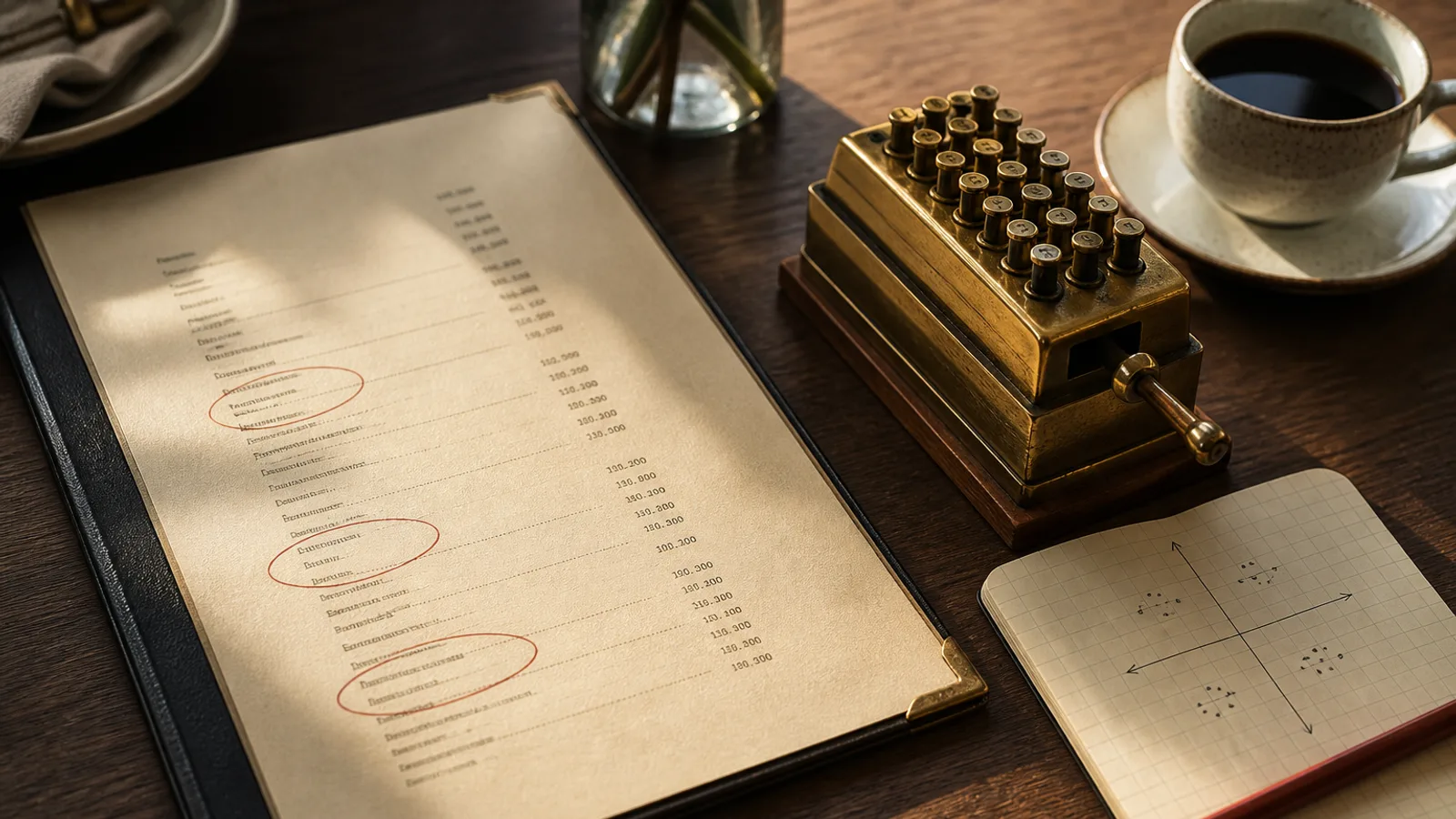
A decoy is a dish you do not particularly want to sell, priced so that the dish next to it looks reasonable. An anchor is the same idea without the cynicism: a real, expensive plate that makes the next decision feel smaller. Both live in behavioural economics textbooks. Both fail in a dining room when the expensive plate is a joke, when the kitchen cannot cook it, or when the guest feels handled. Used honestly, they are just neighbours in a list. Used as a trick, they train regulars to distrust the card.
Anchoring is comparison, not hypnosis
People judge a number against the last number they saw. A 34 € rib-eye makes a 26 € sirloin look like a choice rather than a leap. That is anchoring. It does not require a fake 62 € “reserve tasting” that nobody can order on a Tuesday. It requires one cookable, prideful plate at the top of the section, with a description as serious as the cheaper neighbour. If the expensive dish is written as a dare, guests will treat the whole column as a dare.
Place the anchor first or second in the section, in the same type as everything else. Do not box it. The comparison should happen while the eye is still in the list. A gold frame around 48 € is a billboard that says “look how expensive we are”. A quiet 48 € next to a quiet 28 € is a conversation.
A decoy has to be a plate you can send
The academic decoy is an option designed to lose: a third steak at 36 € that is worse value than the 32 € one, so that 32 € wins. In a restaurant the losing option still has to come out of the pass if someone orders it. If you cannot be proud of that plate, do not print it. A decoy that becomes a dog with a high food cost is not clever. It is waste and a bad review.
- Legal and moral floor: the dish exists, the portion is as described, the price includes what the guest will be charged.
- Kitchen floor: you can fire it on a Saturday without stealing the station from a plough horse.
- Copy floor: write it with the same respect as the dish you hope they choose. A sneering line is visible.
- Time floor: if nobody has ordered it in eight weeks, it is not a decoy. It is clutter. Cut it.
The useful decoy in a European room is often a format, not a worse recipe: a tasting for two at 89 € sitting above two à la carte mains at 24 and 28. Some tables will take the tasting. Most will feel that 28 is sane. Both outcomes are acceptable if the tasting is staffed. A “luxury” garnish on an otherwise identical plate, +8 €, is a decoy that guests resent unless the garnish is obviously different in the room.
Where the tactic belongs, and where it does not
Anchors earn their keep on mains and on wine by the glass, where the spread of prices is wide and the guest is already comparing. They do little on desserts of 8, 9 and 10 €; the differences are too small to feel like a decision. They do harm on a lunch formule, where the guest came for a known number. Do not anchor a 19 € formule with a 34 € “business menu” that is the same chicken. That is not psychology. That is a slight.
Wine lists are the cleanest place to anchor: a serious bottle at 68 € makes 38 € look like Tuesday. Keep the 68 € real, from a producer you will still have in May. A token trophy bottle at 180 € that you cannot replace is theatre, and sommeliers hate reprinting a lie.
How to set one pair this week
- Pick the dish you actually want to sell more of. Cost it. Confirm the kitchen wants the volume.
- Pick a neighbour that is honestly more expensive and still cookable. Put it immediately above or beside.
- Give both the same type size and the same length of description. Do not dress the cheap one as a bargain.
- Wait eight weeks. If the expensive neighbour never sells and the target does not move, you have added a dog. Remove the neighbour.
Do not stack three decoys in one section. Do not raise every price “because anchoring”. Anchoring is a relationship between two numbers, not a licence to inflate the card. Menu engineering still comes first: stars, plough horses, puzzles, dogs. Psychology dresses the matrix. It does not replace it.
Neighbours, not tricks
The guest should be able to overhear your tactic and not feel cheated. That is the test. A real expensive plate next to a real good plate is hospitality with a spine. A fake third option written to lose is a game. Print the first. Leave the second in the textbook.
In Menu Atelier the order you paste is the comparison you print, so you can sit the 34 € rib-eye above the 26 € sirloin before you generate and see the pair on an A5 or an A4 bifold in 3D. If the expensive line dominates the panel when you tilt the card, you boxed it in your head even if you never drew a rule.