Menu descriptions that sell: sensory words, origin, restraint
How to write restaurant menu descriptions that earn their line: one sensory fact, a real origin, the adjectives to cut, and why a paragraph on every dish flattens the card.
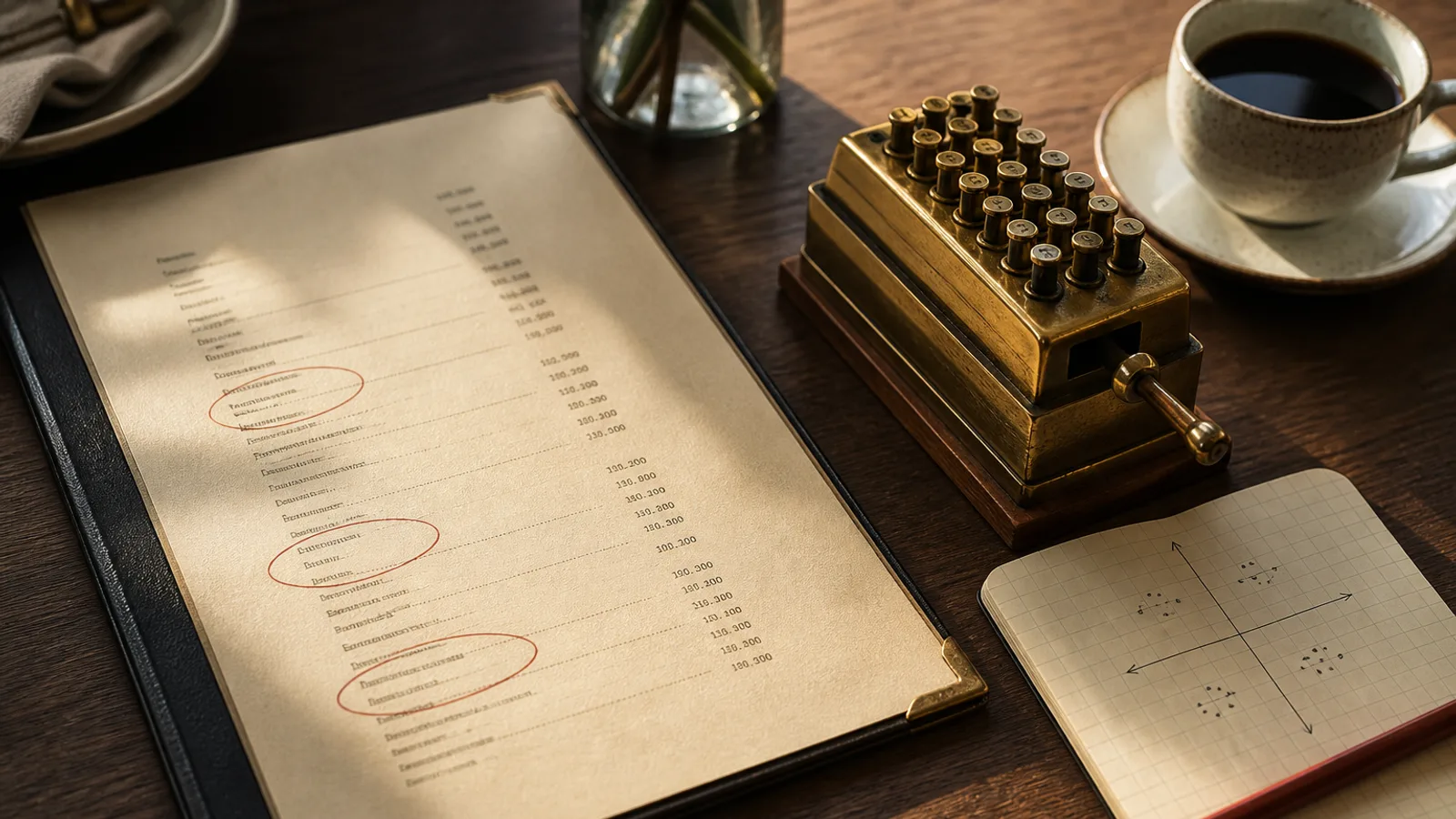
A description has one job: to make the next thirty seconds of decision easier without writing a poem. Most cards fail in the other direction. They stack adjectives (homemade, succulent, our famous, chef's special) until the plate disappears, or they list every ingredient as if the guest were a health inspector. The middle path is short and specific. One sentence that names how the dish will feel or where the one true thing on the plate comes from. Then stop. The type will thank you, and so will the waiter who is tired of translating.
One sensory fact beats five compliments
Sensory does not mean “delicious”. It means a word the guest can test against the plate: smoked, raw, grilled hard, chilled, slow-braised, cracked pepper, lemon zest, brown butter. “Tender succulent chicken” tells them nothing they cannot already hope. “Half chicken, grilled over vine wood, pan juices” tells them the cooking and the smell. Cornell-style work on menus has long suggested that specific, sensory language lifts sales more than empty praise. You do not need a study to see why. Praise is interchangeable. Smoke is not.
Write the sentence after you taste the dish on a Tuesday, not after you remember last year's photo. If the garnish has changed, the line must change. A reprint that still says “seasonal greens” in January is a card that has stopped telling the truth. Seasonal is allowed only when you will actually swap the line mid-season, which on a printed 350 g run means a chalkboard, not a lie in 11 pt.
Origin is a privilege, not a garnish
Name a farm, a bay or a breed when you would say it out loud to a friend and when you can still buy it next month. “Line-caught hake from Concarneau” is a reason to order. “Locally sourced sustainable fish” is a poster. If three dishes claim the same farm, the farm is doing too much work and the card starts to sound like a grant application. Pick the one ingredient per dish that is actually specific. The rest can be silent.
Foreign words need a job. A trattoria can leave tagliatelle and cacio e pepe untranslated if the room is Italian; a line of explanation in the guest's language belongs under the name, not instead of it. Do not write “risotto of the moment with seasonal vegetables and parmesan” if the plate is the same in March and October. Guests who care will ask. Guests who do not care will skip a paragraph.
Length is a hierarchy tool
Stars and puzzles get the full sentence. Plough horses get the name and, at most, a four-word method. Dogs you kept for a reason get a short honest line (the vegetarian main, the child's pasta) and no theatre. If every dish has a three-line story, nothing is highlighted. The card becomes a wall of italic. That is the opposite of selling.
- Cut: homemade, unique, famous, succulent, mouth-watering, secret recipe, you won't believe.
- Keep: the cooking method, the one named ingredient, a texture, a temperature.
- Move to the waiter: the long story of the grandmother, the wine pairing speech, the allergy improvisation.
- Put in a key, not in the line: the 14 EU allergens under Regulation 1169/2011.
Allergens are information, not marketing. A readable mark next to the dish plus a short key is enough. Do not write “contains nuts” in the same italic as “hazelnut praline, warm”. One is a warning. The other is a reason to order. Mixing them trains guests to skip both.
How to rewrite a section in an hour
- Print the current section. Cross out every adjective you could put on any other dish.
- For each remaining line, add at most one method and one origin. Read it aloud. If you would not say it to a regular, cut it.
- Give the two dishes you want to push two extra words. Take two words away from the burger that already sells.
- Set the new lines at 11 pt italic under 11 pt roman names. If they wrap to three lines, they are still too long.
Do this on paper before anyone opens a layout. Descriptions decide column width. A 28-character name with a 140-character blurb will wreck an A5. Better a tight A5 with honest lines than an A4 that exists to hold your prose.
Stop when the plate can finish the sentence
The best descriptions leave a little work for the food. If the line has already used every compliment in the kitchen, the plate can only disappoint. Write less than you are proud of. Reprint when the garnish changes, not when you think of a better adjective.
In Menu Atelier the line you paste under each dish is the line that prints, so the restraint has to happen before you generate. A short list with one sentence each sits cleanly on A5; if a section still wraps, switch to A4 bifold in one click and check the italic in 3D before you spend on 350 g board.