Menu engineering basics: stars, plough horses, puzzles and dogs
How to classify every dish by popularity and contribution margin, what to do with each of the four categories, and how the result should change the design of your menu.
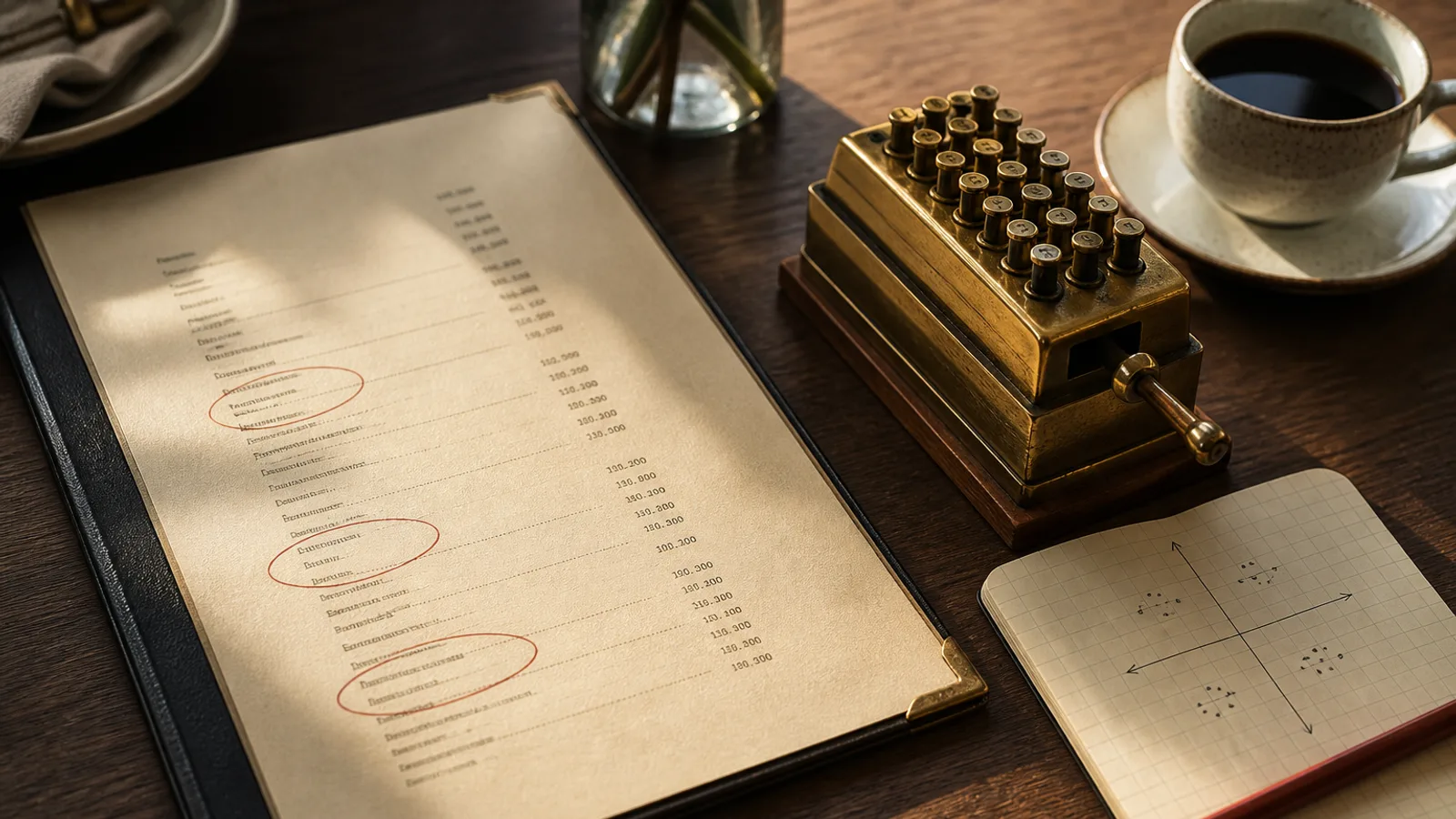
Most restaurant owners know which dishes sell. Far fewer know which dishes make money, and almost none have put the two facts side by side on one sheet of paper. That sheet is menu engineering, a method developed at Michigan State in the 1980s by Kasavana and Smith and still the most useful hour you can spend on your menu before redesigning it. This article explains the four categories, how to compute them from your own sales data in a spreadsheet, and, most importantly, what each category should do to the layout of the card.
Two numbers per dish
Menu engineering needs exactly two figures for each item in a section: how many you sold over a period (popularity) and how much each sale contributes after food cost (contribution margin, that is selling price excluding VAT minus the cost of ingredients). Not the food cost percentage: the margin in euros. A 9 € starter at 25 % food cost contributes 6.75 €; a 16 € main at 35 % contributes 10.40 €. The main has a worse percentage and makes you more money per plate.
Pull four to eight weeks of sales from your till, grouped by dish, and cost each recipe honestly, including garnish, bread and the sauce that gets made in a 10-litre batch. Work within a section (starters against starters, mains against mains), because a dessert will never compete with a main on margin.
Drawing the matrix
For each section compute two thresholds. The margin threshold is the average contribution margin of the section, weighted by units sold. The popularity threshold is 70 % of the fair share: if a section has ten dishes, fair share is 10 % of units each, and the threshold is 7 %. Any dish above both is a star; above margin but below popularity is a puzzle; below margin but above popularity is a plough horse; below both is a dog.
- Stars: popular and profitable. Protect them. Never change the recipe, keep the price steady, place them where the eye lands first.
- Plough horses: popular but low margin. The signature dishes people come for. Raise the price gently, reduce portion cost, or pair them with a high-margin side.
- Puzzles: profitable but unpopular. The dishes to sell harder: better description, better position, a box or a chef's mark, possibly a small price cut.
- Dogs: unpopular and unprofitable. Remove them, or keep one for a reason you can name (a vegetarian option, a children's dish) and stop worrying about it.
The 70 % rule is a convention, not a law. If your section has three dishes, use 60 % to avoid classifying everything as a puzzle. The point is a relative ranking within your own menu, not an absolute score.
What to do with each category
Stars
Stars are where the layout should point. Put them at the top of their section or in the first position after a heading, give them the full description length, and make sure the photo, if there is one, is theirs. Test a small price increase (50 cents to 1 €) once a year; a genuine star will tolerate it.
Plough horses
The classic plough horse is the burger, the carbonara, the steak-frites: the dish that fills the room and pays the least. Three moves work. Reprice by 5 to 8 % and watch whether volume holds. Re-engineer the plate: a cheaper cut, a smaller protein portion with a more generous garnish, house-made sides that cost 40 cents. Or use it as a bridge: place it next to a high-margin dish so that the comparison flatters the puzzle.
Puzzles
A puzzle is usually a communication failure. The dish is good and profitable but the name is opaque, the description is a list of ingredients, or it sits at the bottom of a long section. Rename it, describe it in one sensory sentence, move it to the second position in the section, and consider marking it as a chef's suggestion. Give it eight weeks; if it still does not move, it is a dog with a good margin.
Dogs
Removing dogs is the single most effective menu change: it shortens the card, simplifies the kitchen and reduces waste. Keep a dog only if it has a strategic role you can state in one sentence. Everything else goes.
How the analysis should change the design
The mistake is to run the analysis and then hand the same list to a designer. The classification is a layout brief. A section with two stars, four plough horses and three puzzles should not be laid out alphabetically or by price. It should open with a star, place puzzles in positions two and three where the eye still travels, put plough horses in the middle where they will be found by people who came for them anyway, and close with the second star, which benefits from the recency effect.
- Cut dogs first; the resulting shorter menu is easier to typeset with generous type.
- Order each section by role: star, puzzle, puzzle, plough horses, star.
- Give stars and puzzles the longest descriptions; keep plough horses to a name and one line.
- Use one emphasis device per section (a box, a chef's mark, a small illustration) and give it to a puzzle, not a star.
- Re-run the matrix eight weeks after the reprint to see what moved.
Limits of the method
Menu engineering ignores labour: a puzzle that takes twenty minutes of a cook's time may be less profitable than its margin suggests. It ignores the meal structure: a cheap starter that leads to an expensive main is doing work the matrix cannot see. It ignores seasonality, and it will happily tell you to cut the dish your regulars love because they only order it on Sundays. Treat the matrix as a conversation starter between the kitchen and the person laying out the menu, not as an algorithm that decides.
One sheet, every reprint
The value of menu engineering is not in doing it once but in doing it before every reprint. Eight weeks of till data, an hour in a spreadsheet, four categories, and a layout order that follows from them. The redesigned card sells what you want it to sell, and the next analysis tells you whether it worked.
In Menu Atelier the order you paste your dishes in is the order they appear, so you can arrange each section by role before generating, put the puzzle you want to push in the second slot, and switch a design from A5 single sheet to A4 bifold in one click when cutting the dogs frees enough room for larger type.