Scoring and creasing: why folded menus crack and how to avoid it
Why the fold of a bifold menu cracks and shows white, what scoring and creasing actually do, which boards fold cleanly and how to design the spine so it survives service.
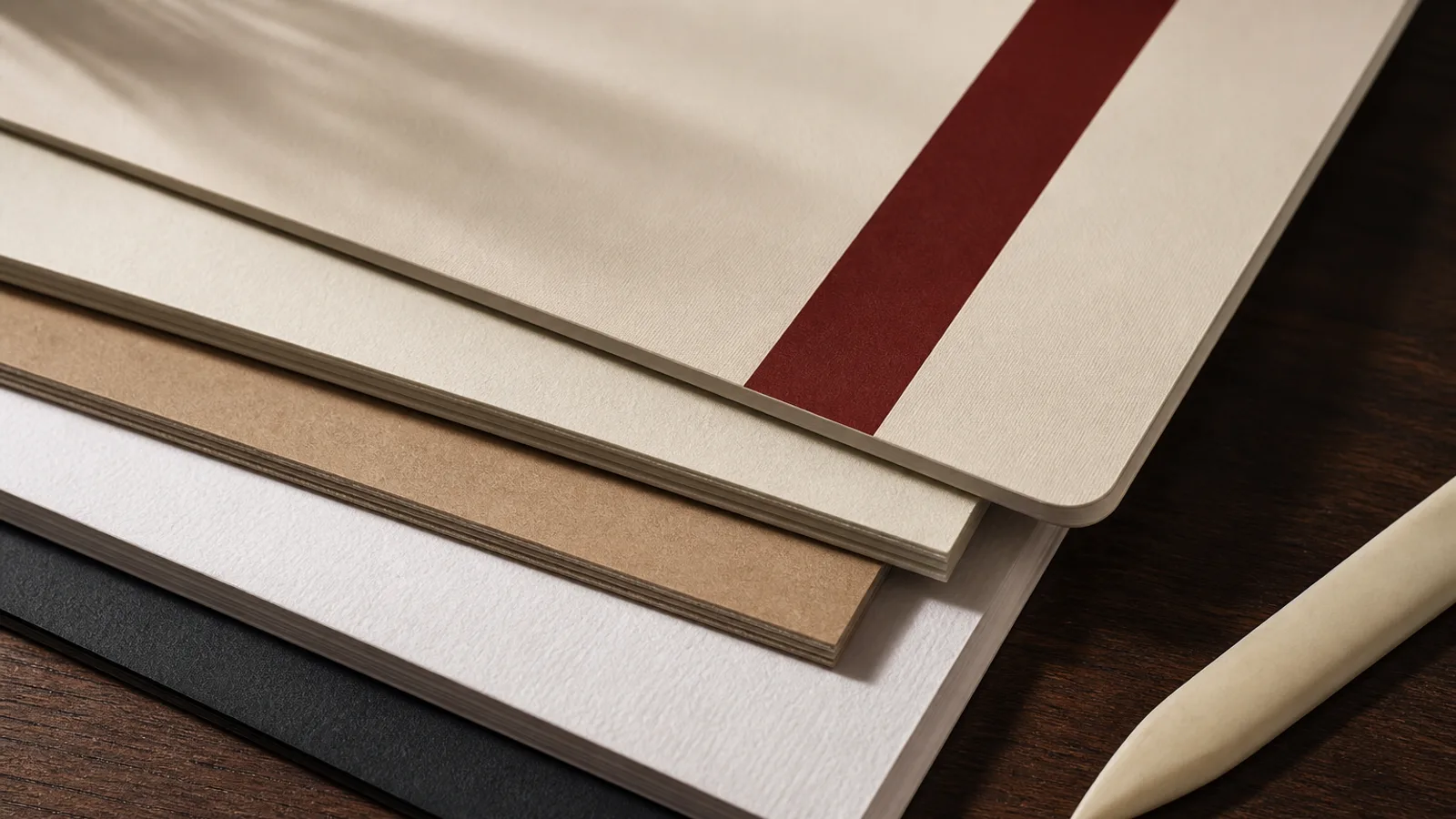
Pick up a bifold menu that has been on tables for a week and look at the spine. If there is a ragged white line running down the fold, the board cracked when it was folded, and every guest has been reading a menu that looks worn out from day one. The fix is not a heavier paper, which makes it worse, nor a lighter one, which makes the menu floppy. It is a proper score or crease before the fold, plus a couple of design habits around the spine. Here is what actually happens in the board, and what to ask for.
What cracks, and why heavier boards crack more
Paper is a mat of fibres held together by hydrogen bonds. When you fold a sheet, the outside of the fold stretches and the inside compresses. On a 120 g sheet the stretch is tiny and the fibres cope. On a 350 g board the outer surface has to stretch around a much thicker core, the fibres on the outside break, and the coating or toner sitting on them splits open. That split is the white line: raw fibre showing through where the ink used to be.
Two things make it worse. First, grain direction: paper folds cleanly along the grain, and fights back across it. A bifold where the fold runs against the grain will crack even with a good score. Second, coatings and digital toner are brittle films; the more ink sits on the spine, the more visibly it fractures. A dark cover on a heavy coated board, folded against the grain with no score, is the worst case, and it is also the most common menu on restaurant tables.
Scoring versus creasing: not the same thing
The words get used interchangeably but the processes differ, and the difference matters on menus. A score is a shallow cut or indentation made by a rotary wheel or a blade; it weakens the surface so the fold happens where you want it. A crease is made by pressing the board between a matrix and a rule, displacing the fibres into a rounded channel without cutting them. The crease compresses the core so the outer surface does not have to stretch as far.
- Rotary scoring: fast, cheap, fine for 200 to 250 g. On 350 g it leaves a hinge that still cracks on coated stock.
- Matrix creasing (letterpress or a creasing machine): the standard for 300 g and above. The channel keeps toner intact and the fold opens flat.
- Fold direction after creasing: the raised bead of the crease should sit on the inside of the fold. Fold the wrong way and you undo the benefit.
Ask your printer whether they crease or score, and on what machine. If the answer is a rotary wheel on the folding machine, expect visible cracking on a 350 g coated board. If the answer is a matrix crease, you are fine. A rough rule: anything above 250 g needs a real crease, and anything above 300 g needs one without exception.
Which boards fold cleanly
Uncoated boards fold better than coated ones because there is no brittle surface layer to split. A 300 g uncoated board with a matrix crease will fold with almost no visible damage even under a dark solid. Silk and matte coated boards are in the middle. Gloss coated boards and anything with a plastic laminate are the most fragile at the spine; laminated menus often crack the film itself, which then peels.
Toner-based digital printing is more prone to fold cracking than offset ink, because fused toner is a plastic layer sitting on the surface rather than an ink absorbed into it. If you are printing digitally, which most short menu runs are, a crease becomes mandatory, and a soft-touch or matte varnish over the toner adds flexibility and hides micro-cracks. Long-grain sheets with the fold running along the grain are the other half of the recipe; a good printer imposes the job that way without being asked.
Designing the spine so it forgives
Even a perfect crease will show a little wear after weeks of opening and closing, so the design should not put anything fragile on the fold. Full-bleed dark backgrounds are the obvious culprit; a hairline white crack on a black cover is visible from across the room, while the same crack on a cream background disappears.
- Keep a 6 to 8 mm zone either side of the fold free of text, logos and fine rules. Nothing should have to survive the crease.
- If the cover is a dark solid, consider stopping the colour 3 mm short of the fold or running a lighter band along the spine that reads as deliberate.
- Avoid gradients and photographs that cross the fold on a bifold cover; the tone shift at the crease reads as a printing fault.
- Choose a lighter board for the inside faces if the menu is a two-sheet booklet; 250 g inside, 350 g cover is a classic and it folds better.
One more detail from the prepress side: check the fold position in the file. On an A4 bifold the spine sits at exactly 148.5 mm from the trim edge; if your layout is off by even 1 mm the crease will land in the margin of one face and the tight edge of the other, and the panels will look uneven when closed. Set the fold as a guide, not by eye.
What to check when the menus arrive
Open the box and fold a menu closed, then open it flat again five or six times. Look at the spine under the dining room lights, not daylight, because that is where guests will see it. A faint matte line is normal on any board and disappears in use. A white or grey line that catches the light is cracking, and it will only get worse. That is the moment to talk to your printer, not after 100 menus have been on tables.
Ask for a creased, not scored, fold on any menu board above 250 g, insist on grain running with the fold, and keep your design 6 mm away from the spine. Menu Atelier prints bifolds on 350 g matte board with a scored fold pressed before folding, and the soft-touch finish hides the small surface marks that any heavy board shows at the spine; when you preview the menu in 3D, the fold is placed at the exact centre so your layout and the crease agree.