Wine list formats: from the one-page house list to the book
How to choose a wine list format: one-page house list, bifold, booklet or binder, plus columns, vintages and a glass list that can change without a reprint.
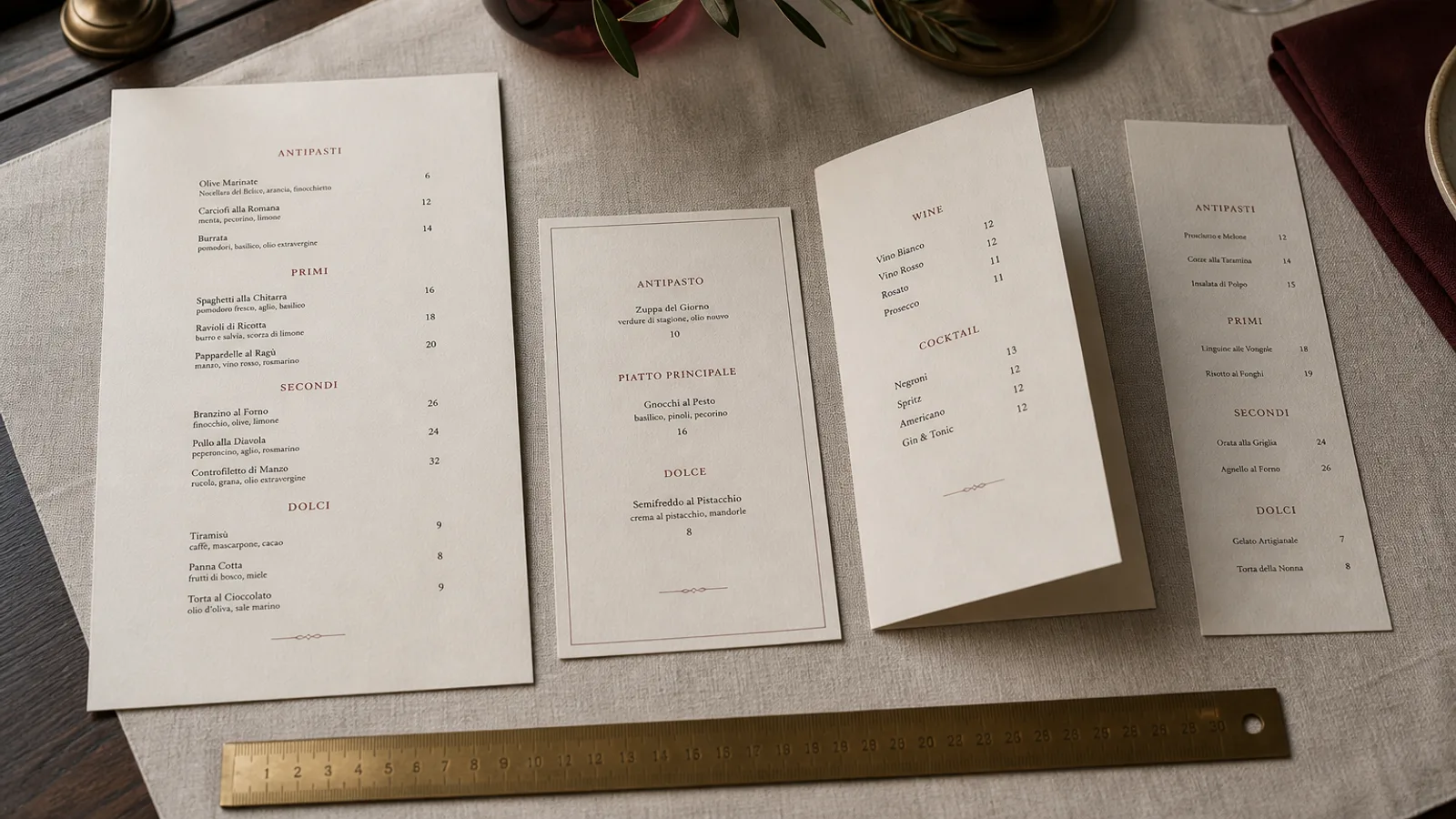
A wine list is a finding tool. The guest, or the sommelier standing over their shoulder, needs to land on a bottle in under a minute. Format is how you help or hinder that landing. Forty bins on a single A4 is a house list. Two hundred bins in the same type on the same A4 is a wall. Eight pages of poetry before the first white is a vanity project. Choose the object for the number of lines you actually pour, then design the columns so a vintage, a producer and a price can be compared without a ruler.
Count the bins, then pick the object
Under 40 bottles plus a glass list: one A4 or an A5 bifold, same paper family as the food carte. This is the neighbourhood bistro and the trattoria. You can reprint when six bins move. Do not start a book because you bought a leather cover on sale.
Forty to 80 bins: an A4 bifold (A3 folded) or a thin 8-page A5 saddle stitch. You now have room for country or style sections and a contents line on the inside cover. Still cheap enough to reprint twice a year.
Over 80, and especially over 150: a booklet or a ring binder with printed sections. The binder is ugly until you have lived through a vintage change on page 11 of a saddle stitch. Rings let you swap a leaf. A well-made A5 binder in the house cloth, with 170 g leaves, is a working tool. A 48-page stitched book that you are afraid to reprint is a museum.
The glass list should almost never live in the same object as the bottles if it changes weekly. A dated A6 or a tall slip, six to twelve wines, clipped to the inside cover or sitting on the table, keeps the book honest. Printing 14 glasses into a 16-page booklet is how you end up with last month's Riesling still on the table.
Columns that a sommelier can point at
The useful line is producer, wine, vintage, size if not 75 cl, price. Some rooms add region or grape. That is already six fields. Set them as a table with a quiet rule or with spacing, not as a paragraph. Align vintages and prices to the right, or use old-style figures on a decimal tab, so 2019 and 2022 and 48 and 120 can be scanned down a column.
Body at 8.5 to 10 pt is acceptable on a list if the leading is 12 to 14 pt and the paper is not gloss. Below 8 pt you are designing for a 28-year-old with a phone torch. Section heads in a size guests can find with a thumb: 11 or 12 pt, a little space above. A contents of six lines on the inside cover of a booklet saves the hunt.
Skip dotted leaders unless the line is short. On a long producer name they turn into noise. A light rule every fifth bin can help the eye stay on the row, the way an accounts book does. Do not colour-code countries; you will run out of colours and the list will look like a tube map.
Paper, covers and the wet glass
Lists are held longer than food cartes and they collect rings. 170 g inners in a 300 g cover, or 250 g throughout on a short list, with a matt coat or soft-touch on the cover, will survive a season of condensation. Uncoated cotton looks lovely and shows every glass. Laminated sleeves over each page are the plastic look again; if you need wipeable pages, coat the sheet, do not bag it.
A leather or cloth cover with a replaceable block is how hotel lists have worked for a century. Measure the pocket. A5 leaves in an A4 cover rattle; A4 leaves in an A5 cover buckle. If the cover is the brand object, print the leaves on a stock that slides, with a 10 mm inner margin for the rings or the clip.
- Under 40 bins: A4 single or A5 bifold, reprint with the food carte.
- 40–80 bins: A4 bifold or 8-page A5 booklet, contents on the inside cover.
- 80+ bins: booklet or ring binder; glass list on a dated slip.
- Cover can be durable; leaves and glasses must be allowed to die.
Order, pairing and the food carte
Group in the order your sommelier actually walks: sparkling, white, rosé, red, sweet, or by region if the room is built that way (Burgundy, Loire, Sicily). A list organised by price alone trains guests to buy the second-cheapest, which every dining room already knows. A list organised by grape only works if your guests shop that way; many European rooms still shop by place.
Pairing suggestions on the food carte (a glass next to a dish) belong on the food object, not repeated as a second wine list. If you print a pairing on the tasting card, keep the full list elsewhere so the guest who wants a bottle is not trapped in three matching lines.
Allergens are quieter here (sulphites are the usual line) but they still want a written statement if the list is the written source. A house cocktail list is a different object: shorter, more designed, often A5. Do not pour cocktails into the wine book unless you are a bar that happens to serve food.
Let the list stay a tool
If a guest cannot find a bottle of white under 40 € in twenty seconds, the format failed, whatever the paper. Count bins, pick the object, give vintage and price a column, and keep the glasses on a slip you are not afraid to reprint on Monday.
Menu Atelier will not replace a 200-bin book, and it should not: it is built for the food carte and the short list, A4 or A5, single or bifold, previewed in 3D. Use it for the house list and the by-the-glass slip in the same type as the food, export the 300 dpi PDF with 3 mm bleed, and grow into a booklet only when the cellar has already grown. The file can stay in the family even when the object becomes a book.