Menu paper weight guide: 250, 300 or 350 g and what each one feels like
What paper weight means in grams per square metre, how 250, 300 and 350 g boards behave in the hand and at the fold, and which to pick for each menu format and venue.
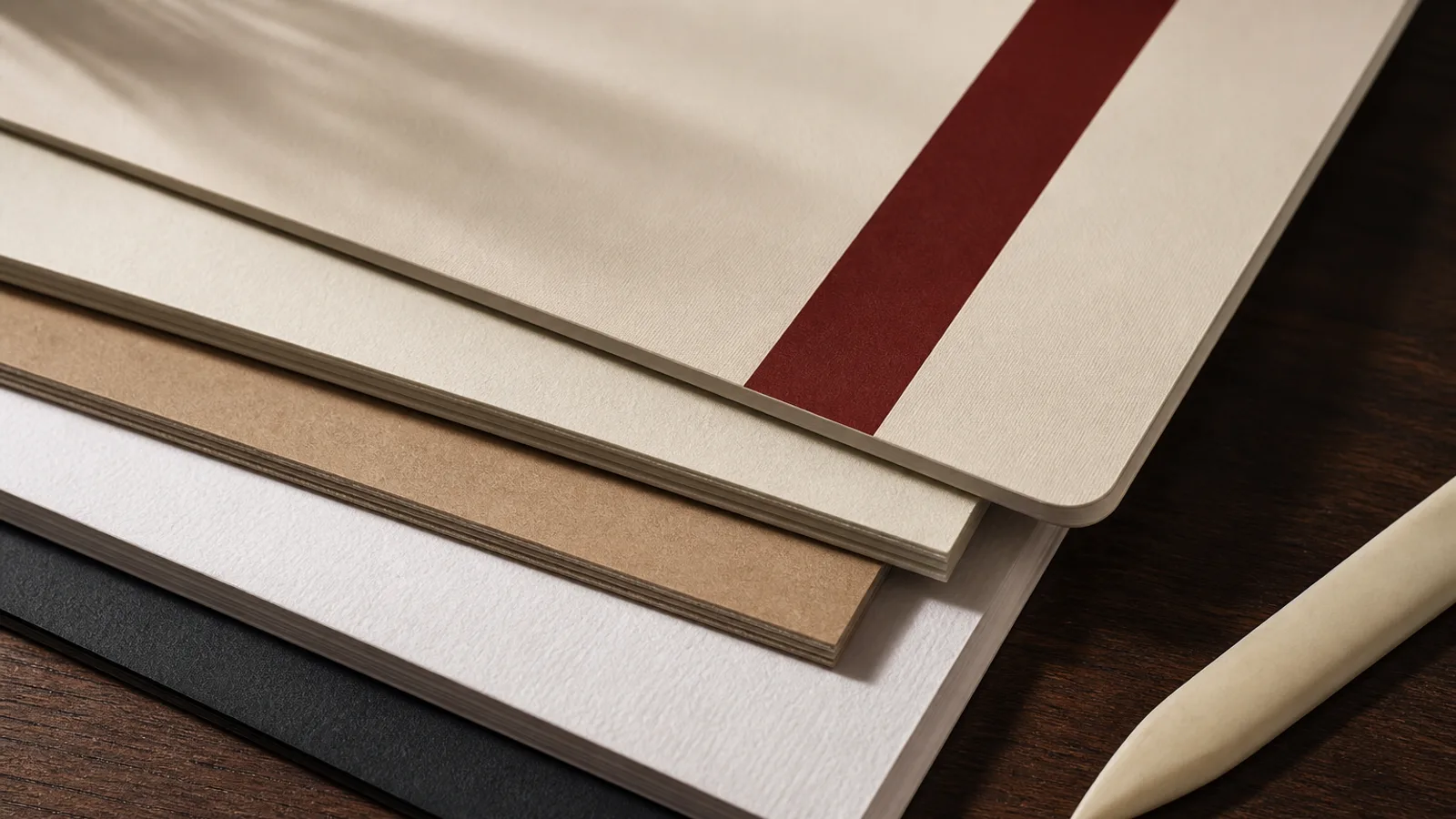
Hand a guest a menu on 170 g paper and it flops. Hand them one on 400 g board and it feels like a place mat. Somewhere between those two is the weight that makes a menu feel considered, and it is not the same for a single A4 sheet, an A5 bifold or a card that will be handled two hundred times a week. This guide explains what the number actually measures, how each common weight behaves in the hand and at the fold, and which one to specify for your format.
What the grams mean, and what they do not
Paper weight in Europe is expressed in grams per square metre, written g/m² or gsm: the mass of a single sheet measuring one metre by one metre. An A4 sheet is 1/16 of a square metre, so an A4 on 300 g paper weighs about 19 g. The figure tells you about mass, not directly about thickness or stiffness, which is why two 300 g papers can feel noticeably different.
Thickness is a separate measurement, caliper, given in microns. A coated 300 g stock might be 290 microns thick; an uncoated 300 g stock with a bulkier fibre could reach 380 microns and feel considerably more substantial. Stiffness depends on both, plus the fibre and the grain direction. When you compare papers, ask for weight and caliper, and ideally hold a sample.
For reference, everyday office paper is 80 g, a good letterhead is 100 to 120 g, a postcard is around 250 to 300 g, and a business card is typically 350 to 400 g.
170 to 200 g: paper, not board
At this weight the sheet still bends under its own weight when held by one edge. It is the right choice for menus that change daily or weekly and are thrown away: a lunch sheet, a specials insert slipped into a heavier cover, a kids' menu that will be drawn on. It prints cheaply on any laser or digital press, and 200 g is the practical upper limit for most office printers if you produce these in-house.
Do not use it for the main menu. It creases at the first handling, shows through when printed double-sided unless the stock is quite opaque, and reads to the guest as temporary, which is fine for a weekly sheet and wrong for the carte.
250 g: the minimum for a menu that lasts a season
At 250 g the sheet holds itself flat when held by one edge, which is the threshold at which a menu stops feeling like a flyer. It is a sensible weight for A5 single sheets and for inside pages of a multi-page menu held in a cover. It folds cleanly without scoring on most stocks, and it is the weight where double-sided printing stops showing through on coated papers.
Its weakness is longevity. In a busy restaurant, 250 g corners soften within two to three weeks and the sheet begins to curl if the room is humid. For a menu meant to last a full season of twelve weeks, it is on the light side.
300 g: the working standard
Most professionally printed restaurant menus are on 300 g board, and for good reason. It is stiff enough to be handed over with one hand, survives a season of daily use, and is still light enough to fold as a bifold without cracking on a coated stock, provided the fold is scored first. Almost every digital and offset press handles it without adjustment.
300 g is the right default for an A4 single sheet or an A4 bifold where the guest holds the menu open. It is also the weight at which soft-touch and matte laminates start to feel right: on lighter stock the coating dominates and the menu feels plasticky.
350 g: the premium feel, and when it is too much
350 g is where a menu starts to feel like an object rather than a sheet. It has the heft of a good business card, corners stay sharp for months, and it lies flat on the table. This is the weight to specify for a bifold A4 or A5 that will be used every service for a season, and for any menu where the venue itself is premium.
Two cautions. First, 350 g must be scored before folding; an unscored fold on 350 g coated board cracks the surface along the spine and the white fibre shows through the ink within days. Second, on a multi-page menu, 350 g pages become heavy and stiff to turn; use it for covers and step down to 250 or 300 g for the inside pages.
- A4 or A5 single sheet, single or double sided: 300 g. Go to 350 g if the room is humid or the menu is handled very often.
- A4 or A5 bifold: 350 g with a scored fold. 300 g if the paper is uncoated and the stock is known to fold well.
- Multi-page menu with cover: 350 g cover, 250 to 300 g inner pages.
- Daily or weekly sheets, kids' menus, inserts: 170 to 200 g, printed cheaply and replaced often.
How weight interacts with finish and format
Coated papers feel thinner than uncoated papers of the same weight, because the coating adds mass without adding bulk. If you like the smoothness of a coated stock but want the hand-feel of something substantial, go up one step in weight. Uncoated and textured papers, by contrast, often feel heavier than their number suggests and can be used a step lighter.
Format matters as well. A5 is small enough that even 300 g feels rigid; A4 has twice the area and needs more stiffness to avoid flopping when held at the top edge. The grain direction should run parallel to the fold on any bifold; a fold across the grain on heavy board is the usual reason a spine cracks even when scored.
Specify it, then check it in the hand
The weight goes on the print order as a number, but the decision is made by holding a sample. Ask your supplier for a blank of the exact stock at the exact weight, fold it if the menu folds, leave it on a table overnight and see how it lies. Ten minutes with a sample prevents the disappointment of a whole run that feels lighter than expected.
When Menu Atelier prints your menus, they come on 350 g matte board with a soft-touch finish, and bifolds are scored along the fold before they are folded, so the spine stays clean. If you prefer to print locally, the export includes the PDF at 300 dpi with 3 mm bleed and crop marks, and the 3D preview lets you see how the menu sits open on a table before you decide between single sheet and bifold.