How much does menu printing cost? A realistic breakdown
What restaurant menu printing actually costs in Europe: paper, quantity, finish and reprints, plus a realistic budget for a small dining room and when cheap quotes backfire.
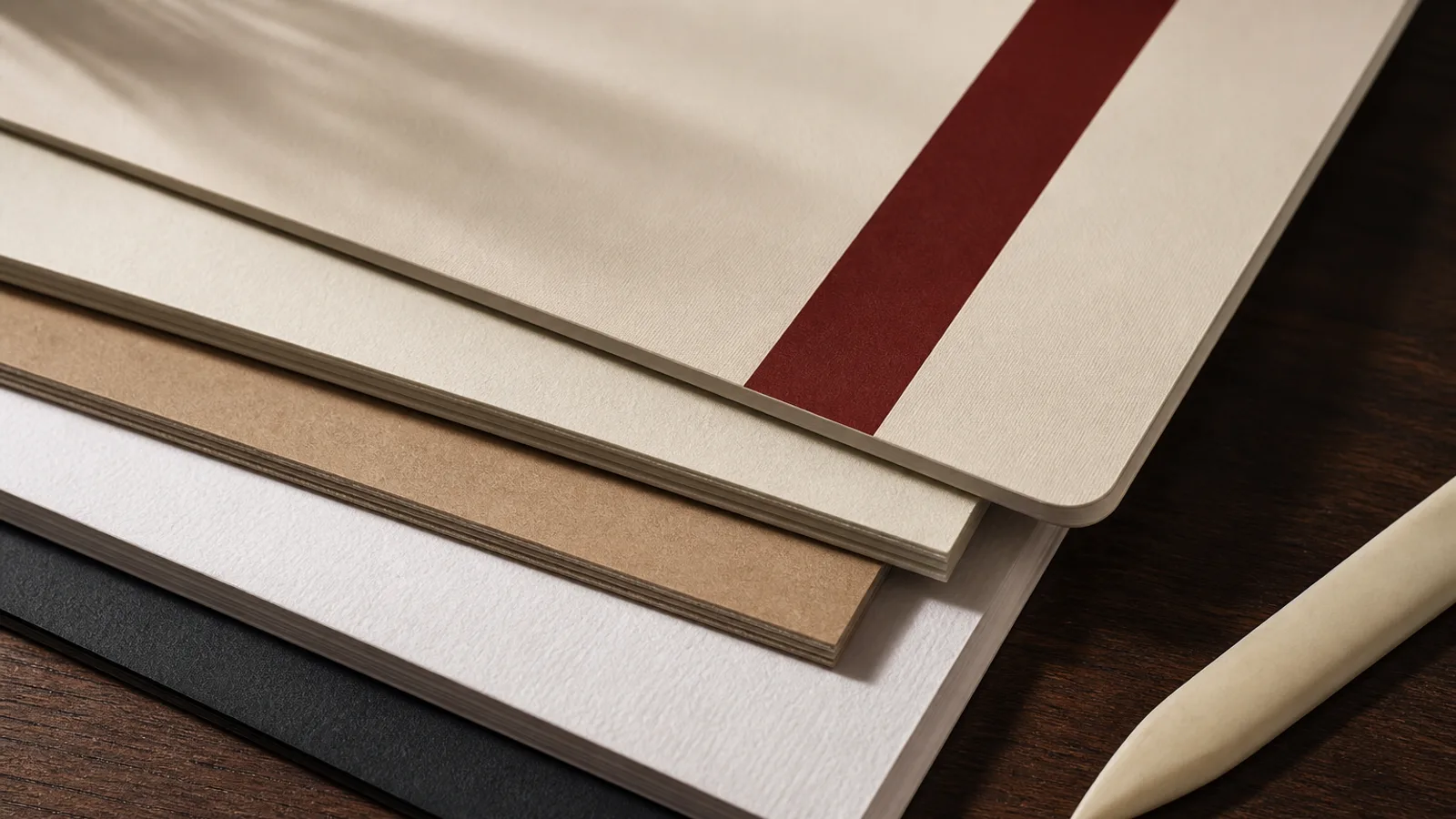
Ask three shops for a quote on forty A5 bifold menus and you will get three numbers that look unrelated: 80 €, 220 €, 480 €. None of them is lying. They are pricing different paper, different finishing, different run lengths and different assumptions about who will reprint when the salmon tartare comes off. This article puts real euro figures on each of those levers so you can read a quote, build a yearly budget, and stop treating the cheapest line as the cheapest year.
What a printed menu is actually made of
A menu is not a flyer. Flyers are 130 to 170 g silk, printed in a gang run with twenty other jobs, cut with a 2 mm tolerance and forgotten. A menu is held, folded, wiped, stacked and handed back every night. The paper has to take that. The fold has to survive it. The ink has to stay put when a wet glass sits on the cover for twenty minutes.
The cost stack is paper, impression, finishing, and the design file that feeds the press. Paper is usually the largest single line once you leave flyer stock. 350 g board costs several times 170 g silk per sheet, and a bifold uses a sheet large enough for two A5 faces plus bleed. Impression on a digital press is cheap at forty copies and barely cheaper at two hundred; offset only starts to win above a few hundred identical sheets. Finishing is the silent adder: scoring the fold, soft-touch lamination, rounded corners, a die-cut window. Each of those is a separate pass.
Design is the line most owners forget to put in the same column. A file that arrives without 3 mm bleed, in RGB, with a 72 dpi logo, costs someone an hour of rescue before it can print. That hour is either billed or absorbed into a higher unit price. A print-ready PDF at 300 dpi with bleed and crop marks removes that hour entirely.
The unit-price trap
Quotes are written per piece because that is how presses are priced. Your year is not priced per piece. If you print 200 menus at 1.40 € each because the unit price looked good, and you change four dishes in six weeks, you throw away most of that stack and print again. Two reprints at 80 copies of 2.80 € each would have cost less and left you with fewer boxes of yesterday's prices.
A useful rule for a 40-cover room: print what you will actually wear through before the next rewrite, plus a small reserve. That is often 40 to 80 copies, not 250. Digital short-run is built for that. Offset and large digital gangs are built for hotels that reprint the same breakfast card for a year.
Count reprints before you count unit price. A neighbourhood bistro that rewrites the carte every season should budget four print events a year, not one. A tasting-menu room that changes the sequence weekly should not be printing the tasting card in 350 g board at all; that card is a 170 g insert sitting in a durable cover.
Paper weight and finish move the number more than colour
Four-colour digital on 170 g silk is the cheap quote. It also feels like a takeaway flyer the moment a guest picks it up. Step to 300 g or 350 g uncoated or silk, and the sheet starts to behave like a menu: it lies flat, it takes a score, it does not flop when held in one hand. Soft-touch lamination or a matt aqueous coating adds 0.30 € to 1.20 € a face depending on run length, and it is the difference between a menu that looks tired in three weeks and one that still looks intentional in three months.
Uncoated 350 g cotton or felt-marked stock is beautiful and thirsty. It drinks ink, so solids need a heavier laydown or a second pass, and it scuffs if you skip a protective coating. Kraft is cheaper per sheet and harder to print: the brown ground kills contrast, so you either print in dark inks only or you flood a panel in white first. Both cost more than the paper saving.
- 170 g silk, digital, no finish: the flyer price, usually under 1 € a face at 100 copies, wrong for a dining-room carte.
- 300–350 g silk or uncoated, scored fold: the honest menu sheet, typically 2 to 5 € a finished bifold in a short run.
- Soft-touch or matt film on 350 g: the version guests remember, a little more per piece, far fewer replacements.
- Special stocks (cotton, kraft, coloured board): budget an extra 20 to 60 % and a proof, because colour shifts.
A realistic yearly budget for a 40-cover room
Take a small European bistro. One A5 bifold for food, one A5 single sheet for wine, reprinted three or four times a year, 60 copies each run. On 350 g matt board with a scored fold, a short digital run of that quality commonly lands between 3 and 8 € per finished menu once you include finishing, more if you add rounded corners or a thick laminate. At 60 copies, a run sits around 180 to 480 €. Four runs is 720 to 1 920 € a year for the food carte, plus a lighter spend on the wine sheet if you keep it simpler.
That range looks wide because finish and paper dominate, not because printers invent numbers. The bottom of the range is a clean digital print on good board with a score. The top is soft-touch, a special stock, or a shop that is really pricing a design rescue into the job. If a quote sits far below 2 € for a finished 350 g bifold in a run of 40, read the paper weight again. Something is 170 g, or uncoated with no protection, or the file is being ganged with flyers.
Shipping across the EU for a 2 kg parcel of board is usually 12 to 25 €, not a reason to choose a worse sheet. What does move the yearly number is reprint frequency. If you rewrite monthly, stop printing the whole carte: print a durable cover once (that can be 8 to 15 € a piece and last a year) and drop in a cheap daily or weekly insert.
When the cheap quote is the expensive year
Menus fail in the dining room, not on the delivery note. Thin stock creases at the fold in a week. Gloss laminate fingerprints under candlelight and peels at the corners after the first dishwasher-adjacent wipe. A file printed in RGB on an office laser looks fine on screen and muddy on the table, so you reprint within a month. Those reprints never appear on the original quote.
The other quiet cost is mismatch. If the lunch formule is a photocopied A4 and the dinner carte is a soft-touch bifold, guests read two different restaurants. Printing the lunch sheet on the same 350 g family, just as a single face, costs a little more than the copy shop and keeps the room coherent. That is a design decision that shows up as a printing line.
Allergen updates are not optional. Regulation 1169/2011 does not care that you have 180 copies left. If a dish changes, the printed line has to change. Budget for that as a reprint or design the carte so the volatile part lives on an insert. Either choice is cheaper than serving a legally stale menu.
Putting a number on the next order
Before you send a file out, write four figures on a scrap: copies you will actually use before the next rewrite, paper weight you will not be ashamed to hand over, finish you can wipe, and how many times this year you expect to do this again. Multiply. That is your real number. Compare quotes against that, not against the lowest unit price on a 250-run of 170 g.
If you want the printing and the file in the same place, Menu Atelier prices the print bundle at 99 € for the download (PDF at 300 dpi with 3 mm bleed and crop marks, plus the faces and the 3D model) and printed menus at 99 € plus 10 € per copy, on 350 g matt board with a soft-touch finish and a scored fold on bifolds, delivered across the EU in 5 to 8 working days. That 10 € line is not the cheapest flyer on the market; it is a finished dining-room menu you do not have to specify paper, coating and score for, because those choices are already made.