Menu size for small tables: bistros, terraces and two-tops
How to pick a menu format for tight tables: measuring the free surface, why A5 and DL win on two-tops, hand-held versus laid-flat reading, terraces and menus per guest.
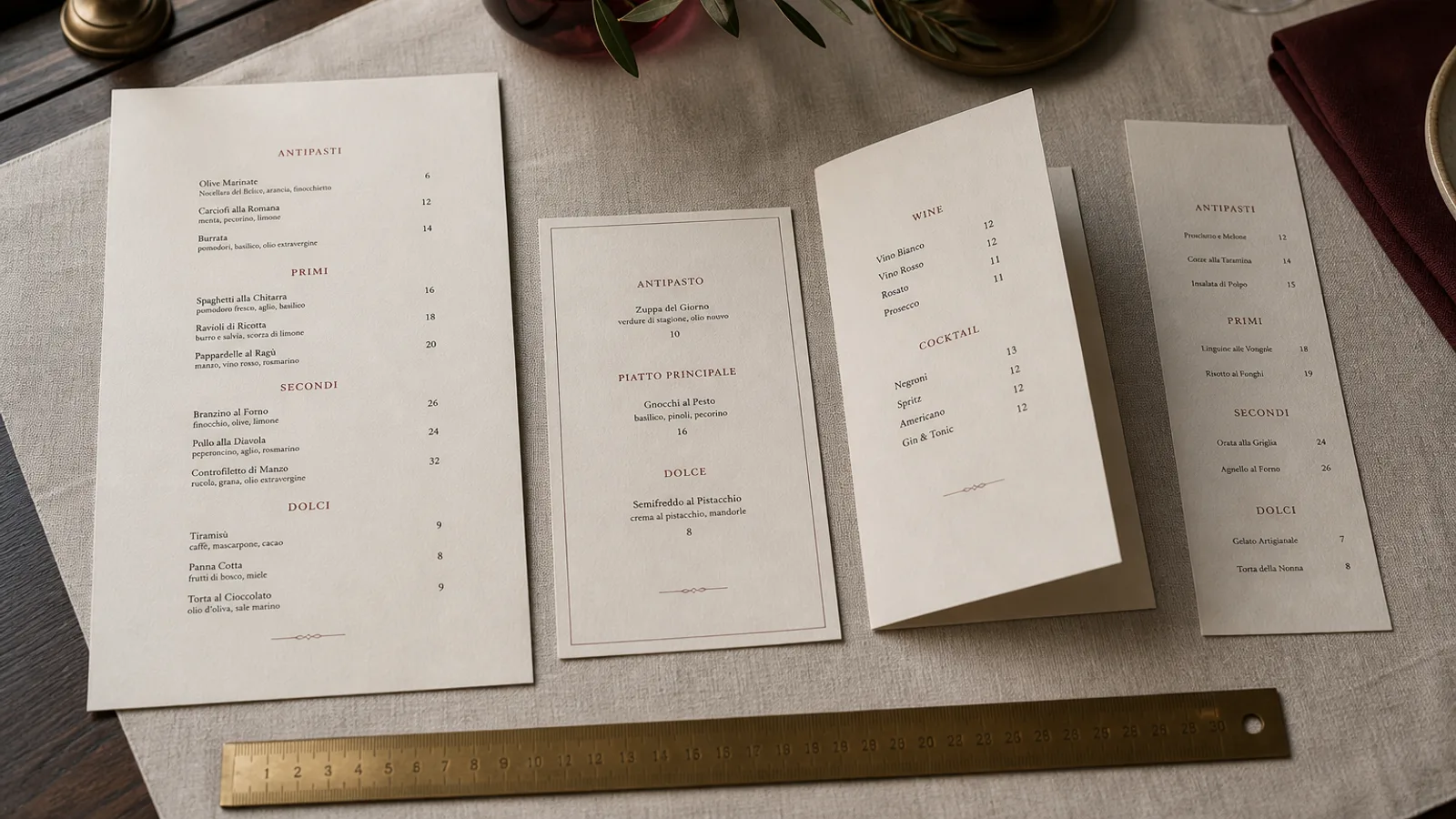
A 60 cm bistro table holds two plates, two glasses, a carafe and a candle, and then it is full. Put an open A4 bifold on it and something has to move. Small-table restaurants, terraces with café rounds, wine bars with ledges, keep choosing menus designed for a 90 cm four-top and then wonder why guests hold them in the air and order quickly. This is a practical method for sizing a menu to the table it will actually sit on, with the measurements and the trade-offs.
Measure the table, then subtract the meal
Start with your smallest table, not your average one. A 60 × 60 cm two-top has 3,600 cm² of surface. Two place settings with glasses and a bread basket take roughly 2,000 cm² of that, leaving a free zone in the middle of about 40 × 40 cm. An open A5 bifold (297 × 210 mm) uses 620 cm² and fits; an open A4 bifold (420 × 297 mm) uses 1,250 cm² and does not. A round 60 cm café table is worse, with about 2,800 cm² total and no corners.
The rule of thumb that comes out of this: the open menu should cover no more than 60 % of the free surface once glasses and bread are down. On a 60 cm two-top, that means A5 bifold or smaller. On a 70 cm square, an A4 single sheet is borderline and an A4 bifold is still too big. Only from 80 cm does the A4 bifold become comfortable.
Hand-held or laid flat: decide the reading posture
There are two ways to read a menu. Laid flat on the table, both hands free, leaning in. Or held up, one or two hands, the way you hold a book. Small tables push guests into the second posture whether the design intends it or not, so design for it. Hand-held menus want stiff board (350 g), a closed size that fits a hand span (148 mm wide is ideal), and a single column, because the eye moves down a held page more comfortably than across it.
- A5 bifold: closes to 148 × 210 mm, opens to A4 landscape. The best compromise for two-tops: enough room for 20 to 28 dishes, still holdable.
- A5 single sheet, double-sided: 148 × 210 mm, food on one face and drinks on the other. The right size for a wine bar or a bistro with a short list.
- DL card, 99 × 210 mm: for drinks, desserts or a very short menu of 8 to 10 items. Lies in the width of a saucer.
- A4 single sheet: acceptable on 70 cm tables if the board is 350 g and the guest holds it; too large to lie flat on anything smaller.
Terraces: wind, light and hands full
Outside, three things change. Wind lifts anything under 300 g, so a single sheet on light paper becomes a kite; go to 350 g board or use a clip holder. Daylight is brighter but glarier, so matte or uncoated finishes are easier to read than gloss, and a cream stock is kinder than bright white in direct sun. And guests on a terrace often hold a drink while reading, which argues for a format that can be read with one hand: A5 or DL, never an open A4.
Weatherproofing is where people reach for lamination, and on a terrace it is defensible, but a heavy board with an aqueous coating survives a summer of light rain and wiping and still goes in the paper recycling. Round the corners; on outdoor tables corners catch on everything.
One menu per guest or one per table
The other lever is quantity. Two open A5 menus on a 60 cm table take as much room as one open A4. If your list is short, one menu per table, handed to whoever asks, is a perfectly good service model and halves your print run. If your list is long or your guests are couples who want to read independently, one menu each is the norm, and the format has to shrink to compensate. A tall DL card per guest plus one A5 shared drinks list is a combination that works well on tight terraces.
Content has to shrink with the format
The mistake that ruins small menus is keeping the A4 dish list and scaling the type. An A5 face at 10.5 pt holds 28 to 32 lines; that is 8 to 10 dishes with a one-line description or 12 to 14 with none. If your list is longer, cut dishes, cut descriptions or accept a bifold, in that order. Never go below 10 pt to fit; on a small table under a candle, 9 pt type is a complaint waiting to happen.
- List the dishes and count lines at 3 per described dish, 1 per undescribed, 3 per heading.
- Pick the largest format that lies within 60 % of your smallest table's free surface.
- If the lines do not fit at 10.5 pt, remove dishes until they do. A short menu on a small table is a feature, not a limitation.
- Print a mock-up, put it on the actual table with plates and glasses, and sit in the chair.
Small table, considered menu
A menu that fits the table signals that the restaurant has thought about how people sit and eat here, which is exactly the impression a small room wants to give. A5 bifold for most bistros, A5 or DL single sheets for bars and terraces, heavy board throughout, one column, type at 10.5 pt or more, and a dish list edited to match.
Menu Atelier lets you build the design once and flip it between A4 and A5, single sheet and bifold, in one click, then look at the result open on a 3D table; if you also order printed copies, the 350 g board is stiff enough for hand-held reading and terrace use without lamination.