Private dining menus: personalised cards for groups
Design a private dining menu that feels written for the table: names, dietary notes, a fixed sequence, and a card guests keep without wedding-stationery theatre.
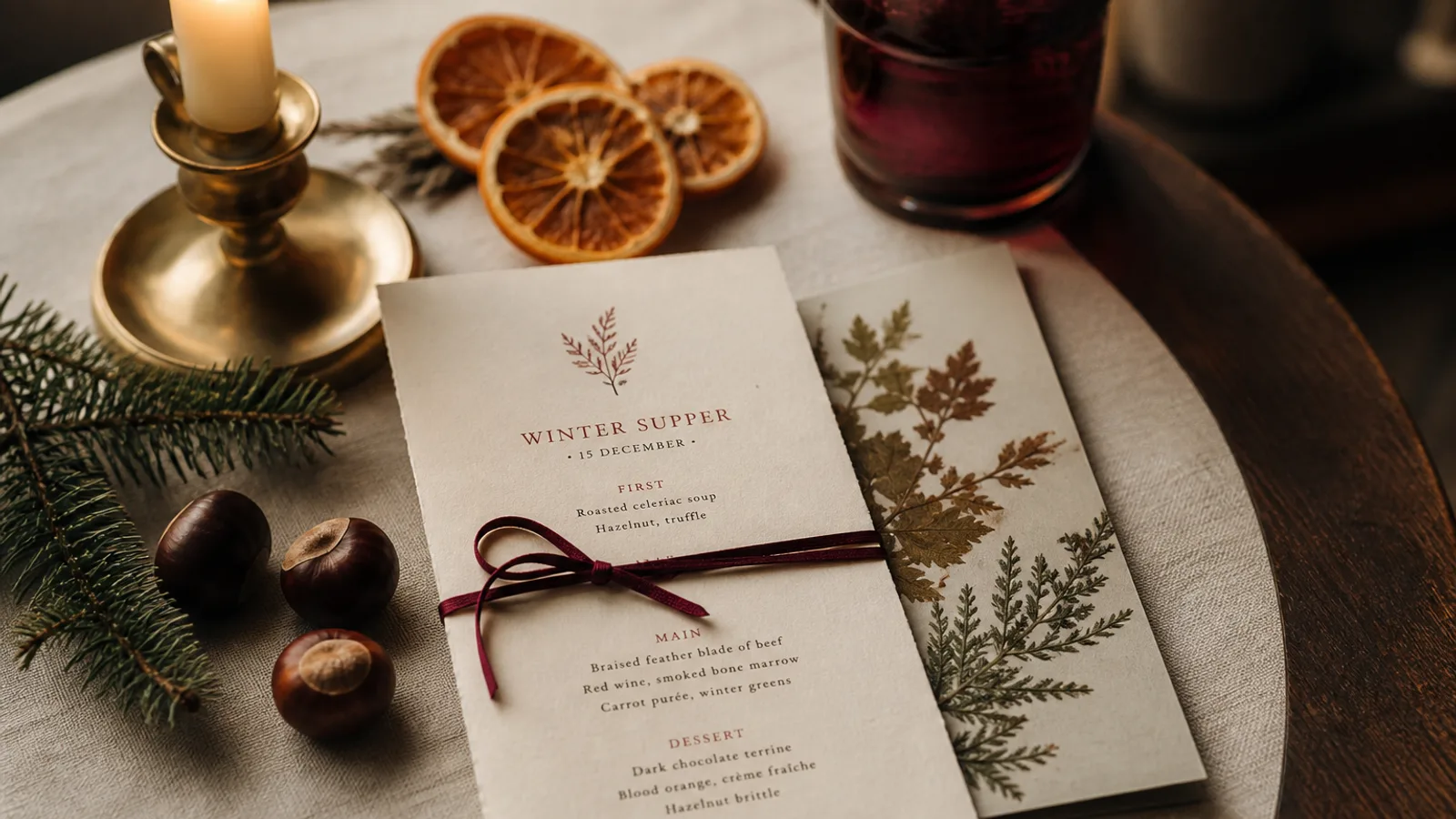
A private dining card has a different job from the à la carte on the next table. It must tell eight or twenty people what will happen over three hours, make a 90 to 180 € price feel settled before the first plate, and, if you do it well, go home in a coat pocket. Most rooms fail by reprinting the dinner menu with "Private dining" in the header, or by over-designing a keepsake that looks like a wedding invitation and eats an hour of service while guests photograph it. This article is about the middle: a card that is clearly for this table, tonight, and still belongs to the restaurant.
Write it as a programme, not as a list
Private dining is almost always a fixed sequence. That means a single column, generous space between courses, no prices on the lines, and one calm figure at the foot: 120 € per person, wine pairing +45 €, service included. Number the courses only if there are six or more; otherwise the names and a short line of description are enough. Guests should be able to read the evening in twenty seconds and put the card down.
If the host has asked for a choice (meat or fish at the main), show both options in the same block, not as two competing columns. A private room is not a steakhouse. Two lines under "Main" is a courtesy; a full à la carte in a private room is a failure of briefing.
Names, dates, and the line that makes it theirs
One personal line is worth more than a monogram. "Dinner for the Morel family, 14 June" or "Closing supper, Atelier Nord" sits under the restaurant name in the same type as the course headings, 11 to 12 pt, not in a script that you do not use anywhere else. Do not add clip-art rings or a generated crest. If the host has a logo (a company dinner), place it once, small, 14 to 18 mm, opposite yours. Two logos of equal size look like a merger.
Dietary notes belong on the card the guest holds, not only on the kitchen ticket. A single line under a course ("yours without the hazelnut") is clearer than a coded icon. If half the table is vegetarian, print two versions of the same design, distinguished by a word at the top, not by a different colour. Staff must be able to see which is which from the pass.
- Fixed sequence, one column, price once at the foot
- One personal line: host name or occasion and the date
- Dietary variants as separate cards in the same dress, labelled in type
- Allergen key still present, even when the kitchen already knows the table
Format: small enough to keep, large enough to read
A5 single face is the default. It sits on a charger, it fits a pocket, it does not fight the floral arrangement someone insisted on. If you add pairings, use the back or step up to a slim 105 × 210 mm card with courses on the front and glasses on the reverse. A4 feels like a conference. A trifold feels like a tourist leaflet. For twelve people or fewer, consider printing one card per guest rather than two shared; the cost at 10 € a copy on a 99 € setup is nothing next to a 1 500 € table.
Paper should match the house card, not leap to a cotton stock you never use. 350 g matte with a soft-touch finish is already a gift. Foil and letterpress belong to weddings you are catering, not to a Thursday in the back room. If you want a keepsake, a dated line and a decent board are enough; guests keep honesty, not ornament.
Wine on the same object
If the evening includes a pairing, put the wine under the course it belongs to, in 8.5 to 9 pt, not on a second sheet that will be lost under a napkin. If guests are choosing bottles, a short list of eight on the back, in the same type as the house wine list, is enough. Do not reprint the full cellar for twenty people who will drink what you pour.
Legal lines still apply in a closed room
Regulation 1169/2011 does not take the night off because the door is shut. The 14 allergens must be available; the cleanest way on a short card is a numbered key at the foot, 7 to 8 pt, same as the house menu. If you have agreed a service charge or a room hire, say so on the card the host approved, in one line. Arguments after a private dinner start in the small print that was only in an email.
Print the cards two days before, not the morning of. Hosts change a guest, a diet, a toast. A source you can edit in ten minutes and reprint overnight is the difference between a calm pass and a handwritten correction that every guest will photograph.
A card they might take home
If you want the card to leave the building, design it so that taking it is natural: A5, one face, a date, no prices if the host would rather the number stay quiet (put the price on the host's copy only). Leave a 15 mm margin at the foot so a signature or a kitchen stamp, if you are that kind of room, has a place. Do not print "a souvenir of your evening" on it. If it is worth keeping, they will keep it.
In Menu Atelier you start from the same design as the house card, change the dish list to the sequence, add the host line, switch to A5 in one click, turn it in 3D, and order a short run on 350 g matte board; a private dinner then costs a content edit, not a second studio job.