Seafood restaurant menus: market prices, seasons and the daily catch
Designing a seafood menu that changes daily: fixed frame and variable insert, market price done honestly, oysters by the half-dozen, seasons and the allergen key.
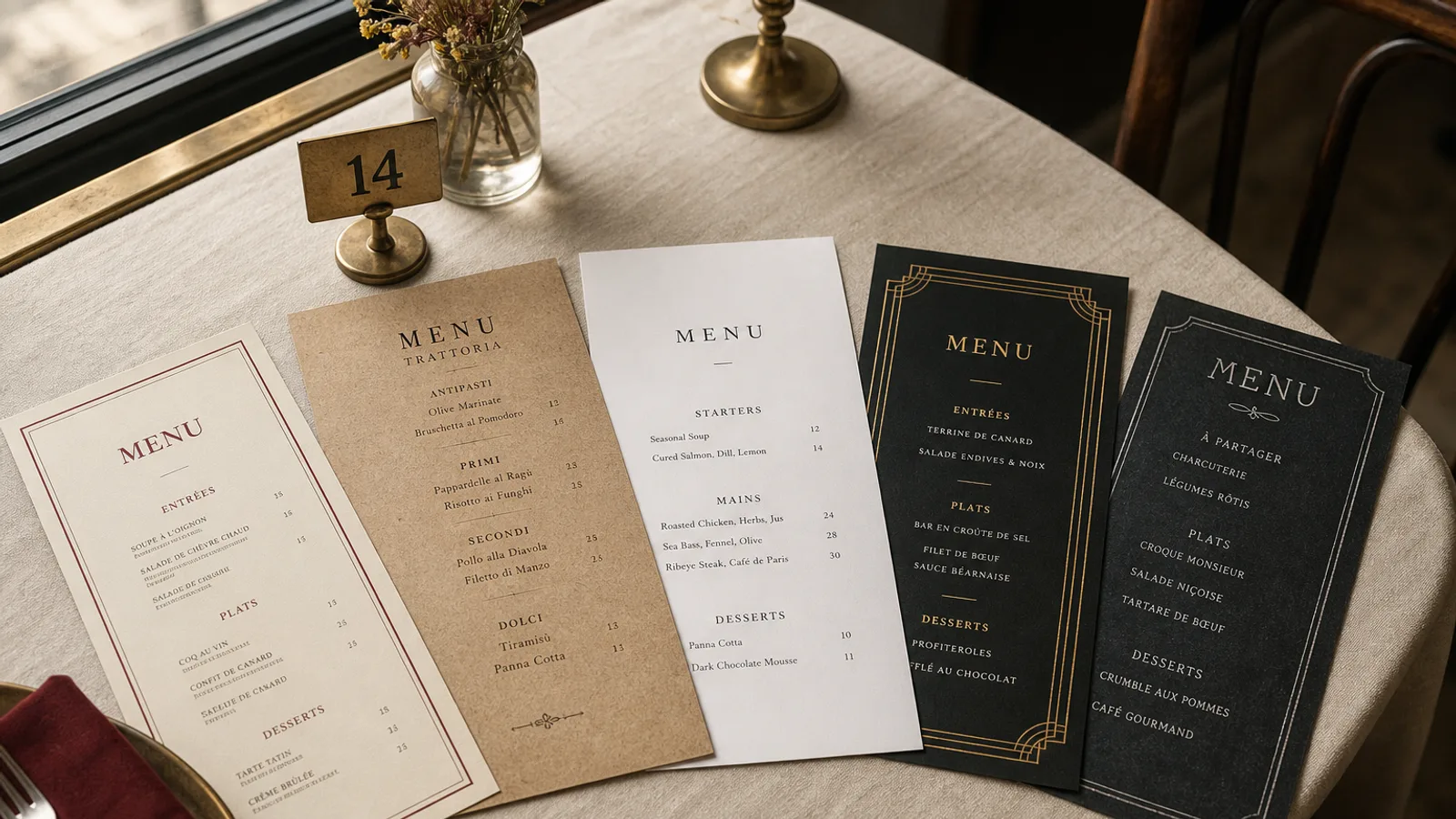
No other kitchen depends so much on what arrived at six this morning. A seafood restaurant that prints a fixed card is lying to half its guests by Thursday; one that writes everything on a chalkboard looks like it has no card at all. The answer is a menu built in two layers: a printed frame that carries the brand, the fixed dishes and the rules, and a variable part that changes with the boat. This article covers how to build that structure, how to price at market without looking evasive, and how to handle oysters, seasons and allergens on the same page.
Two layers: the frame and the catch
Think of the card as a picture frame. The frame is printed once a season on 350 g board: name, style, the dishes that never change (the fish soup, the fried calamari, the moules-frites), desserts, drinks, allergen key. The catch is an insert, an A5 sheet slipped into an A4 bifold or clipped to a single sheet, printed in-house every morning on decent 120 to 160 g paper, in the same typeface and the same grid as the frame.
The trick is to make the insert feel designed rather than improvised. Give it the same margins, the same heading style and a fixed title ("From the market, Wednesday 6 May") with the date in full. A dated insert tells guests the fish is fresh far more convincingly than the word fresh ever will.
Market price without the shrug
"Market price" printed on a card is the fastest way to make a guest nervous. Nobody wants to ask, and nobody likes the surprise. Three ways to keep honesty and avoid the shrug:
- Price per 100 g on the insert, with a typical portion size: "Whole sea bass, grilled, 7.90 € / 100 g, about 500 to 700 g for two". The guest can do the sum in their head.
- A price band on the frame, refined on the insert: "whole fish of the day, 32 to 48 € depending on size", then today's exact price on the insert.
- A fixed per-person price for whole fish where you portion in the kitchen: "sea bream for two, 34 € per person". Simplest, and preferred by most guests.
Whatever you choose, never print "MP" or "SQ" as an abbreviation. It reads as a code the guest is not supposed to understand, and Cornell's menu research on price presentation suggests that anything that forces a guest to ask lowers the chance of ordering it.
Oysters, shellfish and the platter
Oysters have their own grammar: origin, size, and price by the half-dozen or dozen. Set them as a small table with the origin as the row (Marennes-Oléron, Cancale, Galway), the size as a column (No. 3, No. 2), and the prices for 6 and 12. Sizes should be explained in one line under the table, because guests outside France rarely know that a No. 2 is larger than a No. 3.
The seafood platter is the hero and the most-photographed item on the card. Give it its own block with a one-line composition ("6 oysters, 4 langoustines, 200 g prawns, whelks, clams, half a crab") and two prices (for one, for two). If the platter changes with the catch, list the fixed base on the frame and "today's addition" on the insert.
Raw items and the allergen note
Regulation 1169/2011 makes fish, crustaceans and molluscs three separate allergens among the 14, and sulphites are common in the wine used in sauces. A seafood card must carry the full key, and the insert must be covered too: a permanent line on the frame ("today's dishes: ask us for the allergen sheet") plus an updated printed matrix at the pass is the compliant minimum. Add the raw-shellfish health advice on the frame in 7 pt, once, in the footer.
Seasons on the card
The most credible seafood menus do not pretend everything is available all year. A small seasonal marker next to the fixed dishes (a leaf, a month range, or simply "September to April" after scallops) does two things: it explains why a dish disappears, and it makes the ones that are present read as deliberate. Keep the marker typographic rather than pictorial; a tiny icon at 9 pt turns into a smudge on uncoated stock.
- Reprint the frame four times a year and change the seasonal header on the insert with it.
- Move the oyster table to the insert in summer if you stop serving them; an empty oyster block on a printed frame is worse than none.
- Wine: a short list leaning on Muscadet, Albariño, Vermentino and a crisp sparkling, priced by the glass with the measure in cl, is enough on the back face; a long list belongs on a separate card.
Paper, salt and wet hands
Seafood tables are wet. Lemon, brine, melting ice under the platter and finger bowls all reach the card eventually. Print the frame on 350 g matte board with a soft-touch finish that can be wiped; avoid gloss, which shows every fingerprint, and avoid very dark backgrounds, which show every drop of water. The insert can be lighter paper because it is replaced daily, but choose an uncoated stock in the same white as the frame so the two do not clash.
The Mediterranean style suits this kind of restaurant naturally: a warm white page, a single blue or terracotta accent, a serif with old-style numerals for the fixed dishes and lining numerals for the price table.
Printing the catch every morning without losing the design
The whole system depends on the insert looking as good on Wednesday as the frame did on the day it arrived. Fix the insert template once, lock the typeface and margins, and change only the lines. Keep the insert to twelve dishes or fewer; the point of a daily sheet is that it is short and current.
In Menu Atelier you can design the printed frame in A4 bifold and the daily insert in A5 from the same style and brand assets, check them together in 3D, download the frame as a 300 dpi PDF with bleed and crop marks for your print run, and keep the A5 insert file for your own daily print.