Sushi menus: sets, à la carte and omakase on one card
How to put lunch sets, a nigiri list and an omakase on one sushi card without the guest reading a catalogue or missing the chef's sequence.
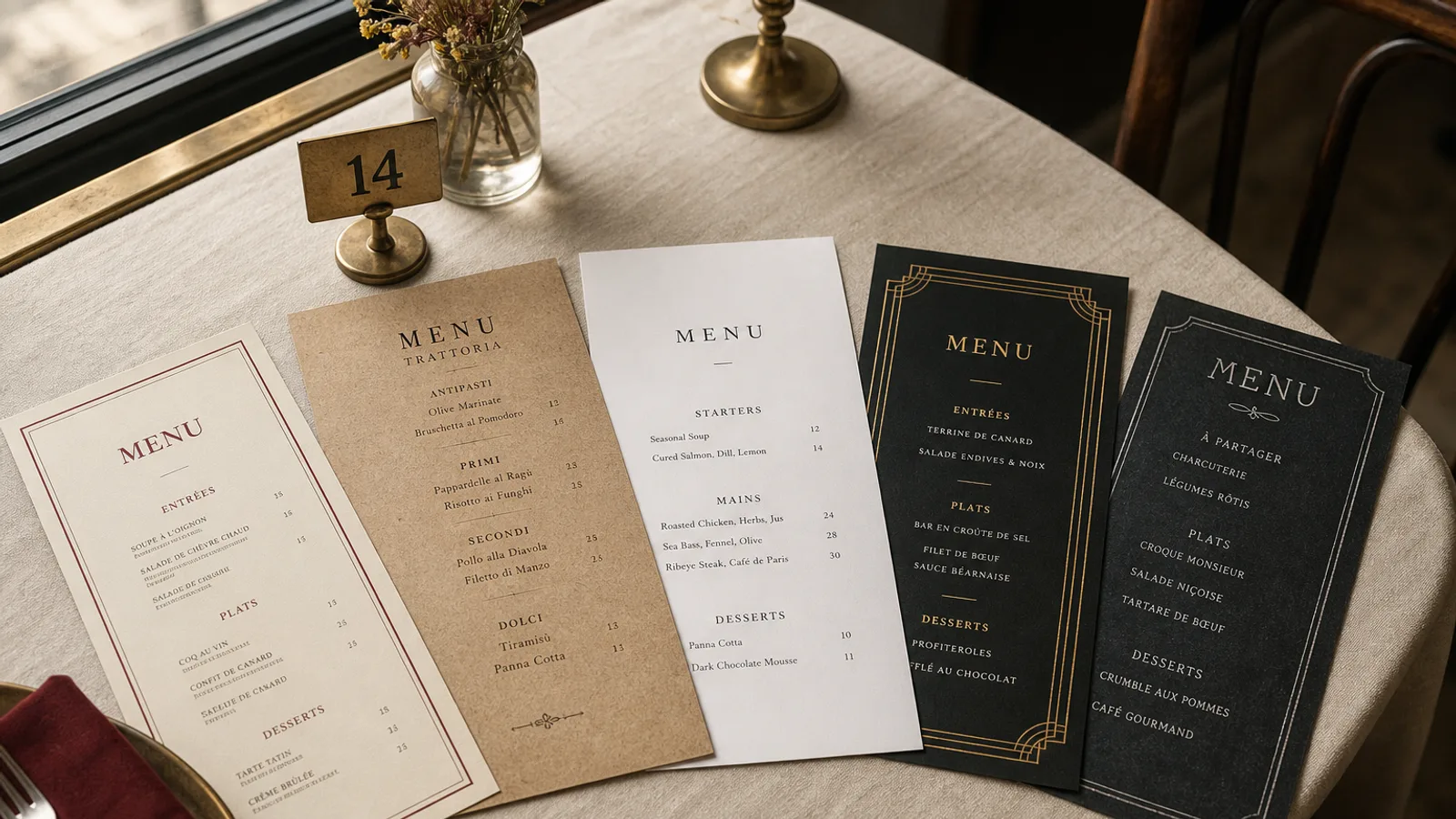
A sushi card has to do three jobs that fight each other. Lunch guests want a set they can point at in forty seconds. Evening guests want to build a plate from nigiri, maki and a few cooked dishes. A few people, often at the counter, want omakase and should not be made to feel they are choosing from a takeaway flyer. One card can hold all three if you give each a territory and refuse to list every cut of fish as a paragraph.
Sets first, because most people will order one
In Europe the lunch set is how a sushi room lives on a Tuesday. Put six to eight sets at the top of the first face or on the cover: a name, a short contents line ("6 nigiri, 6 hosomaki, miso, salad"), the price. 14 to 22 € is the usual lunch band; evening sets can sit higher. Do not hide the sets behind the nigiri list. The guest who came from the office will not hunt.
Name sets by contents, not by poetry. "Set salmon", "Set mixed", "Vegetarian set" outsell "Ocean breeze" and "Tokyo night". If a set includes a drink, say so on the same line. A set that looks cheaper because the miso is omitted in the small print is how you train people to ask the waiter, which at lunch you cannot afford.
The nigiri list is a column, not a novel
Nigiri should read as a column of names and prices, two pieces implied unless you say otherwise. Japanese name first or second, consistently, with the common name in the other position: "Salmon / sake 6 €". Add a one-word origin only when it changes the decision ("otoro, Spain" is useful; "carefully selected" is not). Sixteen to twenty-four nigiri is a real list; forty is a freezer catalogue.
Group by family if the list is long: white fish, oily fish, shellfish, tamago and vegetarian. A single alphabetised column of twenty-two is faster than six decorative boxes. Prices for two pieces, stated once at the head of the column so you do not print "2 pcs" on every line.
- Maki and uramaki in their own block, six to twelve lines, with the piece count (6 or 8) in the name or the header.
- Sashimi as portions (5 slices, 9 slices, mixed boat), not as a second nigiri list with the rice omitted.
- Cooked dishes (gyoza, karaage, a grilled fish) in a short third block; they are the safety net, not the identity.
Omakase needs a door, not a second booklet
Omakase is a conversation. On the card it should be a boxed block: the word, the number of pieces or courses, the price from, and a line that says it is served at the counter or by reservation. "Omakase, from 65 €, 12–16 pieces, ask us or book the counter." That is enough. Printing a sample sequence of twelve poetic titles next to the 8 € salmon nigiri makes the omakase look like another set and makes the set look cheap.
If you run a true omakase and a casual à la carte in the same room, consider a second small card for the counter only. Same paper, same type, no sets. Guests at tables never see it; guests at the hinoki do not have to look at a lunch formula.
Type that can hold Japanese and Latin without a fight
If you print Japanese names, pair a Latin serif or a clean grotesque with a Japanese face that matches the weight, and keep the Japanese at the same optical size, not as a whisper in 7 pt. If you cannot proof the kana, do not print them: a wrong stroke is worse than a missing one. All-caps Latin for every fish name looks like a sports bar. Sentence case, or a modest small-cap for section words (Nigiri, Maki, Sets), is the sushi register.
Colour: one dark (sumi, a warm black), the paper (warm white or a very pale cream), and at most one accent (a seal-red, a deep indigo). Photographs of nigiri on the card are almost always a mistake; they date, they flatten, and they make every piece look like the same photograph. The Sushi Zen habit is empty field, not a collage of salmon.
Allergens, soy and the raw fish note
Soy, gluten (in soy and some mirin), sesame, fish, crustaceans and egg sit on almost every line. Regulation 1169/2011 still wants a key. Number after the price, legend on the back in 8 pt. A one-line note on raw fish and, if you serve it, a note that soy contains gluten unless you offer a tamari, is clearer than a paragraph on the cover. Wasabi and pickled ginger are service; they do not need a menu line.
Paper that survives soy and a wet glass
Sushi tables collect soy drips and condensation. 350 g matte with a soft-touch finish wipes; uncoated 250 g stains on night one. A4 bifold holds sets on the cover or left inner, nigiri and maki on the right, drinks and omakase on the back. A5 double-sided works for a short list. Reprint when the fish list moves more than four lines; a dated insert for the day's arrivals is more honest than a laminated card that still lists shirako in August.
In Menu Atelier the Sushi Zen style is built for this split: a quiet field, a sets block you can lock at the top, a nigiri column, and an omakase box. You switch A4 bifold and A5 in one click, check the card in 3D, and download a 300 dpi PDF with 3 mm bleed or order the run on 350 g matte board.