Tall and narrow menus: DL and custom formats for bars and counters
When a tall, narrow menu beats A5: DL and 100 × 300 mm formats for bars, cafés and counters, with line lengths, type sizes, paper weights and the trimming costs of odd sizes.
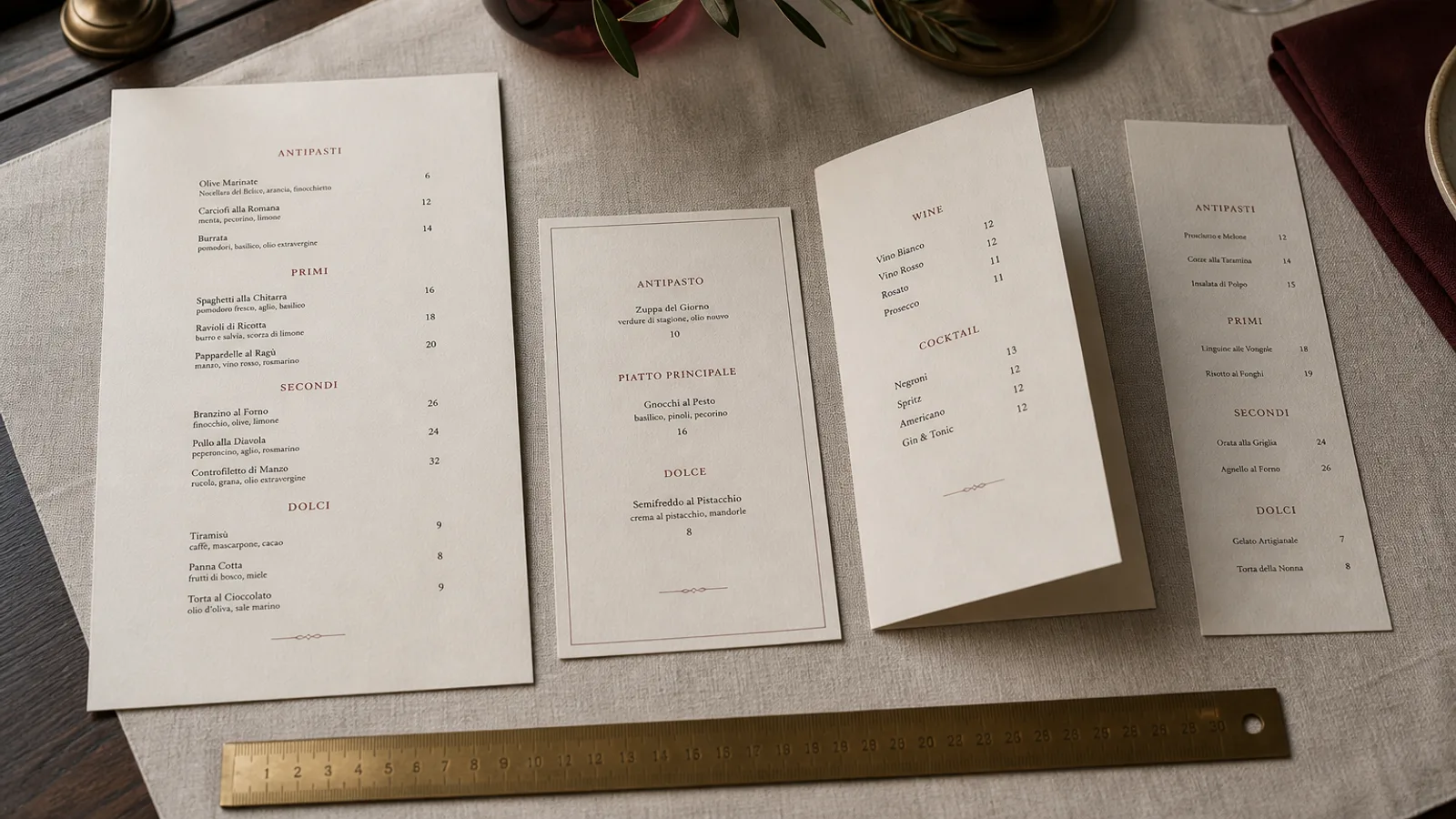
Stand at a bar with a drink in one hand and try to open an A4 bifold. That awkwardness is the whole argument for the tall, narrow menu: a card you hold like a phone, read in one column, and set down in a space the width of a coaster. The DL format, 99 × 210 mm, and its taller cousins are well suited to bars, cafés, counters and dessert lists, and badly suited to almost everything else. This is a guide to using them where they belong, with the numbers that make a narrow column readable and the trimming costs that odd sizes add.
The formats and where they come from
DL is a third of A4: 99 × 210 mm, the panel of a trifold and the size of a long envelope's contents. It is a standard cut, so printers stock it and trimming waste is low. Beyond DL, the useful narrow formats are 100 × 300 mm, 105 × 297 mm (a half A4 cut lengthways, sometimes called A4 long or 1/2 A4) and 120 × 320 mm. None of these is an ISO 216 size, so they are cut from larger sheets and priced as custom trims.
Proportion matters more than the exact numbers. A ratio of around 1:2 to 1:3 between width and height reads as a tall card; go narrower than 1:3 and the card starts to bend in the hand and text lines become too short for anything but a single word and a price.
The narrow column: line length and type
The constraint of a 99 mm wide card is line length. With 8 mm margins you have 83 mm of text width, which at 10 pt holds 28 to 32 characters. That is enough for a cocktail name and a price, or a short list of ingredients on a second line. It is not enough for a dish name, a two-line description and a price on the same line without wrapping into a ragged mess.
- Set the item name on its own line at 10.5 to 11 pt, the price on the same line flush right, and the description on the next line at 8.5 to 9 pt in a lighter weight or italic.
- Keep descriptions to one line of 30 characters or two lines at most. A narrow card punishes long copy immediately.
- Use a single column, always. Two columns on a 99 mm card give you 40 mm each, which is a receipt, not a menu.
- Leading can be tight, 12 to 13 pt on a 10 pt body, because the eye travels a short distance per line.
Vertical rhythm is what makes a tall card look composed. Give each section heading 14 to 18 pt of space above and 6 pt below, and let the list run in a single steady column from top to bottom. A tall card with 12 cocktails at 11 pt, a heading every four items and a footer at 8 pt fills a DL neatly; 25 items on the same card forces 8 pt type and defeats the format.
Paper weight: stiffness in one hand
A narrow card is held rather than laid flat, so stiffness matters more than on any other format. 300 g is the minimum; 350 to 400 g is better, and because there is no fold, the heavier board brings no cracking risk. Uncoated stock takes a pen for daily specials and does not glare under bar lighting. Double-sided printing is natural here: drinks on the front, snacks or the wine list on the back, with a small overleaf note at the foot.
If the card will live on a wet bar, a matte aqueous coating or a soft-touch varnish protects it without the plastic feel of lamination. Round the corners by 3 to 5 mm; on a tall card, sharp corners catch and dog-ear within days.
Custom sizes: what they cost you
Any size that is not an A-size or DL is a custom trim, and the cost shows up in three places. Paper waste: a 100 × 300 mm card cut from an SRA3 sheet (320 × 450 mm) yields only four per sheet with off-cuts, versus six DL cards from the same sheet. Setup: a custom cutting layout costs 15 to 30 € of make-ready on digital jobs. And accessories: menu holders, stands and sleeves are made for A-sizes and DL; a 120 × 320 mm card will not fit a standard holder, so you end up commissioning stands too.
The pragmatic route is to stay with DL or 105 × 297 mm unless a custom size is doing real work for the brand. Both are cut efficiently from A4 and SRA3 and fit off-the-shelf acrylic holders.
Where tall cards belong, and where they do not
- Cocktail and drinks lists: up to 15 items with one-line descriptions. The natural home of the DL card.
- Café counter cards: coffee, tea and pastries as three short sections on the front, opening hours and loyalty scheme on the back.
- Dessert and digestif cards brought to the table after the meal: a tall card at 350 g feels like an invitation rather than a form.
- Tasting menus: one column, one course per line, the card set standing in a holder or laid at each place.
- Not for a full food menu with descriptions: 20 dishes with two-line copy need an A5 bifold, not a taller and taller card.
One column, held in one hand
The tall card works because it is honest about its limits: one column, short lines, a handful of items, heavy board. Break any of those and it becomes a cramped brochure panel. Keep them and it is the most elegant format a bar or counter can put in a guest's hand.
Menu Atelier's core formats are A4 and A5, single sheet or bifold, which cover the dining room; for a bar list or dessert card, an A5 single sheet on 350 g board in a single column gets you most of the tall-card feel with standard holders and no custom trimming, and you can preview it in 3D beside your main menu to check the two read as one family.