Where to place high-margin dishes (the golden triangle is overrated)
Why the menu golden triangle is a weak guide, where high-margin dishes actually get ordered, and how to order each section after you have done the engineering.
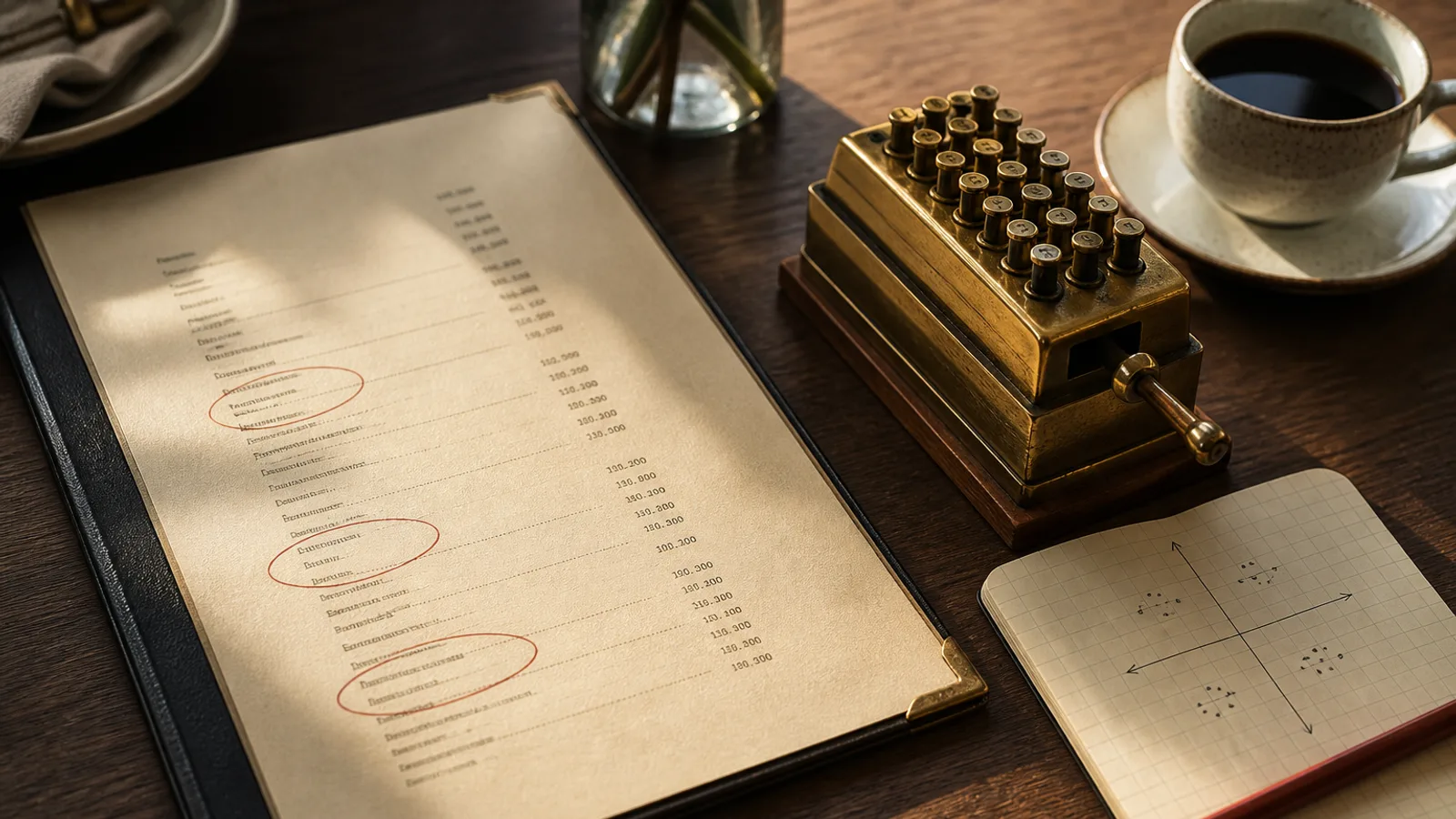
Every few years a slide deck rediscovers the golden triangle: the idea that the guest's eye lands in the middle of the right-hand page, then the top right, then the top left, and that you should park your stars there. It is a pleasant diagram. It is a poor brief. People do not scan a restaurant menu like a supermarket leaflet. They look for a heading they recognise, they read two or three lines, they ask a neighbour, they look at the waiter. Placement still matters. It matters inside a section, in a language the kitchen can live with, not as a treasure map printed on the card.
What eye-path folklore gets wrong
The triangle comes from old studies of printed advertising and from a few hospitality papers that measured first fixations on a two-page spread. Those first fixations last a fraction of a second. They do not decide the order. By the time a guest has found “Mains”, they are reading a list, top to bottom, the way they read a column of news. A bifold A4 is not a magazine ad. An A5 single sheet has no right-hand page at all. If your format is a single column, the triangle has nowhere to sit.
What does hold is primacy and recency inside a short list. The first dish in a section is ordered more than the fourth, all else equal. The last dish is remembered better than the middle. The middle is where plough horses can live without help. That is a typesetter's fact, not a mystic one. It works on a chalkboard and on a 350 g bifold.
Order each section by role, not by price
After you have marked stars, plough horses, puzzles and dogs, throw out alphabetical order and the habit of listing from cheapest to dearest. A price ladder trains the guest to shop. A role order trains them to meet the dish you can stand to cook at a margin you can stand to take.
- Position one: a star, or a puzzle you have rewritten so it can become one. Full description.
- Position two: a high-margin puzzle. This is the slot most owners waste on a second plough horse.
- The middle: the dishes people came for. Short lines. They will find them.
- Last line: a second star or a clean signature, not a dog you kept out of guilt.
If a section has eight mains, you do not have eight slots of equal value. You have two or three that the eye will actually negotiate. That is an argument for cutting the section, not for drawing a triangle on the proof.
Columns, bifolds and the false right-hand page
On a two-column A4, guests often finish the left column before they enter the right. Putting all the high-margin mains in the right column because a blog said “upper right” is how you hide them. Put the section heading where the column starts, and put the star immediately under it. If you have starters on the left and mains on the right of a bifold, the first main at the top of the right panel is your expensive real estate, not the optical centre of the spread.
Photos and boxes steal the path. One photograph will pull the eye off the list; give it to a puzzle, not to the burger that already sells. One box per face is a ceiling. Two boxes and a ribbon and a “chef's kiss” icon is a card that is shouting in three dialects. High-margin dishes do not need a costume if they have the first line and a sentence that names the one specific thing on the plate.
The kitchen's path is a placement rule too
A high-margin dish that clogs the pass at 20:30 is not a star. It is a future complaint. Placement that “works” on paper and fails on the line is failed engineering. Sit with the chef and ask which two dishes they can fire in volume without stealing the plancha from the plough horses. Those two get the early slots. The beautiful, slow, high-margin plate can sit later in the section or on a tasting line where the ticket time is expected.
Lunch is a different card. A formule du midi should put the high-margin main in the only slot that exists: the one under the heading, next to the two sides that actually get chosen. Do not reprint the dinner triangle onto a lunch sheet of twelve lines.
Measure after eight weeks, not after the first Saturday
Move a puzzle into position two, give it the longer line, leave the plough horses in the middle, and wait. One busy Saturday is weather. Eight weeks of till data, compared with the previous period, is a test. If the puzzle still does not move, the name or the plate is wrong; the slot was not magic. If it moves and the pass suffers, you have a kitchen problem the layout cannot solve.
- Do not move more than two dishes per section in a single reprint. You will not know what worked.
- Keep the heading language stable so regulars can still find the section.
- Re-run contribution margin, not only units. A newly popular dog is still a dog.
Put the money where the list begins
Forget the triangle as a layout religion. Treat each section as a short column with a valuable first line, a useful second line, a middle that can carry the favourites, and a last line that should not apologise. That is enough geometry for a restaurant.
In Menu Atelier the order you paste is the order on the card, so you can put the high-margin puzzle in slot two before you generate and see, in 3D, whether a bifold actually opens on that panel. Switching to a single column A5 often does more for those early slots than any diagram of a golden triangle.