The by-the-glass wine list: pricing, pour sizes and turnover on paper
How to build and lay out a by-the-glass wine list that turns over: how many wines, which pour sizes to print, glass versus bottle pricing and where the block sits.
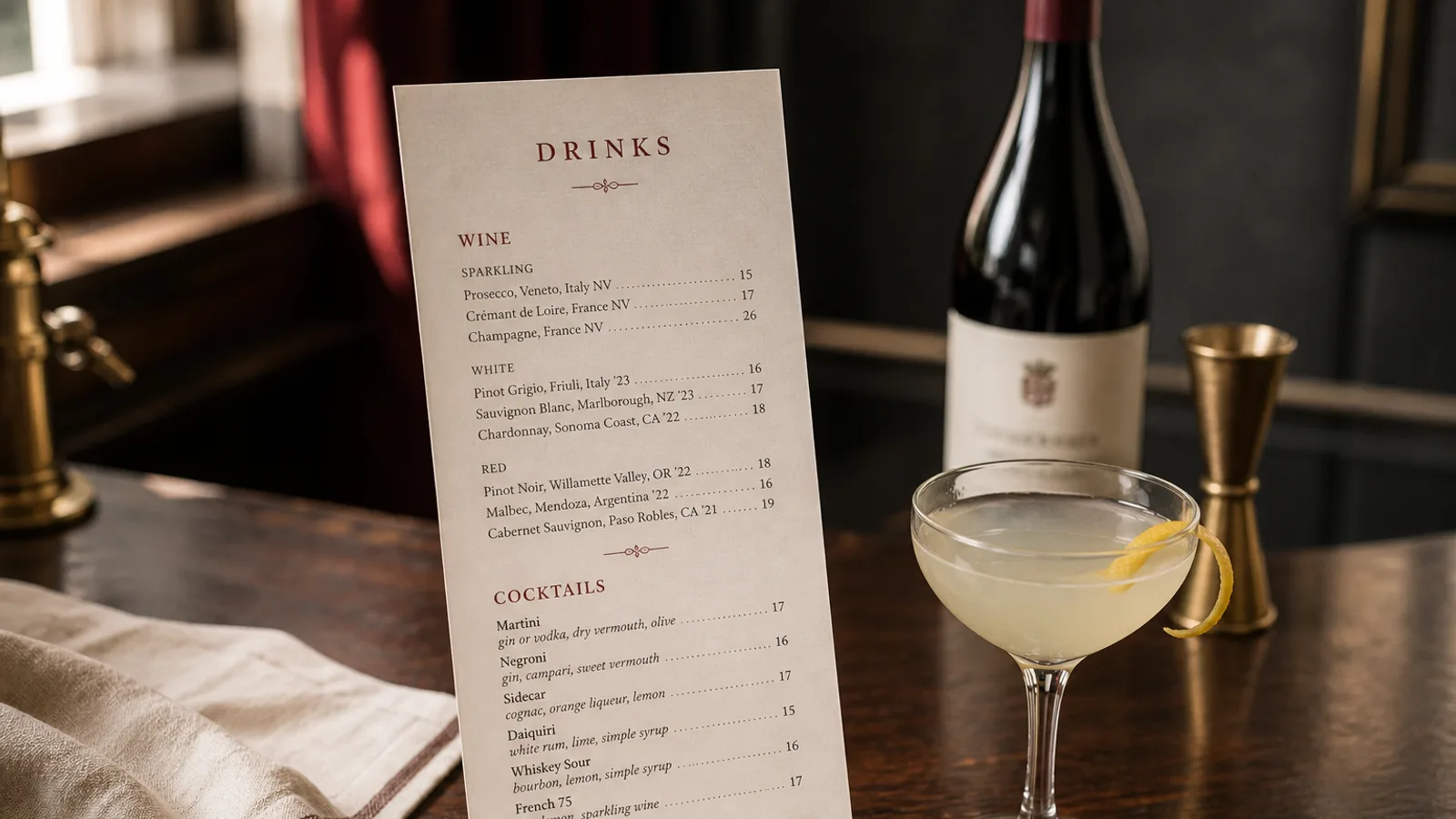
The by-the-glass list is the most read and least designed part of most wine menus. It is where the majority of tables actually order, it is where a stale bottle costs you money every night, and it is usually a cramped block at the top of the list with prices that nobody has thought about since the last supplier visit. This piece takes the list apart: how many wines to offer, which pour sizes to print, how to set the glass price against the bottle price, and how to lay out the block so it is read as an invitation rather than a table of numbers.
How many wines by the glass
The right number is the number you can keep fresh. An open bottle of still wine is at its best for two days, three with a preservation system, and a wine that sells one glass a night is poured flat on its fourth. For a 40-cover restaurant without a preservation system, that means 8 to 12 wines by the glass: two sparkling, three or four white, one rosé, three or four red, and a sweet wine on the dessert card. With an argon system or a Coravin, 15 to 20 becomes realistic and the list can carry one or two serious bottles by the glass at 15 € to 25 €.
Order the wines within each colour from lightest to fullest, not by price. Guests scan for a style; if they wanted the cheapest they would have found it anyway. Give each line the same information as a bottle on the main list: appellation or region, grape if it is not obvious, producer, vintage.
Pour sizes: print them, and print them once
In most EU countries you are required to indicate the volume served, and in every country the guest wants to know it. The standard pour in France, Italy and Spain is 12 to 15 cl; many places also offer a small glass at 7 to 10 cl and a carafe (25, 46 or 50 cl). A common mistake is to print the volume on every line (Chablis 12 cl 8 €, Chablis 15 cl 10 €). Print the sizes once as column headings and let each line carry only the prices.
- A single-size list (all glasses 12.5 cl): simplest to read and to pour; state the volume once under the heading.
- Two sizes (glass and large glass, or glass and carafe): two narrow price columns with a one-word header, prices aligned right.
- Three sizes (taste, glass, carafe): only worth it in a wine bar; on a restaurant menu the third column crowds the line and slows ordering.
Whatever you choose, the volume must match what the glass actually holds at the pour line. If your glasses have no pour line, get glasses with one; a 12.5 cl pour served by eye lands anywhere between 10 and 16 cl and destroys your margin or your reputation.
Pricing the glass against the bottle
The classic rule is that the glass price equals the bottle cost price: a bottle bought at 9 € is poured at 9 € a glass (five glasses of 15 cl), so the first glass pays for the bottle and the rest is margin. That gives a glass price of roughly one fifth to one quarter of the menu bottle price. Guests recognise this arithmetic; a glass priced at a third of the bottle looks like a penalty for not committing, and a table of two will buy the bottle and drink less of it happily.
Show the bottle price on the same line as the glass price, in a second column. Seeing 9 € and 38 € side by side helps a table of four choose the bottle, which is what you want; seeing only the glass price makes them count glasses. Use whole euros or half euros (8, 8.50, 9), never 8.90; wine is not a supermarket item.
The premium glass
One or two wines by the glass at 15 € to 25 € do more than sell themselves: they make the 9 € glass look reasonable and they tell the guest that your list is serious. Choose wines with a story (a grower Champagne, an aged Rioja, a Barolo) and keep them under preservation. If the list has no premium glass, the most expensive glass becomes the one guests avoid.
Layout: where the block sits and how it reads
Put the by-the-glass list at the front of the wine list, on its own page or in a clearly bounded block, because it is what most tables will read first. In a restaurant without a separate wine list, it belongs on the back of the food menu or in a column beside the mains, never in the footer. Set the block in the same type family as the rest of the menu, body size 10 to 11 pt, with a hairline rule or 4 mm of space between colours.
Align prices right in narrow columns with the size headings above them, and drop dotted leaders: the distance between a short wine name and its price is small enough that the eye crosses it without help. Use old-style or tabular figures consistently so that the price columns line up vertically; proportional figures make a column of prices look ragged.
Turnover: the list is a stock document
A by-the-glass list should change more often than the bottle list. Rotate at least two wines a month, seasonally at minimum (lighter reds in summer, richer whites in winter), and use the rotation to move stock: a bottle you are overstocked on becomes the glass of the month. Because the list changes, print it as a separate A5 or DL insert or as a single face of the drinks menu that can be reprinted alone for a few euros a copy, rather than as part of a bound wine book.
Track glasses poured per bottle. If you are consistently getting four glasses out of a 75 cl bottle at a 15 cl pour instead of five, you are over-pouring by 25 percent, and the design fix is a pour line on the glass and a printed volume on the list that staff can point to.
A short list that turns over every two days
Eight to twelve wines you can finish in two days, one premium glass, one printed pour size, glass and bottle prices side by side, a block at the front of the list in the same type as everything else, and a reprint every month. That is a by-the-glass programme, and it is the part of the wine list that pays the rent.
In Menu Atelier, a by-the-glass block can be laid out with two price columns and a single volume note under the heading; the design reflows when you switch the list from an A4 sheet to an A5 insert, and you can order a small run of the insert alone when the wines rotate.