The chef's note: writing a short menu introduction guests actually read
How to write a chef's note or menu introduction that earns its place: length, what to say, what to cut, where it sits on the card and how to set it so it reads in a dim room.
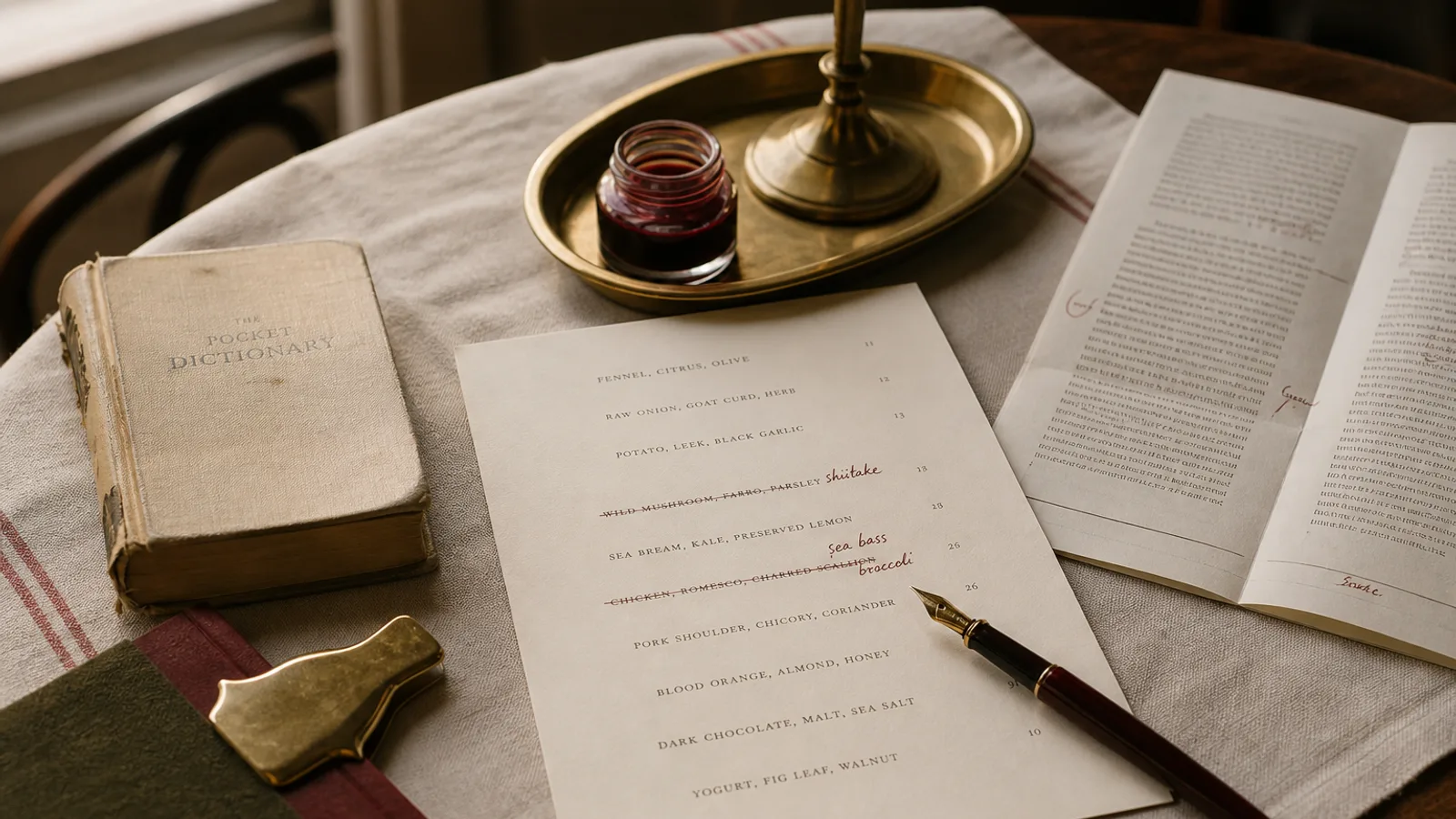
A chef's note is the one paragraph on a menu that is not selling a dish, which is exactly why it is so often badly written. Freed from the discipline of naming ingredients and prices, it drifts into passion, journeys and philosophies, and the guest skips it after the first line. Yet a good note, sixty to ninety words in a plain voice, does something no dish line can: it tells the guest how to eat here tonight. This article covers what a note is for, the four things worth saying, the length and placement that get it read, and the sentences to strike out.
What the note is for
The note has three legitimate jobs, and it should do at least one of them clearly. It can explain how the menu works when the format is not obvious: sharing plates, a market menu that changes daily, a tasting sequence. It can situate the kitchen in a place and a season in a way individual dishes cannot: the region, the producers, what is good this month. And it can set the register for the evening, so the tone of the dish descriptions makes sense.
What it is not for: telling the chef's life story, thanking the guest for coming, describing the restaurant's philosophy in the abstract, or listing values (fresh, local, seasonal, honest) that every restaurant claims. A guest who has already sat down does not need to be convinced to be there. She needs to be helped to order.
The four things worth saying
A note that works usually contains two or three of these, in two to four sentences. Rarely all four; never none.
- How to order. "Dishes come as they are ready and are made to share; three per person is about right." Or: "The menu changes with the market; what is written is what we have today." One sentence, practical, no apology.
- Where and when. "We are in the middle of the artichoke season, and the lamb is from the hills above the village until the end of June." A specific place and a specific month do more than the word seasonal ever will.
- One thing to notice. A single dish, a technique, an ingredient you want to draw attention to: "The bread is baked at four in the afternoon and is at its best around eight." This is the note's chance to sell something.
- One line of voice. A sentence that sounds like a person rather than an institution, in the same register the dishes use. Warm if the menu is warm; dry if the menu is dry. This is where a little humour is allowed, if that is your house style.
Sign it, or not, but be consistent: a note signed with a first name reads as a person speaking; an unsigned note reads as the house. Both work. A signature in a script typeface that imitates handwriting does not; it reads as a greeting card.
Length: sixty to ninety words, and why
The evidence from anyone who has watched guests read menus is consistent: a block of text longer than five or six lines at menu type size is skipped. At 9 pt in a 90 mm column, that is around 60 to 90 words. Write more and the note becomes a wall the eye slides past on its way to the prices. Write less than thirty and it is a slogan, not a note.
Short sentences help more than short words. Fifteen to twenty words per sentence, at most one subordinate clause, no semicolons. The note is read standing at the door, or sitting with a coat still on, in the first minute; it should be understood at that speed.
Where it sits on the card
On a single sheet, the note goes at the top, under the restaurant name and before the first section heading, spanning the full width or the left column. On a bifold, it belongs on the inside left page, at the top, where the eye lands when the card is opened; the right-hand page is for the dishes you most want to sell and should not be spent on prose. The back cover is the wrong place: a note there is read, if at all, after ordering.
Give it a different texture from the dish lines so it is recognised as a different kind of text: italic at 9 to 9.5 pt when the body is 10 pt roman, or the same roman set in a measure that is visibly narrower than the columns below. Leading slightly more open than the body (12 pt on 9 pt type is comfortable). No box, no background tint, no quotation marks around the whole thing: those devices announce "marketing copy" and are skipped accordingly.
Sentences to strike out
Some phrases appear in so many chef's notes that they have stopped meaning anything. Cutting them is the fastest way to improve a draft.
- "Our passion for…": passion is demonstrated by the food, not declared on the card. Replace with the specific thing you are passionate about, named.
- "A culinary journey" and "an experience": a dinner is a dinner. If the meal is a sequence, say how many courses and how long it takes.
- "Fresh, seasonal, local ingredients": three words every restaurant uses. Replace with a season, a place and a producer, or delete.
- "We hope you enjoy": pleasant, empty, and it puts the guest in the position of judging. Cut it and end on the practical line instead.
- "Since 1987" in the note when it is already in the logo. Once is heritage; twice is insecurity.
Keeping it current
The note's great advantage over a mission statement is that it can change. A note that names the month and the produce has to be rewritten each time the card is reprinted, which is a discipline, not a burden: it forces the kitchen to say what is actually good now. If your card changes every six weeks, the note changes every six weeks. If you cannot commit to that, write a note without a date in it, but keep the how-to-order sentence and the one thing to notice.
For bilingual or translated cards, the note is the one piece of copy where you can allow the register to differ between languages, because it is a voice rather than a specification; but the practical sentence about how to order must be in every language, verbatim in meaning.
A paragraph that earns its lines
The chef's note is prime real estate at the top of the page. It earns it when it tells the guest how to eat here, where the food comes from this month, and what to look out for, in a voice that sounds like a person, in under ninety words. It loses it the moment it starts talking about passion. Write it last, after the dishes, when you know what the card actually says, and read it aloud once before it goes to print.
In Menu Atelier the mood sentence you write when starting a design can be carried onto the card as an introduction block, placed at the top of the inside left page on a bifold or under the header on a single sheet, and set in the introduction style of your chosen theme; the block reflows when you switch format, and you can see in the 3D preview whether it still reads at five lines or fewer.