Menu copy for tourist areas: clarity without dumbing down
How to write restaurant menu copy in tourist areas that guests from anywhere can order from, without flattening the dishes or sounding like a guidebook.
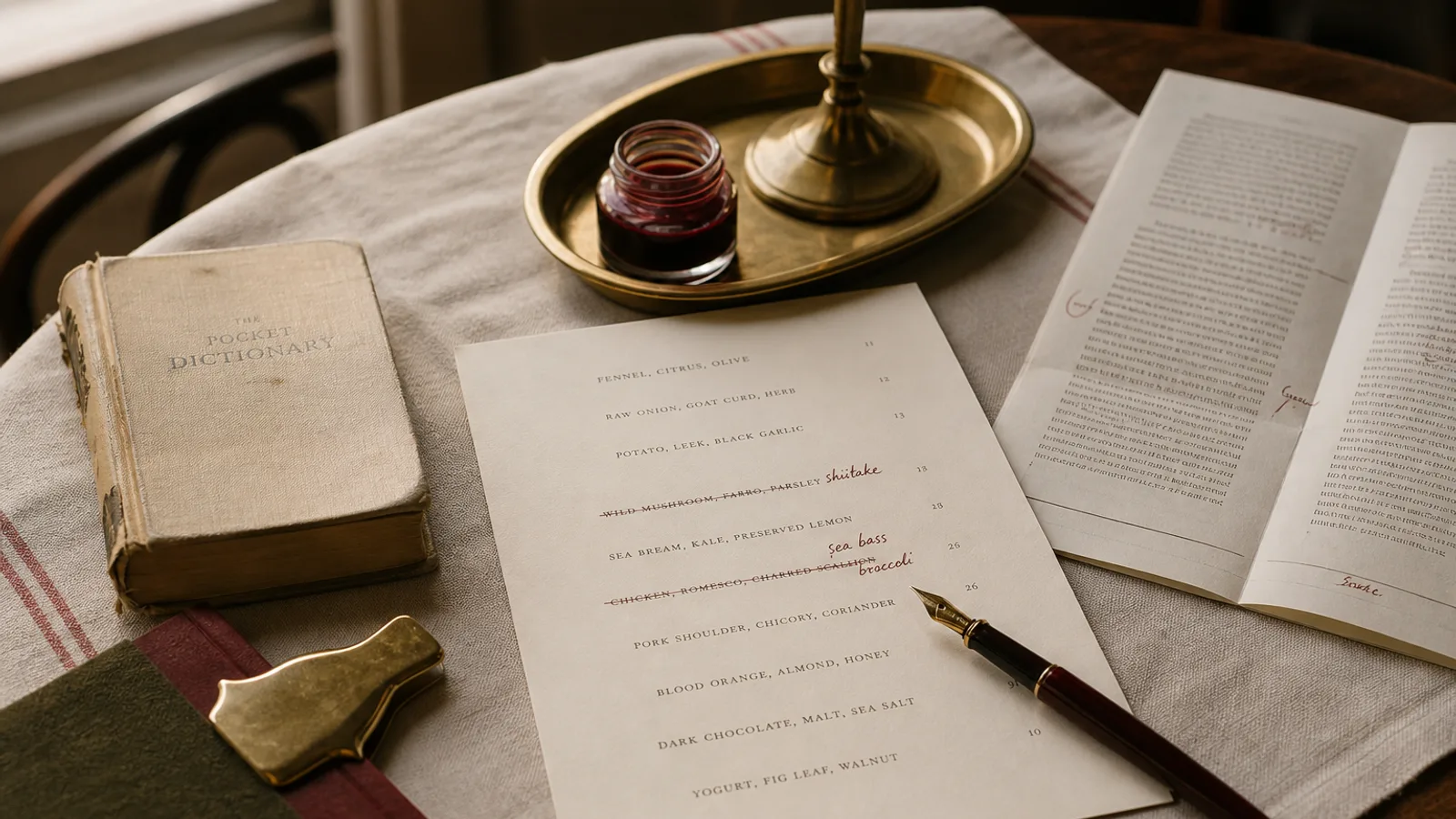
A table of guests who do not speak the local language will order from the first line they understand. If that line is a joke, a dialect name or a chef’s invention with no translation, they will skip it and pick the next thing that looks safe. In a tourist area this happens all evening, and the kitchen spends the night cooking the same four dishes. The fix is not to write a children’s menu. It is to write a grown-up card that a stranger can read in ninety seconds.
What a tourist actually needs on the line
A guest from elsewhere needs three facts: what the dish is, what is in it, and roughly how it is cooked or served. They do not need the story of the farm or a pun on the region. Put the protein or the main vegetable first, then the method, then the garnish. “Grilled sea bream, fennel, lemon, olive oil” is enough. “Our fisherman’s catch of the day, kissed by the Mediterranean breeze” is not a dish; it is a postcard, and it will be skipped.
Keep descriptions between six and eighteen words. Under six, a foreign guest cannot tell a stew from a grill. Over eighteen, they stop reading and look at the neighbouring table. If a dish has a local name that matters — bouillabaisse, osso buco, gazpacho — keep the name and put the plain description underneath in 9 or 10 pt, not in parentheses after the title. Parentheses are where tourists stop trusting you.
Names that travel, names that do not
Dialect and house names are fine on a card used by regulars. On a card used by people who landed that morning, they are a closed door. If the dish is called “the captain” or “nonna’s Sunday”, write the real dish on the next line in the same typeface, one size smaller. Do not hide it in a footnote. The guest who has to hunt for meaning will not hunt; they will order pizza.
Protected names should stay exact: Parmigiano Reggiano, Comté, Jamón Ibérico. Invented Italianate or Provençal names for dishes that are not those things should go. A tourist who knows the real word will notice; a tourist who does not will still feel the card is trying too hard. One invented name on a card of twenty is charm. Eight is a theme park.
How many languages, and where
Two languages is the useful maximum on a printed card. A third language belongs on a separate card or on a QR companion, not in a third column that shrinks every description to six words. The local language leads; the second language sits under it, same structure, slightly smaller, never in italic unless the whole secondary language is italic. Mixing English, French and German on one line with slashes is unreadable at 9 pt in restaurant light.
If your room is mostly one foreign language — English on the Côte d’Azur in July, German in the Dolomites, French in Barcelona in August — print that language as the second voice, not a generic English that nobody in the room speaks well. A bilingual card that matches the actual guests beats a four-language leaflet that looks like an airport departure board.
- Lead with the local name; put the translation on the line below, not after a slash.
- Keep both languages in the same sentence order: name, method, garnish, then price.
- Put the allergen legend and the cover or service charge in both languages, not only the local one.
- Do not translate protected designations; translate the surrounding sentence.
What not to simplify
Clarity is not the same as talking down. Do not replace “confit” with “cooked slowly in fat” if the guest who cares already knows the word and the guest who does not will understand “duck, slow-cooked, garlic, thyme”. Do not write “spicy!!!” or “very popular with tourists”. Do not add little flags next to dishes. Do not mark “safe choices” or “adventurous”. Those marks tell a guest they are being managed, and they order the grilled chicken.
Allergens stay exact. Regulation 1169/2011 does not relax because the table is foreign. The fourteen substances must be declared in a language the guest can use; if the card is bilingual, the legend is bilingual. A number system with a key at the foot of the page works if the key is large enough to read at 7 pt minimum, preferably 8. A pictogram-only legend without words fails the guest who has never seen your icons.
Prices and the tourist suspicion
Tourists assume two menus. The only way to kill that suspicion is one card, one price list, printed, with tax and service stated in both languages. If you have a formule du midi or a menú del día, write the hours and the rules on the same card, not on a paper insert the waiter decides whether to bring. A cover charge or pane e coperto must appear as an amount, not as a surprise on the bill.
A card a stranger can finish
Write the card so a guest who has never been to the country can order the dish the kitchen is proud of, not only the dish whose name they already know. That means a real name, a short factual description, a second language used with discipline, and no cute marks that sort guests into brave and timid. The cooking can stay local. The sentences have to travel.
In Menu Atelier you can keep two languages on each dish and switch the card from a single A4 sheet to an A5 bifold in one click, which is the usual way a tourist-area room keeps a short lunch card and a fuller evening card without rewriting the copy twice.