Cocktail menu design: descriptions, spirits and the signatures
How to write and lay out a cocktail list: short descriptions, a signature block that earns its place, classics that do not apologise, and spirits that stay off the card.
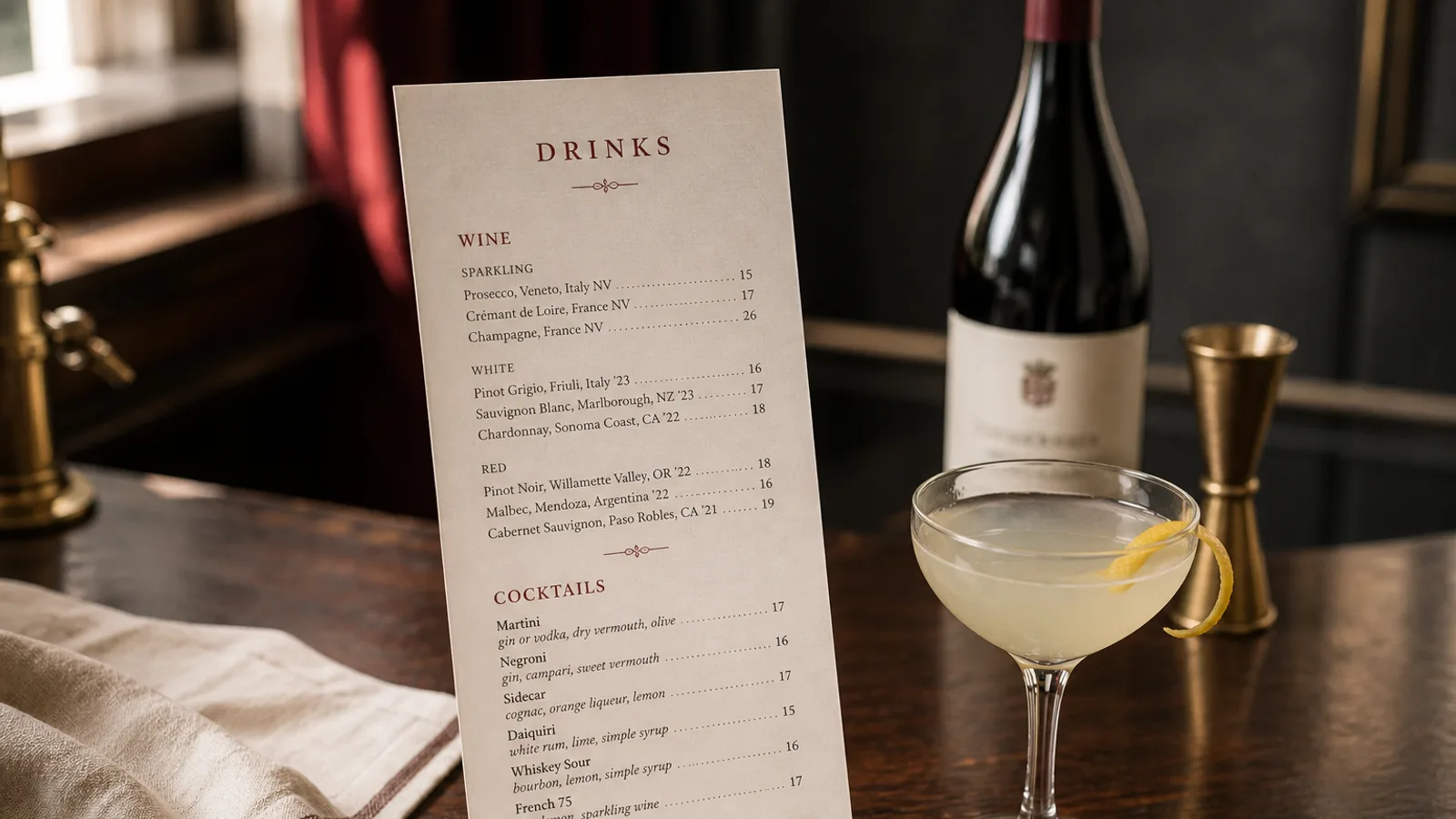
A cocktail list is a set of recipes the guest will never cook. They need a name they can say, a reason to want it, and a price. Everything else is the bartender talking. Most lists fail by writing a paragraph for each drink and then adding a second page of whiskies "in case". The useful card is twelve to eighteen cocktails, grouped so the eye can rest, written so a guest who does not know a Last Word still orders something they will like.
Signatures first, and they must be signatures
Six to eight house drinks at the top. If they read as slight twists on a Daiquiri with a new name, they are not signatures; they are classics in costume. A signature needs one idea a guest can hold: a spirit, a local ingredient, a technique, a glass. "Rhum agricole, green walnut, lime, soda" is a description. "Our take on a tropical classic, bright and refreshing with a hint of the orchard" is a press release. Cut the press release.
Name the drink in a way the waiter can hear across the bar. Two words beat five. Avoid names that are only funny once, and avoid names that collide with a classic (calling a gin drink "Negroni" because it is red). Price the signatures in the same band as the classics, or a euro or two above, not in a VIP column that trains people to skip them.
The description is a shopping list, not a mood
The honest cocktail line is name, then spirit plus two or three modifiers, then price. Optionally a glass ("coupe", "highball") if the shape changes the drink. ABV or a low-ABV mark when it matters. That is enough for a guest and enough for a new bartender to remember the build. Adjectives earn a place only when they prevent a mistake: "spicy", "smoked", "very dry", "contains egg white". "Elegant" and "playful" prevent nothing.
- One type size for names (12 pt), one for the build (10 pt), one for the price (same as the name). A third decorative face for "notes" is how lists become posters.
- Allergens (egg, nuts in orgeat, milk, sulphites in wine-based drinks) as a number after the price, legend on the back.
- A low-ABV or no-alcohol section with the same description style, not a pity line that says "mocktail" in a smaller face.
Classics without apology
Four to six classics belong on the card so the guest who wants a Martini is not made to feel they failed the list. Write them as you write the signatures: name, build, price. You may omit the build on a Negroni if the room is sure; you should not omit it on a house Martini if you pour it wet, with olive, at a fixed spec. "Martini — our spec, ask" is allowed. A paragraph on the history of the Martinez is not.
Do not print "available on request" for twenty more classics. That sentence is a second menu the guest cannot see. If you will make a Whisky Sour, either list it or train the floor to offer it. A ghost list makes the printed card feel unfinished.
Spirits are a second document
A pouring list of forty whiskies, twelve agaves and the gins belongs on a second small card or in the bartender's head until asked. On the cocktail card, spirits steal attention from the drinks you designed. If you must show a short spirits block, keep it to six or eight bottles that are not already implied by the cocktails, with a single price for a standard measure in cl. A flight is a line ("mezcal flight, 3 × 2 cl, 18 €"), not a tasting booklet stapled to the Daiquiris.
Group so the indecisive can stop
Group by idea (bright, stirred, long, low ABV) or by base spirit, not by a rainbow of icons. Four groups of four is readable; one list of eighteen is a wall. A guest who wants "something like a Negroni but not a Negroni" should land in the stirred section, not hunt. Beer and wine, if they share the card, take the back face in a compact list. They are not cocktails and should not interrupt them.
Type and paper for a list that will change
A condensed serif or a sturdy grotesque, 11 to 12 pt on names, plenty of night-time contrast. Dark card or cream: pick one and test under the actual lamps. 350 g matte, soft-touch, A5 or a tall narrow sheet. Design the signatures as a block you can swap when a bottle runs out, without redrawing the classics. Reprint monthly; a cocktail list that still names last winter's amaro in May is a list on autopilot.
In Menu Atelier the Art Deco Cocktail style holds a signature block, a classics column and a low-ABV section without turning the card into a poster. You switch A5 and a tall single sheet in one click, check it in 3D, and download a 300 dpi PDF with 3 mm bleed or order the run on 350 g matte board.