Dessert and digestif menu design: the last card of the evening
How to design a dessert and digestif card that gets read after a full meal: one-page layout, pairing desserts with sweet wines and spirits, coffee placement and pricing.
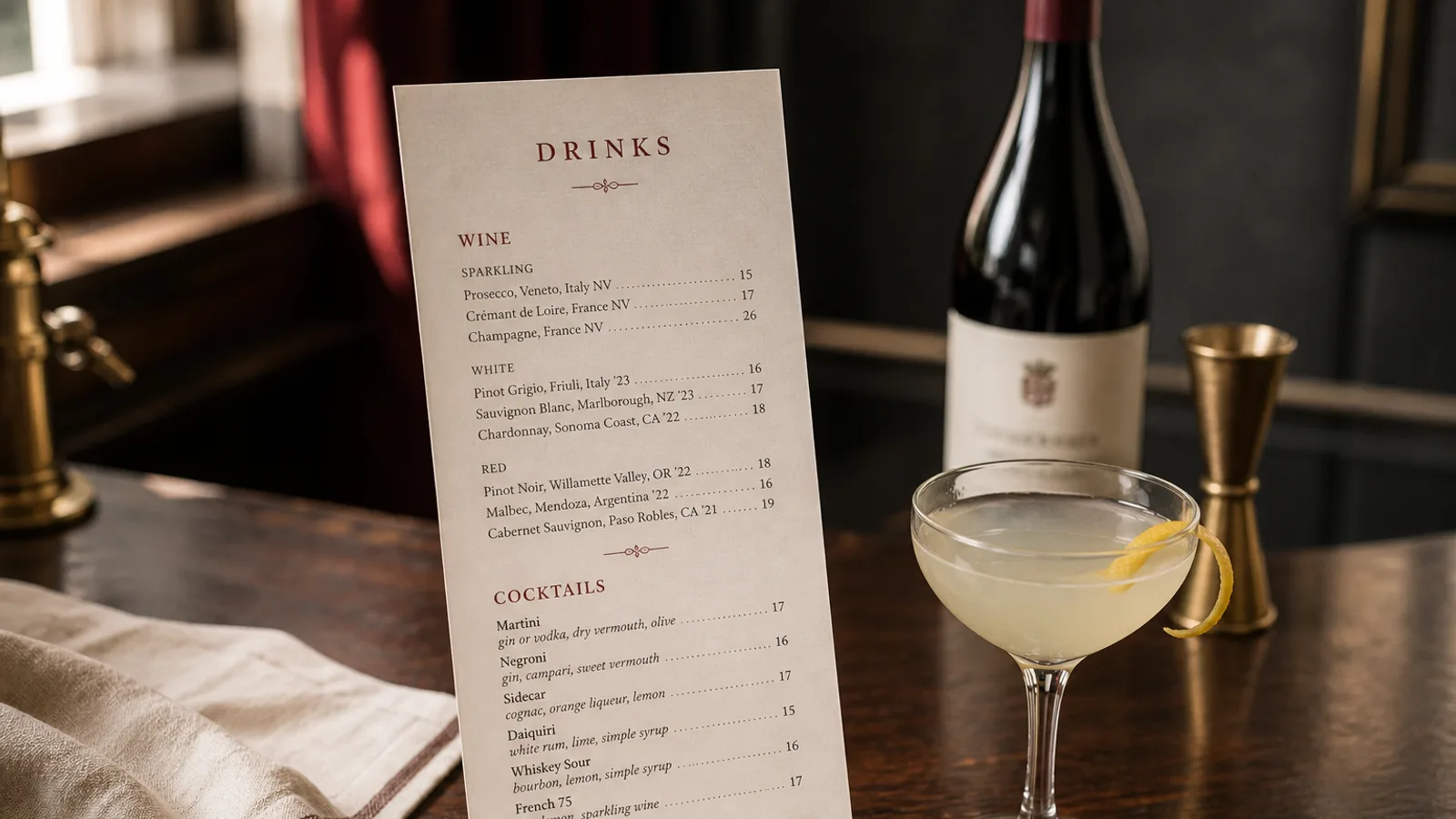
The dessert card is handed to guests who have already eaten and already spent. They are relaxed, slightly full, and looking for a reason to stay ten more minutes. That is a different reader from the one who opened the main menu hungry, and it deserves a different piece of paper: shorter, warmer, and combining sweets with the drinks that go with them. Here is how to structure that card so that a table of four leaves 40 € more than they would have with a bare list of five desserts.
One card, not two
The single most effective decision is to put desserts, dessert wines, digestifs and coffee on the same card. When the sweet wines live on the wine list and the digestifs on the back of the drinks menu, nobody sees them at the moment they matter. A combined card puts a glass of Sauternes next to the tarte and a grappa next to the espresso, and the guest reads them as one decision rather than three.
This card should be small. An A5 single sheet, printed on both sides, is enough for most restaurants: desserts and cheese on the front, drinks on the back, or desserts on the left and drinks on the right of an A5 bifold if you want it to stand on the table. It should never be A4; a full-size card at the end of the meal feels like homework.
The desserts: fewer, described better
Five to seven desserts is the right number. Beyond that, the pastry section cannot keep everything fresh and the guest cannot choose. Order them from lightest to richest (fruit, then dairy, then chocolate), with cheese at the end or in its own small block. Describe each in one line that names the main components and the texture: warm, crisp, frozen, set. Guests at dessert are choosing by texture as much as by flavour.
Give the house dessert, the one you are known for, a slightly longer description or a discreet marker, but do not box it. A single dessert priced 1 € to 2 € above the others, with a real story behind it, will outsell the rest without any decoration.
Pairing lines under desserts
The most productive line on the whole card is the small italic under each dessert that names a glass: with a Maury, a late-harvest Riesling, a Pedro Ximénez, an aged rum. Set it one point smaller than the description, with the price of the glass. Three or four pairings across the card are enough; do not pair every dessert.
The drinks side: structure by how the evening ends
Group the back of the card in the order a guest might take them: sweet and fortified wines first (by the glass, 5 to 7 cl pours, 7 € to 15 €), then spirits and liqueurs (brandy, grappa, whisky, amaro, eaux-de-vie), then coffee and tea. Within spirits, group by family and order by price, and give each line the producer, the age or style and the volume. State pours once at the top of the section (all digestifs served in 4 cl) rather than on every line.
- Sweet and fortified wines: 4 to 6 by the glass, at least one white, one red, one sparkling or Moscato d'Asti
- Spirits and liqueurs: 8 to 12 lines, arranged by family, with one or two premium bottles that justify the top of the range
- Coffee and tea: espresso, double, decaf, one filter or French press, three or four teas by family, and a hot chocolate in winter
- A single line for the coffee-and-digestif pairing (an affogato, a caffè corretto, an Irish coffee) if you serve one
Typography for a tired reader
Lighting is lower at 10 pm than at 8 pm, and the guest has had wine. Size the type at least half a point larger than the main menu: 11 pt body, 12.5 pt or more for dessert names. Increase line spacing to 1.4 or 1.5. Choose a paper with warmth (natural white or cream, 300 to 350 g uncoated or soft-touch) and avoid glossy finishes that reflect candles. A dessert card is the one menu where a small ornament, a tinted background or a hand-drawn touch feels right rather than fussy.
Prices sit at the end of the line in the same size as the description, without leaders. Keep the number of price points small: if all your desserts are 9 € or 11 €, say so and let the pairing line carry the variation.
Pricing the last 20 minutes
A dessert at 9 €, a 5 cl glass of sweet wine at 9 € and an espresso at 2.50 € add 20.50 € to a cover on food that costs perhaps 2 € to make. Across a table of four where only two would have ordered dessert from a bare list, a combined card that persuades three of them to take a dessert and two to add a glass adds 40 € or more. The card pays for itself on its first night.
Do not offer a dessert menu with three courses of sweets or a coffee-gourmand tray unless the kitchen can do it well; a mediocre assortment undermines the whole card. One excellent gourmand plate at 12 € to 14 € is a better upsell than four mediocre mini-desserts.
Bringing the card at the right moment
The card should arrive with the plates cleared, unasked, and before the question about coffee. Servers who ask whether anyone wants dessert get a no; servers who set down a warm, small, beautifully printed card get a pause and a look. Train the room to present it every time. The design does the selling; the server only has to deliver it.
In Menu Atelier, a dessert and digestif card is a compact A5 design that shares the styling of your main menu; you can build it as a double-sided single sheet or a small bifold, view the two faces in 3D, and download the print bundle or order it printed on 350 g matte board with a soft-touch finish.