The future of restaurant menus: paper, screens and what guests will want
A grounded look at where restaurant menus are heading: what the QR decade taught us, where screens belong, why paper is not going anywhere, and what to invest in now.
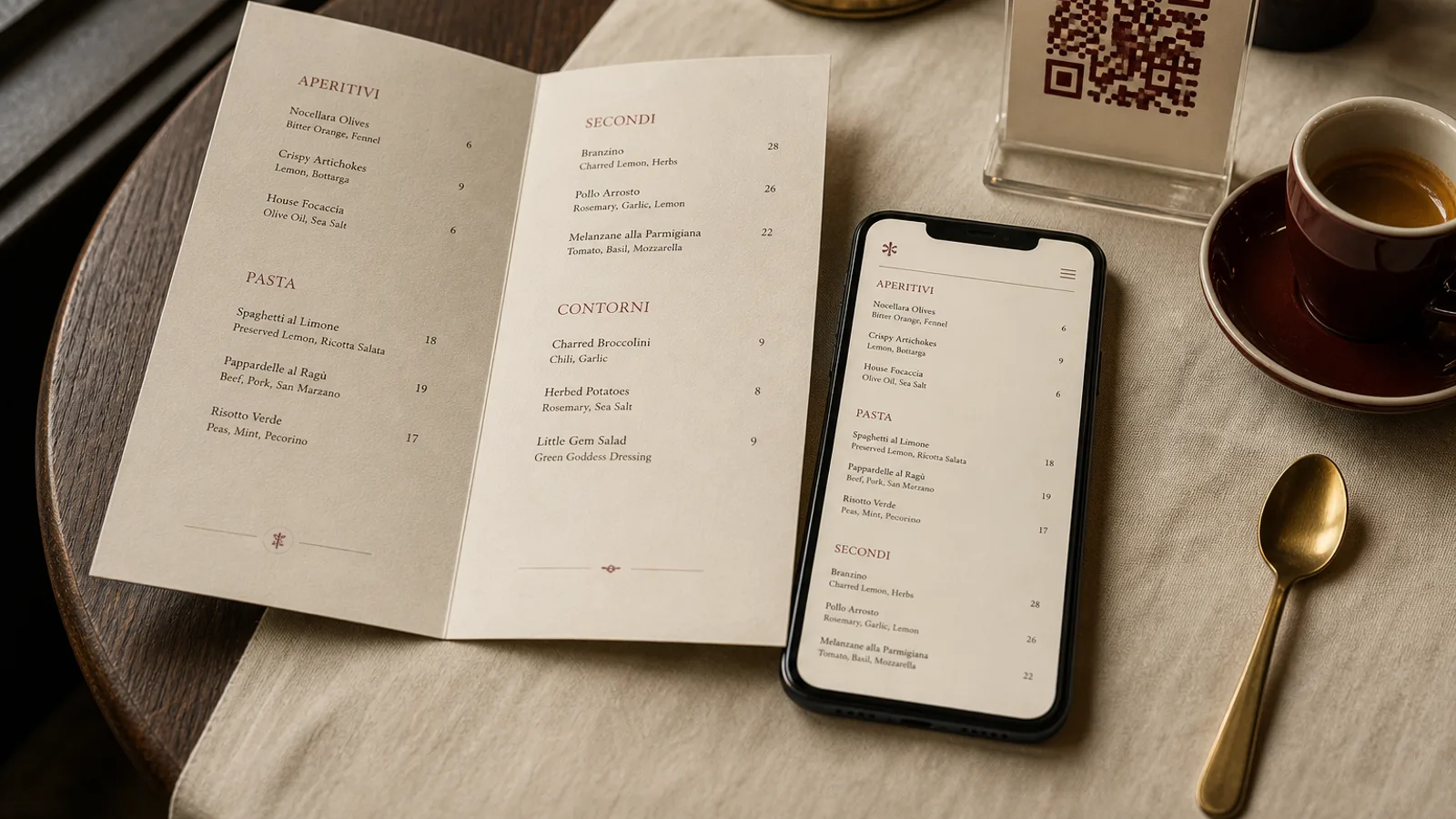
Every few years someone announces that the printed menu is finished. Tablets were going to do it in 2012, QR codes in 2020, and now voice ordering or a personalised menu on the guest's own phone is supposed to finish the job. Meanwhile the menu on the table is still a piece of paper in the vast majority of restaurants that guests love, and the venues that went fully digital have mostly quietly printed cards again. This is not nostalgia; it is a pattern with reasons behind it. Here is what a decade of experiments actually tells us about where menus are heading, and what a restaurant owner should invest in now rather than in five years.
What the QR decade settled
The pandemic gave the digital menu the largest field trial in the history of the industry: for about eighteen months, almost every restaurant in Europe had one. The results were unambiguous. Guests tolerated it as a health measure and abandoned it as soon as they could. Surveys across several countries found large majorities preferring a physical menu, with the strongest preference among guests over fifty and in restaurants above the fast-casual tier. Operators found that QR menus lowered the average bill in full-service rooms because guests ordered faster and less, and stopped asking servers for recommendations.
The QR menu did not die; it found its place. It works as a fallback for the guest who prefers their phone, as the menu for a bar with 200 spirits, as the ordering channel in a food court, and as the accessible version for screen readers. It failed as the primary object on the table in restaurants where the meal is the occasion.
Why paper keeps winning at the table
The reasons are practical rather than romantic. A printed menu is shared: two people lean over one card and decide together, which no phone allows. It has no notifications. It carries the restaurant's identity in paper weight, type and format, which a web page in a browser tab does not. It is visible across the table, so a server can point at a dish. And it is a signal: a heavy card on 350 g board tells the guest, before a word is read, what kind of evening this will be.
None of those advantages depend on technology staying still. They come from what a meal in a room is, and that is unlikely to change.
Where screens genuinely belong
Screens have won decisively in three places, and they will keep those.
- Behind the guest: kitchen display systems, handheld ordering devices for servers, and stock-linked availability that removes a dish from every channel the moment it runs out.
- Before the visit: the menu on Google, on the website, in delivery apps and in booking confirmations, where the guest decides whether to come at all. This is where most menus are now read for the first time.
- In high-volume, low-service formats: food courts, canteens, fast casual, conveyor sushi, where a screen or a kiosk replaces a queue rather than a conversation.
The realistic future is not paper or screens; it is paper on the table and screens everywhere else, driven from the same dish list so they never disagree.
What will change on the paper itself
The printed menu is not standing still either. Four shifts are already visible in good restaurants and will spread.
- Shorter cards, reprinted more often. A 25-dish menu on a single A4 or an A5 bifold, reprinted every four to eight weeks, is replacing the laminated 80-item book that lived for two years. Digital printing at 2 to 4 € per copy made this possible.
- Better paper and finish as a deliberate signal. Uncoated 300 to 350 g board, soft-touch surfaces and scored folds are moving from fine dining down to neighbourhood restaurants, precisely because they are what a screen cannot offer.
- Legibility as a design requirement. Body text at 11 pt or more, higher contrast and clearer sections, learned from the accessibility conversation and from an ageing clientele.
- Cleaner allergen handling. Coded footnotes and a legend, or a separate allergen card, have become standard since Regulation 1169/2011 and will stay.
Personalisation, AI and the honest limits
The current promise is the menu that adapts to the guest: allergies filtered out, past favourites highlighted, prices adjusted by demand. Some of that is real and useful, particularly allergen filtering in online ordering. Some of it collides with what guests want from a restaurant. Dynamic pricing on a dinner menu reads as a betrayal of the shared, public price list, and a menu that hides dishes from you removes the small pleasure of discovering something you would not have searched for.
Where AI is already changing menus is upstream, in the making of them. Laying out a menu used to require a designer or a template fight in a word processor. It can now be generated from the dish list in minutes, in a coherent style, with correct typographic details like dotted leaders and aligned prices, and regenerated when a price changes. That lowers the cost of a good printed card to almost nothing, which in turn makes the frequent-reprint model above possible for a bistro with one owner.
What to invest in now
If you are planning for the next five years rather than the next quarter, the priorities are clear. Keep one dish list as the source of every channel. Put a well-designed, well-printed card on the table and be prepared to reprint it often. Make sure the pre-visit menu on Google and your website is current and readable on a phone. Give servers handhelds and the kitchen a screen. Skip tablets on tables and skip dynamic pricing.
Menu Atelier is built for exactly this version of the future: the dish list is the input, the AI lays out the printed card in one of eight styles, you check it in 3D and switch between A4 and A5 or single sheet and bifold in one click, then download the print-ready files with bleed and crop marks or have us print it on 350 g matte board with a soft-touch finish and ship it across the EU. Paper on the table, data everywhere else.