The printed menu as souvenir: designing something guests want to keep
How to design a printed menu guests take home on purpose: formats that fit a bag, paper that ages well, a date and a signature, and what a keepsake menu costs per cover.
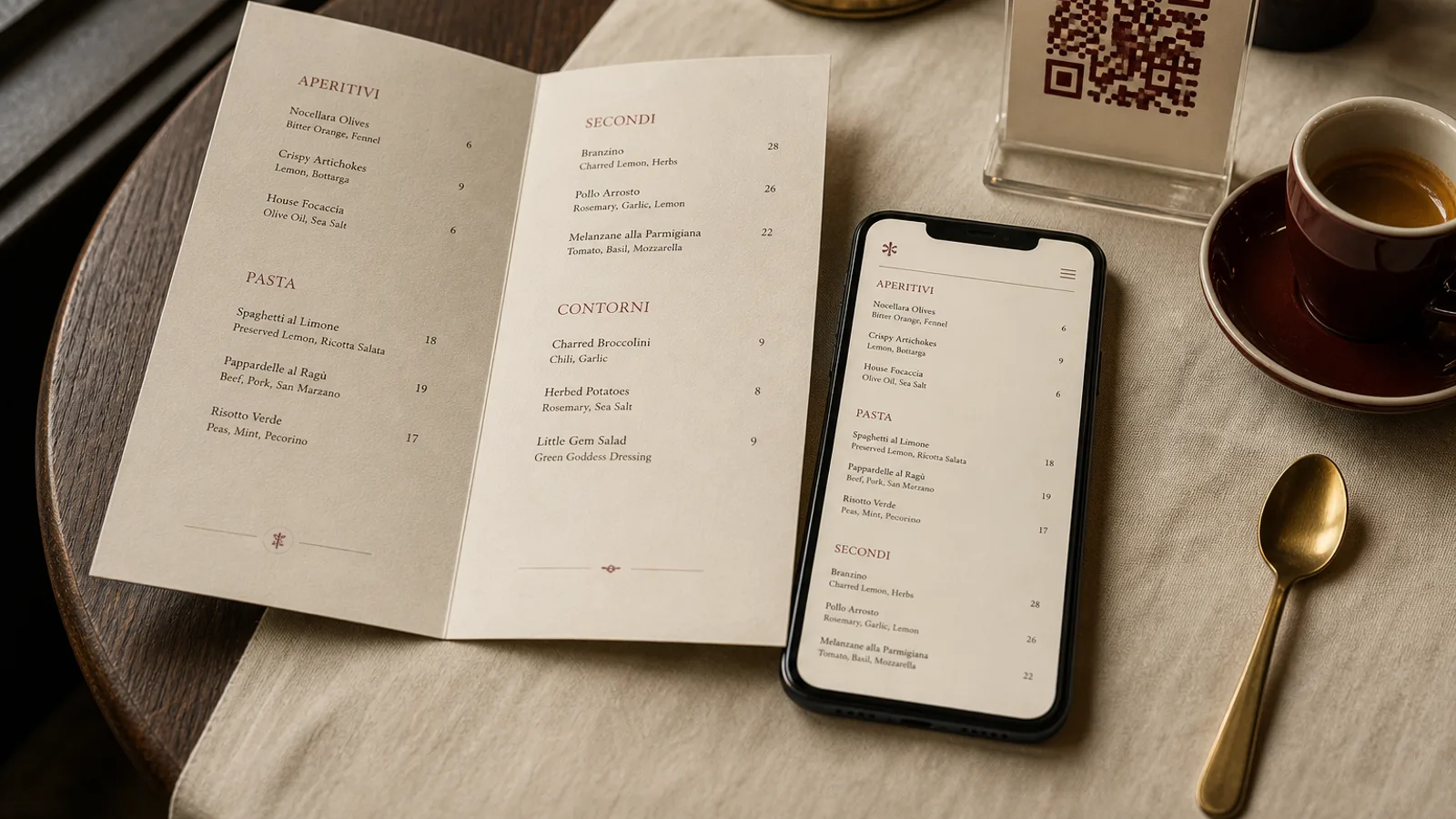
Open the drawer of anyone who eats out often and you will find them: a tasting menu from an anniversary dinner, a paper placemat with a map of the region, a small card from a bar in another city. Nobody keeps a QR code. A menu that leaves with the guest is the cheapest piece of marketing a restaurant can produce, it works for years, and it is shown to exactly the people most likely to book. This article is about designing that object deliberately: what makes a menu worth keeping, what format and paper survive a handbag, what it costs, and when it makes no sense at all.
Why some menus get kept and most get left
Guests keep things that record an evening, not things that list prices. The menus that end up in drawers are almost always the ones that were specific to that night: a tasting menu with the date, a wedding menu with two names, a card that says “Tuesday 14 October, vendange dinner”. A standard card with the full list and prices is information; a dated menu is a memory.
The second condition is physical. The object has to feel worth more than the paper it is printed on: a heavier board, a texture, a colour on the edge, a fold that closes it like a little book. And it has to fit in a jacket pocket or a handbag without being folded in half against its will, which rules out most A4 cards immediately.
Formats that leave the room intact
The format decides whether the menu goes home or in the bin. A single-sheet A4 at 210 × 297 mm is too big for a bag and creases the moment it is folded. Three formats work reliably.
- A5 bifold, 148 × 210 mm closed, four panels. The classic tasting menu: cover with the name and the date, the courses inside, a note or the team's names on the back. Fits a jacket pocket, stands up on a bookshelf.
- DL card, 99 × 210 mm, single or bifold. Slips into a bag alongside a phone. Excellent for a fixed menu of six to eight lines, bars and cocktail lists.
- A6 card, 105 × 148 mm, printed both sides. Postcard size, so guests instinctively treat it as something to keep or even to post. Room for one menu, a short story about the dish and a small illustration.
Whatever the format, print the trim exactly. A souvenir with a crooked edge or a fold 2 mm off centre reads as cheap even to people who could not say why. Give bifolds a proper score before folding so the spine is crisp, and keep 3 mm of bleed on any colour that runs to the edge.
Paper and finish that age well
A souvenir will spend years in a drawer or pinned to a fridge. Uncoated board of 300 to 350 g ages gracefully; a matte, soft-touch finish resists fingerprints and feels expensive in the hand. Gloss coating looks good for an evening and then shows every scratch. Very thin paper under 170 g curls and tears; anything above 400 g does not fold cleanly without a deep score.
Ink matters less than people expect, with one exception: large solid areas of dark ink on uncoated board can crack along a fold. If you want a dark cover, choose a coated board or keep the fold line free of heavy coverage. Coloured edges, a blind emboss of the logo or a single foil element lift the object from card to keepsake, but each adds 0.30 to 1 € per copy at small runs, so use one, not three.
What to print on it
A menu people keep is shorter than a menu people order from. Take out the prices unless it is a set menu with a single figure; nobody frames a price list. Take out the allergen codes and put the legend on a separate insert, or brief the staff to explain verbally; Regulation 1169/2011 requires that the information be available, not that it be printed on the souvenir itself. Then add the things a standard card never carries.
- The date, in full, and the occasion if there is one.
- The names of the chef and the team, or a hand-signed line by the chef on a tasting menu. Ten seconds of signing per copy is the highest-return detail in the whole business.
- One or two sentences about where a key ingredient came from, or why the dish exists.
- The restaurant's name and city, small, so the card still makes sense in a drawer in another country three years later.
- Space. A souvenir menu with 40 percent of the page empty looks confident; a crammed one looks like a receipt.
The arithmetic per cover
A run of 100 A5 bifold menus on 350 g board with a soft-touch finish costs in the region of 1.50 to 3 € per copy from most printers, less for a plain A6 card, more with foil or coloured edges. For a tasting-menu restaurant serving 40 covers a night, a dated menu costs 60 to 120 € per service and is the only piece of advertising the guest will show to friends the next day.
Contrast that with a chalkboard photograph on social media, which lives for 24 hours, or a QR code, which is forgotten the moment the phone locks. A printed souvenir with the chef's signature has, in our experience, a way of coming back as a booking a year later with the words “we were here for our anniversary”.
When not to bother
A souvenir menu is a tool for occasions, not for a Tuesday lunch. A neighbourhood bistro with a long à la carte menu and a lunch formula should keep a durable, reusable card and reserve dated menus for events: New Year's Eve, a guest-chef dinner, a harvest evening. A bar can produce a small dated card for a launch or a seasonal list. Printing a keepsake every day devalues it and doubles your paper budget for nothing.
The right cadence for most restaurants is a stable card for daily service and a dated souvenir menu for the six to twelve special evenings a year. In Menu Atelier the two come from the same design: keep the everyday card as an A4 or A5 bifold, then duplicate it, switch to a DL or A6 format in one click, remove the prices, add the date and a line from the chef, check it in 3D, and download the print-ready PDF or have us print it on 350 g matte board with a soft-touch finish and a scored fold.