Happy hour menu design: clear times, clear prices, no arguments at the bar
How to design a happy hour menu that states times and prices so plainly that nobody disputes the bill: layout, dual-price columns, legal wording and print formats.
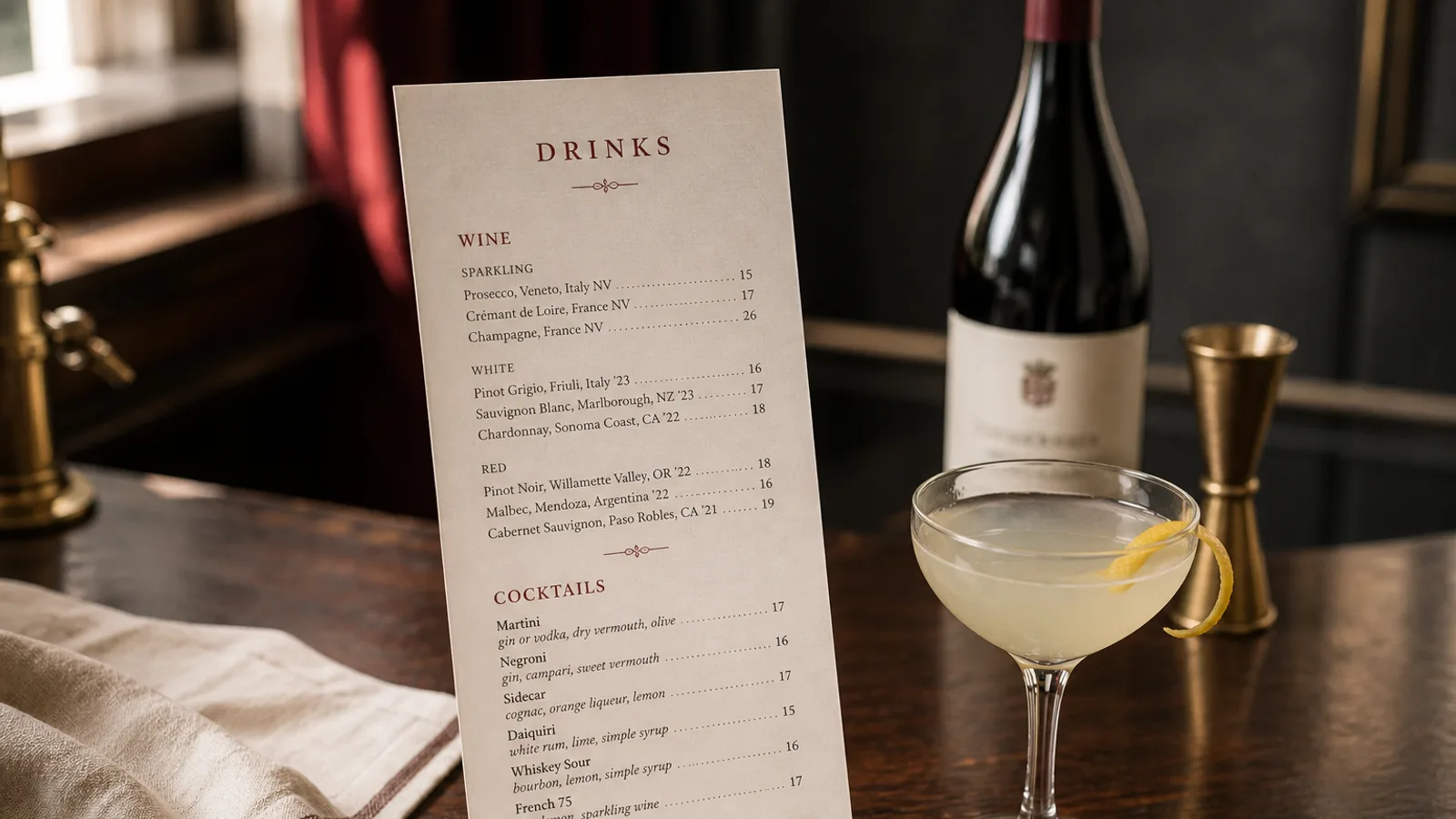
Every bar manager knows the 7:02 pm conversation: a table ordered at 6:55, the drinks arrived at 7:04, and the bill shows full price. The happy hour menu is the piece of paper that either prevents that argument or causes it. Designed well, it also does something more interesting than discounting: it fills the room between 5 and 7 pm with people who stay for a second round at full price. This article covers the layout decisions, the pricing display and the wording that make a happy hour menu unambiguous and easy to update.
State the rule once, in one sentence, at the top
The most important line on the menu is the one that defines the offer, and it must appear before any price. Write it as a single sentence with the days, the times and what the times refer to: Happy hour Monday to Friday, 5 pm to 7 pm, prices apply to orders placed before 7 pm. That last clause resolves the 7:02 problem in advance. Set this sentence in the body size or one point larger, not in tiny footnote type, and repeat it on both faces if the menu is double-sided.
Use 24-hour or 12-hour times consistently with the rest of your printed material. In most of Europe, 17:00–19:00 is clearer than 5–7 pm and avoids any doubt about morning and evening. If the offer excludes public holidays, event nights or the terrace, say so in the same sentence or in a second one directly beneath it; scattering exclusions in a footnote is where disputes come from.
Two prices or one list?
There are two honest ways to show a happy hour price. The first is a dedicated list: only the drinks included in the offer, at the happy hour price, on a card that is handed out or displayed during those hours. The second is a dual-price column on the regular drinks menu, with a Happy hour column beside the standard price. Each has a failure mode.
- A dedicated list is cleaner and sells the offer harder, but it must be physically removed at 7 pm; a stale card on a table is the source of most complaints.
- A dual-price column stays accurate all evening and shows the guest what they are saving, but it makes the regular price look expensive and it adds a column that crowds an A5 page.
- Strikethrough prices (14 € crossed out, 9 €) look like a supermarket flyer; avoid them on anything you want to read as a bar rather than a promotion.
For most bars, a dedicated A5 or DL card in a table stand is the right choice, with the regular menu unchanged. It keeps the main drinks menu stable, and the card itself is cheap to reprint when the offer changes. If you go for dual columns, set the happy hour price in the same type as the regular price, not bolder, and head the column with the time window rather than the words Happy hour.
What to include, and how many lines
A happy hour list that reproduces the whole cocktail menu at a discount trains guests to never pay full price. A short list of 8 to 12 items does the job better: two or three cocktails you can batch, a beer on tap, a house white and red by the glass, a sparkling wine, a non-alcoholic option, and two or three snacks. The snacks matter; they are what turn a discounted round into a table that stays for dinner.
Group the items in the same order as the main menu so regulars find things where they expect them. Give each drink a name and a one-line description, exactly as on the main menu; a happy hour menu that lists bare names looks like a price war. State the volume next to any drink where the happy hour pour differs from the regular one (a 25 cl beer rather than 50 cl), in the same size as the price.
Price points that work
Round prices work best in a promotion: 5, 6, 8, not 5.90. A cocktail that costs 12 € normally and 8 € at happy hour is a convincing offer; 12 € to 10.50 € is not worth the paper. Keep the range tight, three or four price points at most, so that the card can be read at a glance across a standing bar.
Legal wording in the EU
Several member states regulate drink promotions. France restricts happy hours under the public health code and requires that non-alcoholic drinks be offered on the same reduced terms during the promotion; the menu should show at least one soft drink at a happy hour price. Some Italian and Spanish regions require that reduced-price alcohol be accompanied by the availability of food. Check your local rules, but the design principle is the same everywhere: the offer as printed must be the offer as billed, and any condition the guest could not have known is a condition you will end up waiving.
Allergen information under Regulation 1169/2011 applies to the snacks and to any drink containing allergens (egg white, nuts, milk, sulphites); use the same shorthand as the main menu and keep the key on the card.
Format, paper and how often to reprint
A happy hour card lives on a wet bar and in a table stand; it needs to survive. Print on 350 g board rather than paper, and consider a matte finish that does not show fingerprints. A5 single-sided is enough for 8 to 12 lines; DL (99 × 210 mm) suits a narrow table stand. Print in small runs of 30 to 50 because the offer will change with the season; a card that says summer spritz in November tells the guest you have stopped paying attention.
Keep the same visual family as the main menu, same typefaces and colours, so the card reads as part of the bar rather than a flyer someone left behind. If you want a single element of contrast, make it the time window, set larger or in the brand's accent colour.
A card that ends the 7:02 argument
One sentence with days, hours and the order-time rule; 8 to 12 items with round prices; a soft drink on the same terms; the same typefaces as the main menu; 350 g board in an A5 stand, removed at 7 on the dot. That is the whole discipline. Everything else is what you choose to pour.
In Menu Atelier, a happy hour card is a second design built from the same drinks list as the main menu, so names and descriptions stay identical; you can switch it to A5 or DL, check it in 3D in the table stand orientation, and order 30 or 50 copies on 350 g matte board delivered in 5 to 8 working days.