How to write menu descriptions: length, adjectives and honesty
How long a dish description should be, which adjectives earn their place, and how to stay honest so the plate that arrives matches the line the guest just read.
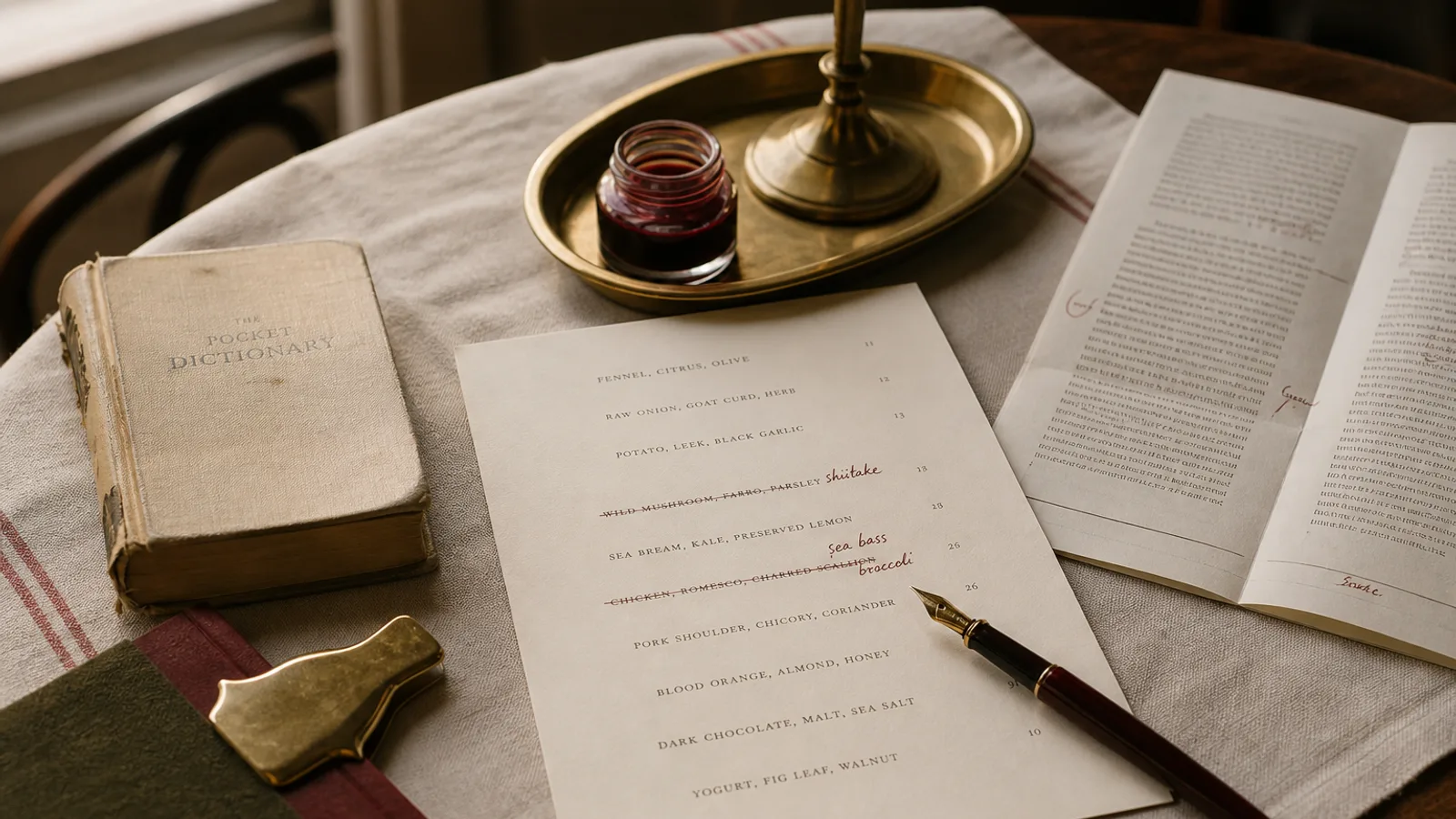
A menu description has one job: tell the guest what will land on the table, in an order they can decide from, without a speech from the waiter. Most rooms write too much, or they write perfume. "Succulent", "drizzled", "nestled" are not information. Neither is a 40-word paragraph under a 14 € starter. This article is a working method: a length, a sequence of facts, a short list of words to delete, and a test you can run on Tuesday before you print.
The useful length is shorter than you think
For an à la carte at 10 pt, 8 to 18 words is the band that fits one line, sometimes two, on an A5. That is enough for the protein or the main vegetable, the two or three treatments that change the dish, and a marker the guest needs ("raw", "spicy", "contains nuts"). A tasting menu can go to 20 or 25 words because the guest is not choosing among 30 lines. A burger room can go to four words. Matching length to the format is the first design decision that is also a writing decision.
If the description wraps to three lines, you have either too many adjectives or a dish that should be two dishes. Cut until it fits. Type that wraps under the price column is how a 12 € figure gets lost. The description serves the name and the price, not the other way around.
A sequence that guests can scan
Write in the order the guest will eat, or in the order of the thing they are buying. "Hake, grilled, fennel, aioli" is a plate. "Our take on a coastal classic, lovingly…" is a brochure. Lead with the noun they will say to the waiter (hake, not "catch of the day" unless it really changes). Then the method if it matters (raw, smoked, 48-hour). Then the two companions that are not garnish. Stop.
Provenance earns a word when it is specific and true: "Lozère lamb", "line-caught", "our bread". "Locally sourced" is not a fact; every kitchen in the postcode can write it. If you cannot name the farm or the harbour, skip the virtue and keep the fennel.
- 8–18 words on à la carte; fewer on a burger card; a little more on a tasting
- Noun first, method if it changes the dish, two companions, stop
- Specific origin or none; never "locally sourced" as a substitute for a name
- Delete: succulent, drizzled, nestled, decadent, perfectly, our famous
Adjectives that do a job
An adjective stays if it changes the order. "Spicy", "raw", "smoked", "fermented", "offal" tell a guest whether they want the plate. "Tender" and "fresh" do not: nobody is offering the opposite. "House" is useful when it means you make it ("house ricotta") and empty when it means you sell it ("house salad"). "Seasonal" is a date, not a flavour; if the card is dated, you do not need the word.
Foreign words are adjectives in disguise. "Mise en place" on an English card is noise. A French technique on a French card is fine. A Japanese cut on an Italian menu needs a translation or a waiter, and you will not have a waiter for every table at 8.30. If the guest must ask what the word means, put the meaning on the card or drop the word.
The honesty test
Read the line, then look at the pass. If the plate has four elements and the card named two, you have under-written and the guest will ask. If the card named six and the plate has four, you have over-promised. The Cornell-style finding that menus steer choice is real enough; it does not license fiction. A "truffle" that is oil, a "wagyu" that is not, a "fresh pasta" that came in a bag: those lines are how reviews start, and they are also how allergen conversations go wrong.
Allergens belong in the facts, not in the poetry
If the dish contains one of the 14 allergens under Regulation 1169/2011, the description should not hide it behind a cute name. "Romesco" means nuts to you and a red sauce to a tourist. Add the nut or the number. "Pesto" means pine nut and cheese. Write them, or key them, in 7 to 8 pt next to the name. A beautiful sentence that omits the hazelnut is a legal and a human failure.
Prices stay out of the description. "Worth every penny" is not a line you get to write. The figure in the column is the sentence. If you need to explain a supplement ("+8 € for 5 g truffle"), that is a second fact, set after the description, not inside the adjectives.
Write it once, then typeset it
Draft in a spreadsheet, one cell per dish, and read the column aloud. Anything you stumble on, cut. Then pour the text into the layout and cut again to the measure. Do not write in the design file; you will fall in love with a wrap. Do not let a generator invent descriptions from the dish name: it will give you the same succulent drizzle as the room next door.
In Menu Atelier you paste the dishes and the lines you actually wrote; the system typesets them at a size that fits the format, and you can switch A4 to A5 and see which descriptions suddenly wrap. Fix the words, not the tracking. The 3D preview will not save a dishonest sentence, but it will show you when an honest one has become a third line.