Provenance on menus: naming farms and boats without writing an essay
How to show local sourcing on a menu without turning every dish into a paragraph: what to name, where to put suppliers, legal rules on origin claims and clean layouts.
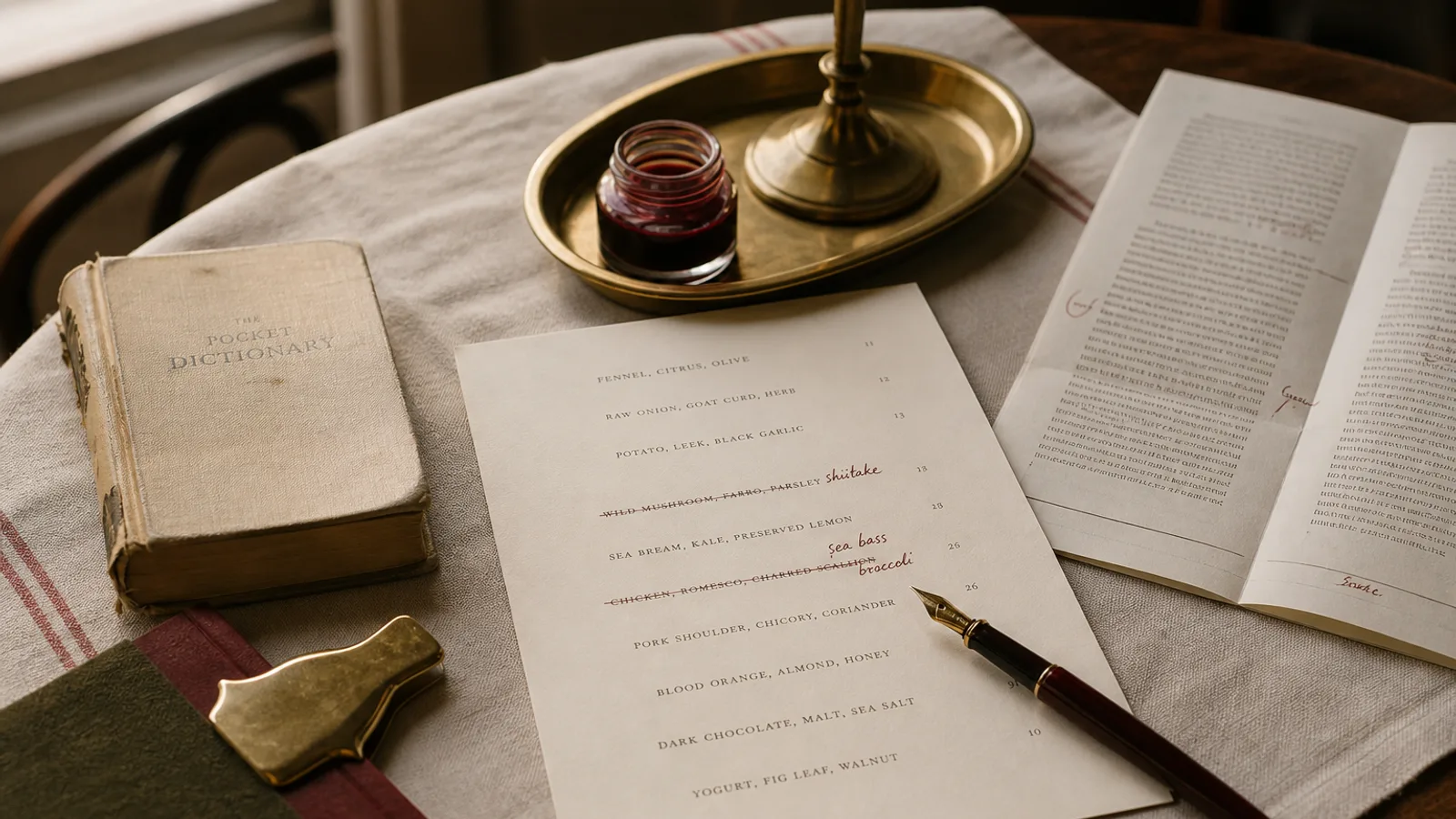
There is a version of the farm-to-table menu where every dish comes with a genealogy: the pig's breed, the farmer's first name, the valley, the altitude, the mode of transport. Guests admire it for thirty seconds and then cannot find the price. Provenance is one of the strongest things a menu can communicate, and one of the easiest to overdo. This article is about deciding which origins deserve a name, where those names live on the card, what the law lets you claim, and how to keep the dish line short enough to read.
Why provenance works, and why it stops working
A named origin does three jobs at once. It justifies a price (a 32 € turbot from a named day boat is a different object from "turbot"). It signals a kitchen that chooses rather than orders from a catalogue. And it gives the server a story to tell in one sentence. Cornell's menu research on descriptive labels found that specific, evocative names lift both sales and perceived quality; provenance is the most credible form of that specificity because it can be checked.
It stops working through repetition. When all 30 dishes carry a farm name, none of them stands out and the reader stops processing the names as information. It also stops working when the name is meaningless to the guest: a hamlet nobody has heard of adds syllables, not trust. The rule of thumb is that a provenance mention should either be recognisable (a region, a breed, a well-known producer) or be explained in three words ("a small dairy in the Aubrac").
Choose the five that matter
Walk through your menu with a pencil and mark the ingredients where provenance genuinely changes the dish and where you can genuinely vouch for it. You will usually find five to eight. These are the ones that get named on the dish line.
- The protein that carries the highest price: the beef, the lamb, the whole fish. This is where the guest is most likely to ask "where is this from", so answer before they ask.
- The ingredient your area is known for: Bresse chicken, San Marzano tomatoes, Padrón peppers, Puy lentils. Here the name is part of the dish's identity and the guest already knows it.
- The thing you make or grow yourselves: your own bread, your own smoked fish, the herbs from the courtyard. "Our own" is the shortest provenance claim in existence.
- One or two supplier relationships you are actually proud of and that will still exist in six months. A farm you visit, a fisherman you call on Tuesday mornings.
- The cheese board and the wine list, where origin is the whole point and where the guest expects it.
Everything else stays anonymous on the dish line. Carrots do not need a birthplace unless they are the dish.
Where the names go: line, footer or back page
The dish line has room for one provenance element, in the name or in the first words of the description, and it should be short: "Aubrac beef", "Line-caught sea bass from Saint-Jean-de-Luz", "Cantabrian anchovies". Anything longer than five words pushes the price off the line and turns a menu into a catalogue.
The full story belongs somewhere else. Three formats work well and they can be combined.
- A supplier list on the back page or inside cover: eight to twelve names with a town and a product, set in 8 pt in two columns, under a heading like "Our producers". It costs a quarter of a page and it lets you name everyone once without repeating anything on the dishes.
- A short footer line under the relevant section: "All our fish is from the Atlantic coast, landed within 48 hours" under the fish section says more than five individual boat names.
- A chef's note of 60 to 90 words at the top of the menu that names the region, the season and two or three producers, in a warmer register than the dish lines.
Typographically, a supplier name in the dish line should be set exactly like the rest of the description, not in bold or italic. Emphasis on the farm name makes the farmer the hero instead of the dish. If you want a visual cue, a small consistent mark (a dot, a tiny house icon) before dishes that use a named producer is enough.
What you can legally claim
Provenance is one of the few pieces of menu copy that can get you fined. Regulation 1169/2011 forbids misleading information about the origin of a food, and national consumer authorities do check menus. In France, since 2002 the origin of beef must be indicated in restaurants, and since 2022 that extends to pork, poultry, lamb and veal, with the country of rearing and slaughter. Italy and Spain enforce protected designations strictly: if it says Parmigiano Reggiano, Jamón de Jabugo or Chianina, it must be exactly that.
"Local" has no legal definition, which does not make it free. If your local tomatoes come from 400 km away in January, drop the word for the winter card. "Homemade" is regulated in France under the fait maison scheme and means made on the premises from raw ingredients. "Organic" requires that the ingredient be certified and, if you use it on more than a couple of lines, that your kitchen be certified too.
Wild versus farmed fish is a claim guests care about and one that must be accurate. Write "wild" only when it always is; if the supply varies, write the species and the fishing area and leave the adjective out.
Keeping it true across the season
The provenance line is the one most likely to go stale. Boats change, a farm has a bad year, the lamb switches from the Pyrenees to New Zealand in March because that is what is available. Every named origin on the menu is a maintenance commitment, and the honest way to handle it is to name only what you can keep, and to reprint when it changes.
One practical trick: name the region rather than the individual producer wherever the supply rotates. "Brittany artichokes" survives three different growers; "artichokes from Yann's farm" survives one.
Say less, and let it be checked
Provenance works because it is verifiable. A guest can look up a breed, ask about a fisherman, taste the difference in a named cheese. Five well-chosen names on the dish lines, a producer list on the back, a footer line where the whole section shares an origin, and nothing invented: that is a menu that sounds proud without sounding like a brochure.
In Menu Atelier, a producers block can be added to the back face of a bifold or the foot of a single sheet and styled to match the body text of the chosen design; because dish descriptions are kept short by the layout engine, a long provenance story naturally ends up there rather than on the line, where it belongs.