Menu boards vs handheld menus: which suits your service?
When a wall board is the right menu and when a handheld card is: queue speed, table service, type sizes, and the rooms that need both.
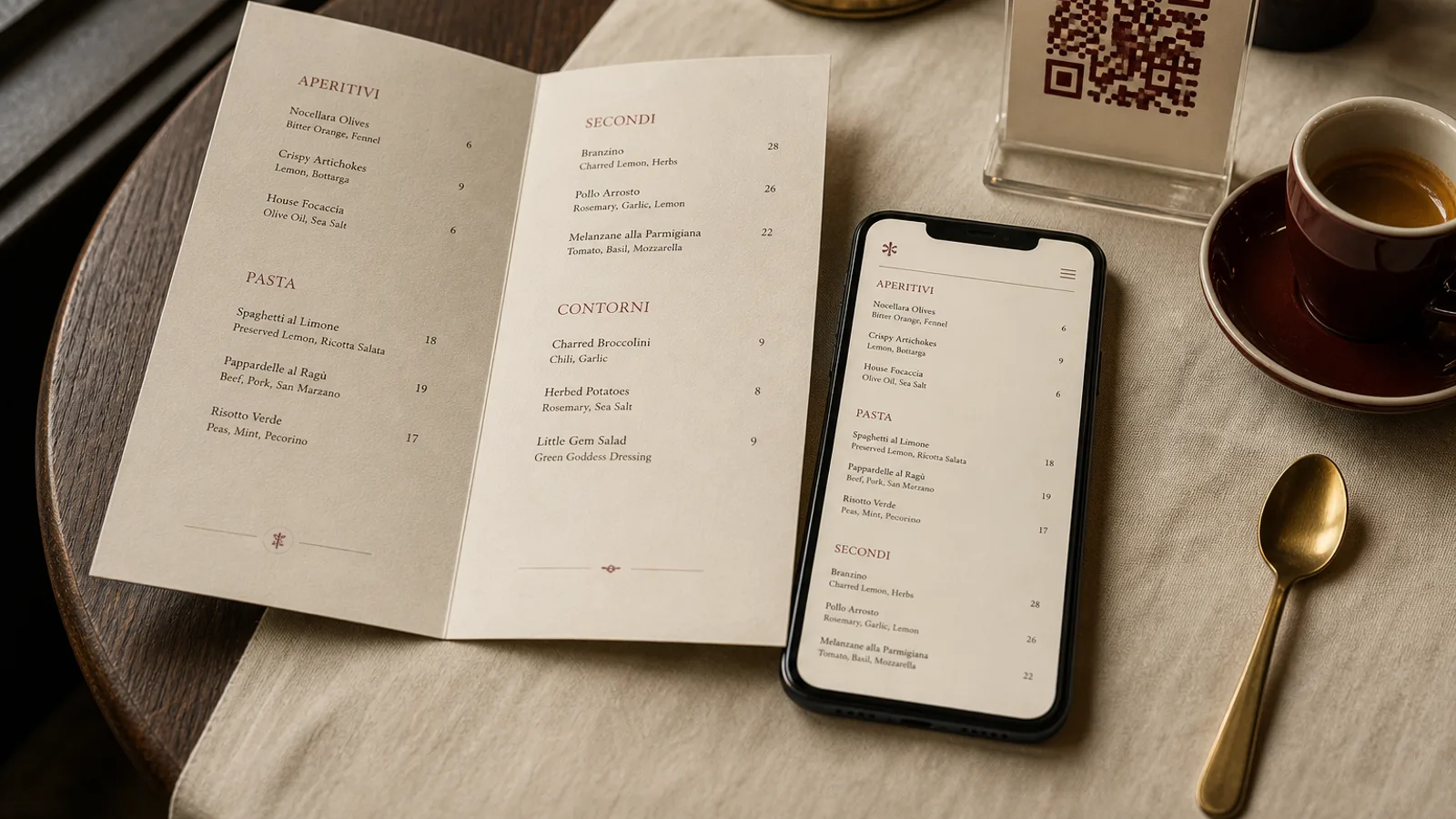
A board on the wall and a card in the hand are not interchangeable. One is read standing, at two or three metres, often in a queue, with a decision that has to happen before the person behind you sighs. The other is read sitting, at 40 cm, with time to compare and a neighbour who wants to see the same page. Choose the object that matches the service, not the object you happen to have already designed last winter.
Boards belong to the queue
Counter service, bakeries, ice-cream windows, lunch lines: the guest decides while moving. The board has to be readable from the back of the line. That means fewer items, larger type, and prices that do not require a second look. A well-set board holds 12 to 25 lines, not 60. Headings at 48 to 72 pt, dishes at 28 to 36 pt, prices in the same colour and a similar size. If you need a magnifying glass from the door, it is not a board; it is a poster of a card.
Chalk and letter boards forgive daily changes and punish long descriptions. Write the name, one fact, the price. “Lentil soup, lemon, 8 €” is a board line. A three-sentence origin story is not. If the offer rotates, change the board at the same hour every day so regulars know when to look. A board that is half last Tuesday is worse than a short board.
Handheld cards belong to the table
Table service needs an object that can be shared, annotated by the waiter, and put down. An A5 bifold or a single A4 sheet does that. Type can drop to 10 or 11 pt because the reading distance is a forearm. Descriptions can run to a line. Wine can have a vintage. Allergens can live in a legend. None of this works on a wall at three metres, and forcing it onto a board produces the familiar disaster: guests squinting, then asking the staff to recite the menu.
A handheld card also holds the brand in the hand: paper weight, fold, the soft-touch of 350 g matte. A board holds the brand in the room: the panel, the lighting, the lettering. They are different surfaces. A photographed card blown up behind the counter is neither; it is a card that nobody can hold and a board that nobody can read.
When you need both
Many rooms have two speeds. A lunch window or a terrace queue, then a slower evening service at tables. Print a short board for the queue — the formule, the three sandwiches, the day’s tart — and a fuller card for the evening. Do not put the evening card on the wall “to save printing”. You will lose the queue and you will still need cards after six.
- Board: 12–25 lines, 28 pt minimum on dishes, high contrast, no paragraphs, prices aligned.
- Handheld: 20–40 lines, 10–11 pt, short descriptions, allergen legend, a fold the waiter can close.
- Both: the same names and prices for the dishes that appear in both places.
- Neither: a laminated A3 of an 80-line card taped to the glass.
Digital boards are still boards
A screen above the counter follows board rules, not website rules. One column, large type, no carousels of dishes that rotate away before the guest has read them. Motion is for sold-out lines and the day’s special, not for a Ken Burns pan across a photograph of pasta. If the screen fails, you need a paper board or a short handheld list within reach. A black rectangle over the pass is not a menu.
Match the object to the minute
Ask how long the guest has and how far they stand. Under a minute, standing: a board. Several minutes, sitting: a card. Both, in the same day: both objects, same source list, different type sizes. A lunch queue and an evening table are not the same reader, even when they order the same soup on the same sunny day. The rooms that get this right stop asking staff to be the menu, and stop asking guests to decode a wall of 9 pt.
In Menu Atelier you design the handheld card — A4 or A5, single sheet or bifold — and see it in 3D before you print on 350 g matte; for a board, export a face as a high-resolution PNG and set the type larger in the layout, rather than photographing a finished card and hoping it reads from the door.