Menu proofreading checklist: read it like a guest, then like a lawyer
A two-pass proofreading checklist for restaurant menus before print: the guest pass for sense, flow and prices, the legal pass for allergens, origin and mandatory mentions.
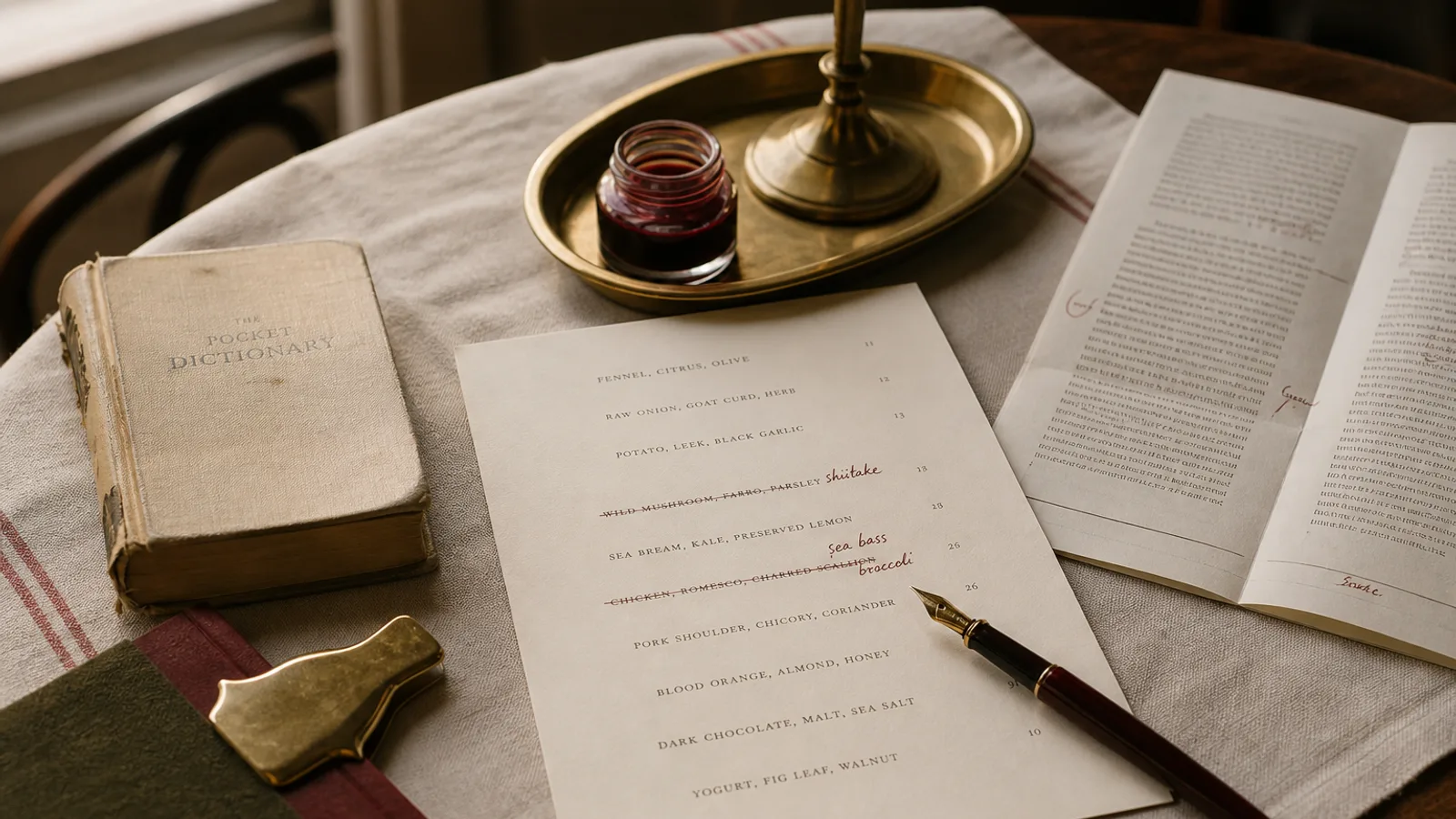
The moment a menu is most likely to go wrong is the twenty minutes before it goes to print, when everyone is tired of looking at it and the only question anyone asks is "does it look fine?". It usually does look fine. It also usually has a price that no longer matches the till, an allergen that was dropped when a dish was rewritten, and a dish that appears twice. Proofreading a menu is a different task from proofreading a letter, because the document has two very different readers: the guest, who wants to choose dinner, and the inspector, who wants to check compliance. Read it once as each of them.
Before you start: print it
Do not proofread on screen. Print the menu at 100 percent on plain paper, ideally on the paper stock you will use or something close, and take it away from the desk where you wrote it. Errors invisible after thirty on-screen readings appear in the first minute on paper, because the eye reads a printed page more slowly and more completely. If the final format is a bifold, fold the proof; page order errors only show up folded.
Ideally the proofreader is not the writer. If it must be you, leave at least a night between the last edit and the read.
Pass one: read it like a guest
Sit down with the proof as if you had just arrived for dinner. You are hungry, you have four minutes, the light is low. Go through the card once from the front cover to the last line and note everything that makes you pause, then check these points in order.
- Can I tell in five seconds how this menu works? Course structure, sharing logic, set menu rules, service hours: whatever is not obvious needs one line of explanation, and that line must be where the eye lands first.
- Does every dish tell me what it is? Read each name and description as if you had never eaten here. A dish with only a name in dialect or a chef's invention needs a description; a dish whose description repeats the name needs a shorter one.
- Is every price present, aligned and plausible? Read the price column top to bottom on its own. Missing prices, a 14 among the 24s, a starter more expensive than the mains: all of these are found in the column, not on the line.
- Read every dish name aloud. Misspellings that the eye forgives (mozarella, expresso, Ceasar) trip the tongue. Check accents, doubled consonants and the foreign words you use most.
- Check consistency across the card: capitalisation, punctuation at the end of descriptions, separators (commas or middle dots), units (g, cl, h), decimal format (12,50 or 12.50, never both). One template line per dish type, applied everywhere.
- Look at the headings alone. Are there between five and seven? Does any section have a single item? Does the order match how the meal is eaten?
- Turn the card over, open it, close it. Does the back cover carry what a guest would look for there (allergen legend, opening hours, address)? Is anything on the back that should be on the front?
Then read the whole thing once more at normal speed, ignoring detail, for tone. Does it sound like one person throughout? Is there a sentence that is trying too hard? Cut it.
Pass two: read it like a lawyer
Now switch reader. You are a consumer inspector, or the lawyer of a guest who had a bad reaction. You are not interested in whether the menu is pleasant; you want to know whether every mandatory mention is present and every claim is accurate.
- Allergens: for every dish, are the relevant substances among the 14 of Regulation 1169/2011 declared, either on the line or in a matrix the menu points to? Compare the card against the kitchen's allergen register dish by dish, not from memory. Check that the legend is complete and, on a bilingual card, present in both languages.
- Origin: is the origin of meats indicated where national law requires it (in France, beef since 2002 and pork, poultry, lamb and veal since 2022)? Is every protected designation (Parmigiano Reggiano, Comté, Jabugo) used only for the genuine product? Is fish marked fresh or defrosted where that is required?
- Claims: every "homemade", "organic", "wild", "local", "gluten-free" must be true tonight and defensible tomorrow. Fait maison in France has a legal definition; organic requires certification; gluten-free means under 20 mg/kg. Where you are not sure, soften the wording or remove it.
- Prices and mentions: are prices shown inclusive of tax and service where the law requires it? Is the service or cover charge stated clearly with its amount? Are the mandatory mentions of your country present (in France, the notice on the sale of alcohol to minors and the price display rules; in Italy, the coperto stated as an amount; in Spain, the note that a complaints book is available, where applicable)?
- Legal identity: company name, address and, where required, registration number on the card or on a companion document. Small type is fine; absence is not.
Pass three, briefly: read it like the printer
Once the words are right, spend two minutes on the file. Is the document at the final trim size, with 3 mm bleed on all sides if anything prints to the edge? Are crop marks present? Is all text at least 3 mm inside the trim edge (5 mm is safer on a bifold near the fold)? Is the smallest type 7 pt or larger, and is any grey text at least 60 percent black? Are colours in CMYK and images at 300 dpi at final size? Are fonts embedded in the PDF? Is the fold in the right place and are the pages in the right order when folded?
None of this is proofreading in the usual sense, but a perfect text on a file that trims through the price column is a reprint at your expense.
Sign-off and the print date
When both passes are done and every note has been fixed, print one more proof and read only the corrections. Corrections are where new errors are introduced: a fixed price shifts a line, a rewritten description loses its allergen numbers. Then have one person, ideally the owner or the head chef, initial the proof as approved. That signature is not bureaucracy; it makes someone responsible for the version that goes to press.
Finally, put a discreet version mark in the footer, 6 pt, in the text colour: the month and year, or a simple v3. When a change is made later and cards are reprinted, the staff can tell at a glance which cards on the floor are old and pull them. A menu that cannot be dated cannot be recalled.
Two readers, one card
The guest pass makes the menu pleasant and clear; the legal pass makes it safe. Neither is optional, and neither replaces the other. Twenty minutes on paper, in the right order, is the cheapest insurance in the restaurant.
In Menu Atelier the exported print bundle already includes the 3 mm bleed, crop marks and a 300 dpi CMYK PDF, so the printer's pass is done for you; the allergen legend is generated from the tags on each dish, which removes the most common legal-pass error, and the 3D preview lets you check page order on a bifold before you approve the export.