Tone of voice on a menu: from playful to formal, and how to hold it
How to pick a tone of voice for your menu copy, keep it consistent across 40 dishes, and match it to your room, your prices and your typography, with rewritten examples.
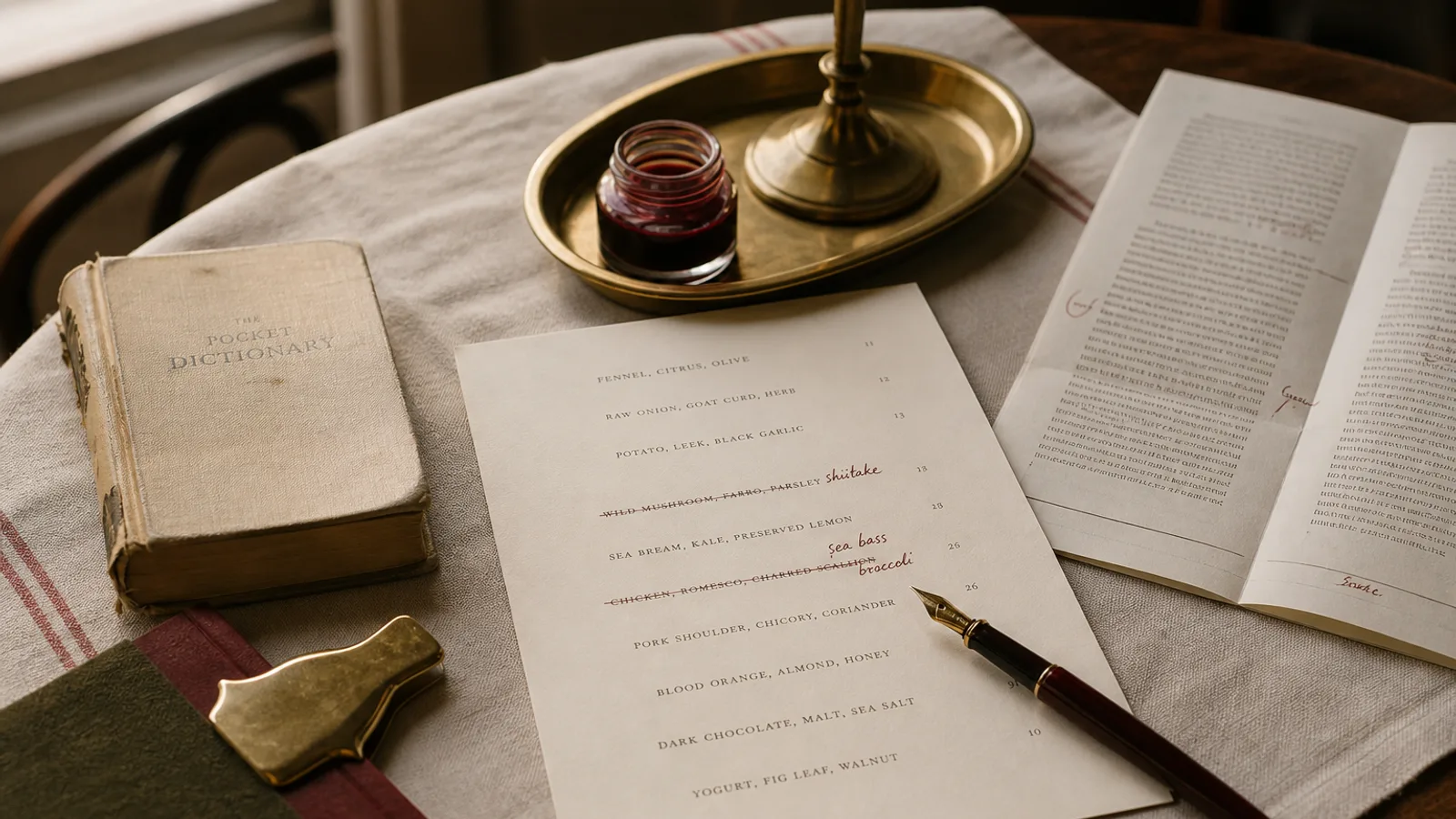
Read your menu aloud in the voice of the person you imagine wrote it. If that person changes between the starters and the desserts, you have a tone problem. Most menus do: the chef wrote the mains with precision, the manager added the brunch section with exclamation marks, and someone copied the wine notes from a distributor's sheet. The result is a card that sounds like a committee. Tone of voice is the fix, and it is less about being clever than about deciding once, writing rules down, and applying them to every line.
Tone is a promise about the evening
Guests read tone before they read dishes. Three words into a description they have already decided whether this is a place that takes itself seriously, a place that wants to be their friend, or a place that is unsure. That impression sets expectations for the price, the service and the plating. A menu written in a chatty voice at 38 € a main feels like a mismatch; a menu written in hushed fine-dining prose at 12 € feels like pretension.
So the first question is not "what tone do I like" but "what does the room already say". Wooden tables, chalk board, open kitchen and a 22 € average spend point one way. Linen, dimmed lights, a sommelier and a 90 € tasting menu point another. The menu should sound like the room, only slightly more articulate.
The spectrum, with the same dish at four points
Tone is a dial, not a switch. Here is one dish, a roast chicken with potatoes, written at four settings so you can hear the difference.
- Playful: Sunday chicken, any day. Half a free-range bird, crisp skin, potatoes that spent an hour in its fat. 19 €
- Warm and direct: Roast free-range chicken, thyme, potatoes cooked in the roasting juices. 19 €
- Editorial: Free-range chicken from the Landes, roasted whole, carved to order; potatoes confit in the jus. 24 €
- Formal: Poulet des Landes rôti, pommes de terre confites au jus. 29 €
Notice what changes. The playful version speaks to the guest in the second person and permits a joke; the warm version uses plain nouns and commas; the editorial version adds provenance and process; the formal version removes verbs and lets French do the work. Notice also what does not change: none of them uses "delicious", "succulent" or "mouth-watering". Adjectives that evaluate the dish for the guest are the mark of an unsure writer at any point on the dial.
Write the rules down before you write the menu
Consistency comes from constraints, not talent. A one-page tone sheet, kept with the recipe book, is enough. It should settle these points.
- Person and address: do you speak to the guest ("our", "you") or describe the plate impersonally? Fine dining usually the latter; bistros and cafés often the former. Never both.
- Sentence shape: full sentences with verbs, or noun phrases separated by commas? Noun phrases are faster to read and suit shorter descriptions of 8 to 14 words; sentences suit a chef's note and section introductions.
- Capitalisation: sentence case for dish names, or title case? Sentence case reads calmer and is the norm in French, Italian and Spanish; title case is an English habit that turns every line into a headline. Pick one and apply it to the entire card.
- Foreign words: which ones stay in the original (guanciale, crème fraîche, pimentón) and whether they are italicised. Decide a list, not a case-by-case feeling.
- Numbers and units: 48 h or 48 hours, 200 g or 200g, 24 mois or 24-month. Small, but the inconsistency is visible.
- Banned words: a short list of adjectives and clichés you will not use. Most menus improve immediately when "delicious", "fresh", "homemade" and "tasty" are struck out and replaced with a fact.
Playful tone: where it earns its place and where it costs
Humour on a menu works when it is in the structure and not in every line. A section called "Things on toast" or "Not quite dessert" sets a tone once and then lets the dishes be described plainly. Eleven jokes in eleven descriptions exhaust the reader and stop being funny by the fourth. The best playful menus have two or three moments of wit per page and a straight face the rest of the time.
Playful tone also translates badly. If a third of your guests read the menu in a second language, the wordplay becomes noise or, worse, confusion. Keep the humour in the headings and the chef's note, keep dish descriptions literal, and the translated card will still be yours.
Formal tone: precision, not stiffness
The formal register fails when it mistakes vagueness for elegance. "A symphony of seasonal flavours" says nothing; "Turbot, brown butter, salsify, hazelnut" says everything and sounds more expensive. Formal menus should be the most precise, not the most flowery: exact cuts, named varieties, cooking method in one word, garnish listed in order of importance on the plate.
The typography should agree. A formal voice set in a bouncy rounded sans reads as a costume; a playful voice set in a Didone with hairline serifs reads as irony the guest did not ask for. Serif faces with old-style numerals suit the editorial and formal end; humanist sans faces and hand-lettered headings suit the warm and playful end. When the words and the letterforms say the same thing, the guest stops noticing either and starts choosing food.
The whole card, one voice
Tone lives in the small print too. "Service not included" and "We are unable to split bills" are the two sentences most likely to break a warm voice into a cold one. Rewrite the footnotes in the same register as the dishes: "Service is at your discretion" and "One bill per table, please" carry the same information without changing character. Read the entire menu, header to legal line, in one sitting, in one voice, before it goes to print.
In Menu Atelier you describe the mood of the restaurant in a sentence when you start a design, and the eight base styles, from Café Chalk to Fine Dining Editorial, pair typography with a register; the AI keeps the dish descriptions you paste intact, so the words remain yours, and the layout, type and spacing are chosen to agree with them.