Templates vs custom design: a third way for restaurant menus
Why a downloaded menu template looks generic, a full custom job costs more than most rooms can repay, and how a brief-led system sits between the two.
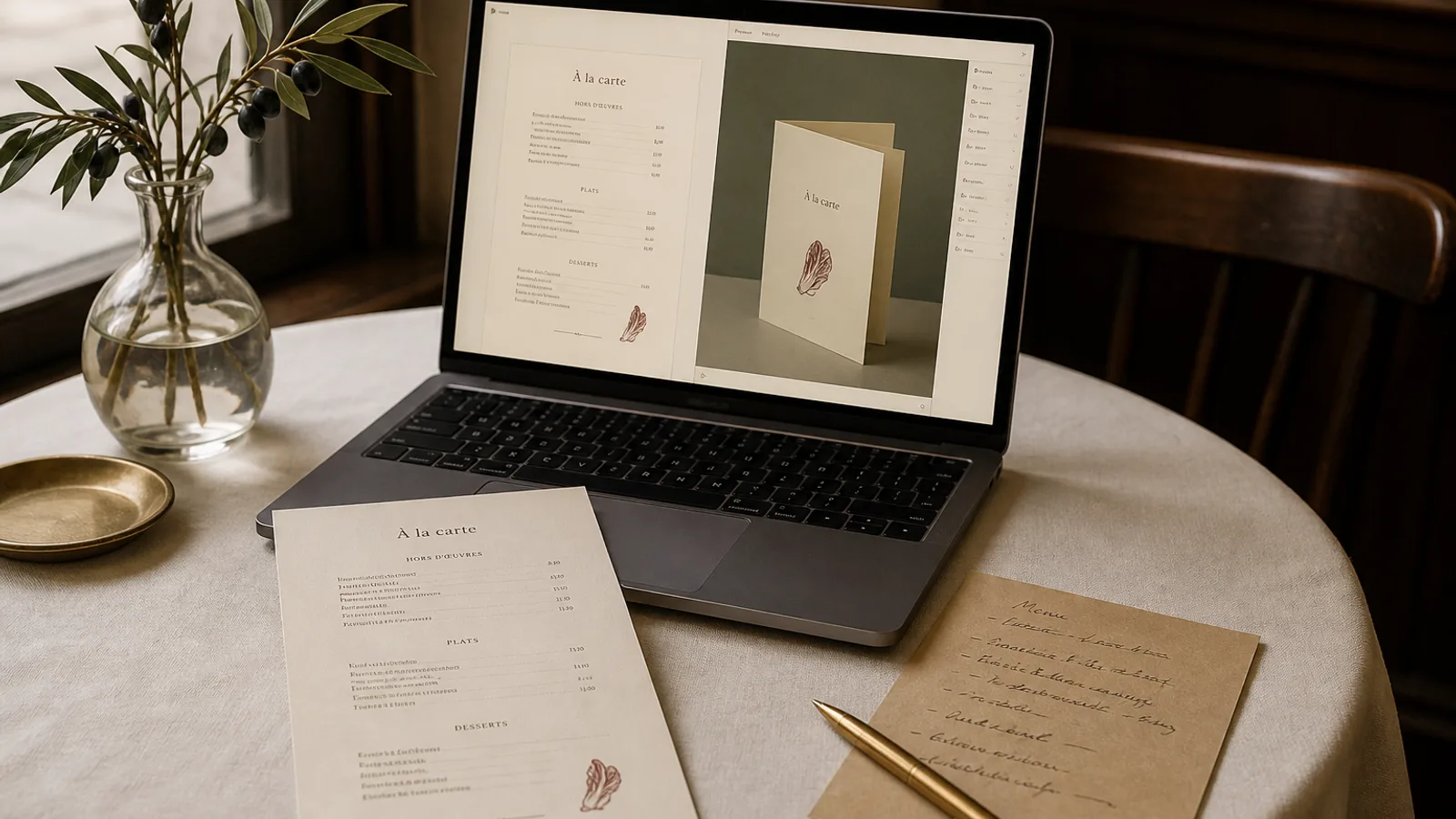
The usual choice is false. Either you download a Canva template that three other rooms on the street are already using, or you brief a studio for 1 500 to 4 000 € and wait three weeks for a first PDF. There is a third way, and it is the one most independent restaurants should be on: a design generated from your dishes, your logo and a sentence about the room, then edited until it is yours. This article is honest about what a template cannot do, what a custom job is actually paying for, and where a brief-led system earns its keep.
What a template is really selling you
A template is a layout with dummy type. It was designed for a dish count the author guessed (usually 18 to 24), a format they liked (usually US Letter or A4), and a mood that photographs well in a marketplace thumbnail. When you paste 36 dishes into it, the hierarchy collapses. When you change the heading colour to match your awning, the contrast on the descriptions dies. When you print it on 350 g board instead of the 170 g the mockup assumed, the hairlines go faint and the logo, drawn for screen, looks soft.
The deeper problem is recognition. Guests do not know the name of the template, but they know they have held it before. A script heading, a wreath, a kraft background: these are marketplace defaults. Using them tells the room you bought a costume. If two neighbours share the same file, the cheaper one looks like a copy even when it is not.
What a custom studio job is actually for
A good studio is not charging for placing 28 dishes in two columns. They are charging for judgement: which of four good directions is right for your street, how the card should feel next to the plates you already bought, whether the wine list should be a second object. That judgement is worth an hour, sometimes a day. It is rarely worth a six-week project with three rounds of revisions billed at 80 € an hour, not if the output is a single A4 that you will rewrite in November.
Pay a studio when the room is new and the brand does not exist yet, or when the menu is the brand (a tasting-menu house, a hotel dining room that must match a 200-page brand book). Do not pay a studio to move the pea soup to the other column. That is typesetting, and typesetting is now a system job.
- Template: cheap, fast, generic, breaks when the dish count or format changes
- Studio: expensive, slow, strong on direction, wasteful on weekly edits
- Brief-led system: your content and logo, generated layout, human check, reprint in an afternoon
The third way, in practice
You arrive with a dish list, a logo file, three photos of the room, and one sentence. The system proposes a layout that already knows your count of dishes, your format, and the mood you described. You reject the clichés in the brief (no script, no chalkboard, no gold). You check every price and every allergen number. You turn the card in 3D, switch A4 to A5 if the table is small, and export a print file with 3 mm bleed. That is not a template, because the geometry was built for your list. It is not a custom studio job, because nobody sat in a kickoff for two hours.
The quality test is simple. Could a guest who knows the room pick this card out of a pile of marketplace files? If the type, the paper tone and the logo size feel like the banquettes, yes. If it still looks like "Rustic Food Menu 04", you under-briefed, or you picked a starting style and did not rewrite the sentence.
Starting styles are not templates
Eight named starting points (Bistro Classic, Trattoria Rustica, Modern Minimal, and the rest) look like templates until you put your list into them. A template has dummy dishes welded to dummy columns. A starting style is a set of rules: type pairing, palette, ornament weight. Your 31 dishes reflow inside those rules. That difference is why a starting style can move from single sheet to bifold without the wreckage a template produces when you change page size.
Cost, time, and when to reprint
A marketplace template is 0 to 15 € and an evening of fighting columns. A studio cover costs 1 500 € and up, then 200 to 400 € every time the list changes if you go back to them, or it costs your Tuesday if you edit the InDesign file yourself and break the styles. A brief-led pass is free to generate, 99 € to download a print-ready bundle, and 99 € plus 10 € a copy if you want the cards printed on 350 g matte board and shipped. The reprint is the same price as the first run, which is the point: seasonal versions stop being a budget event.
Time follows money. Template: one evening, plus another when the print shop (yours, locally) rejects the RGB file. Studio: two to six weeks. System: an afternoon to a design you would print, then a day for a single proof copy in the room. If asparagus arrives early, you edit three lines and export again. That is the difference guests never see and owners feel every March.
When a template is still the right object
A one-night staff party. A pop-up that lasts a weekend and will never reprint. A first week in a new room while the real card is being finished. In those cases, a clean template, printed on whatever the office printer has, is honest. Do not laminate it. Do not pretend it is the brand. Date it, and throw it away on Monday.
For everything that will sit on the table for more than a week, skip the marketplace. Either pay a person for direction, or brief a system and keep the direction yourself. The middle option, a pretty file that belongs to everyone, is the one that makes a good kitchen look cheaper than it is.
Choose the job, not the costume
Templates sell a picture of a menu. Studios sell judgement and time. A brief-led system sells layout, reflow and prepress against your content. Most rooms need the third, with an hour of human taste at the start and a printed proof at the end. That split is how you look designed without commissioning a project every time the soup changes.
Menu Atelier is built as that third way: you paste dishes, upload a logo and photos, write one sentence or pick a starting style, turn the result in 3D, and download a 300 dpi bundle with crop marks, or order copies we print on 350 g matte board; the design is generated for your list, not poured into a hole drawn for someone else's.