Menu design without a designer: what actually changed in 2026
What a restaurant owner can now do without hiring a designer: lock a style, set type that holds, export print-ready files, and where a human still earns the fee.
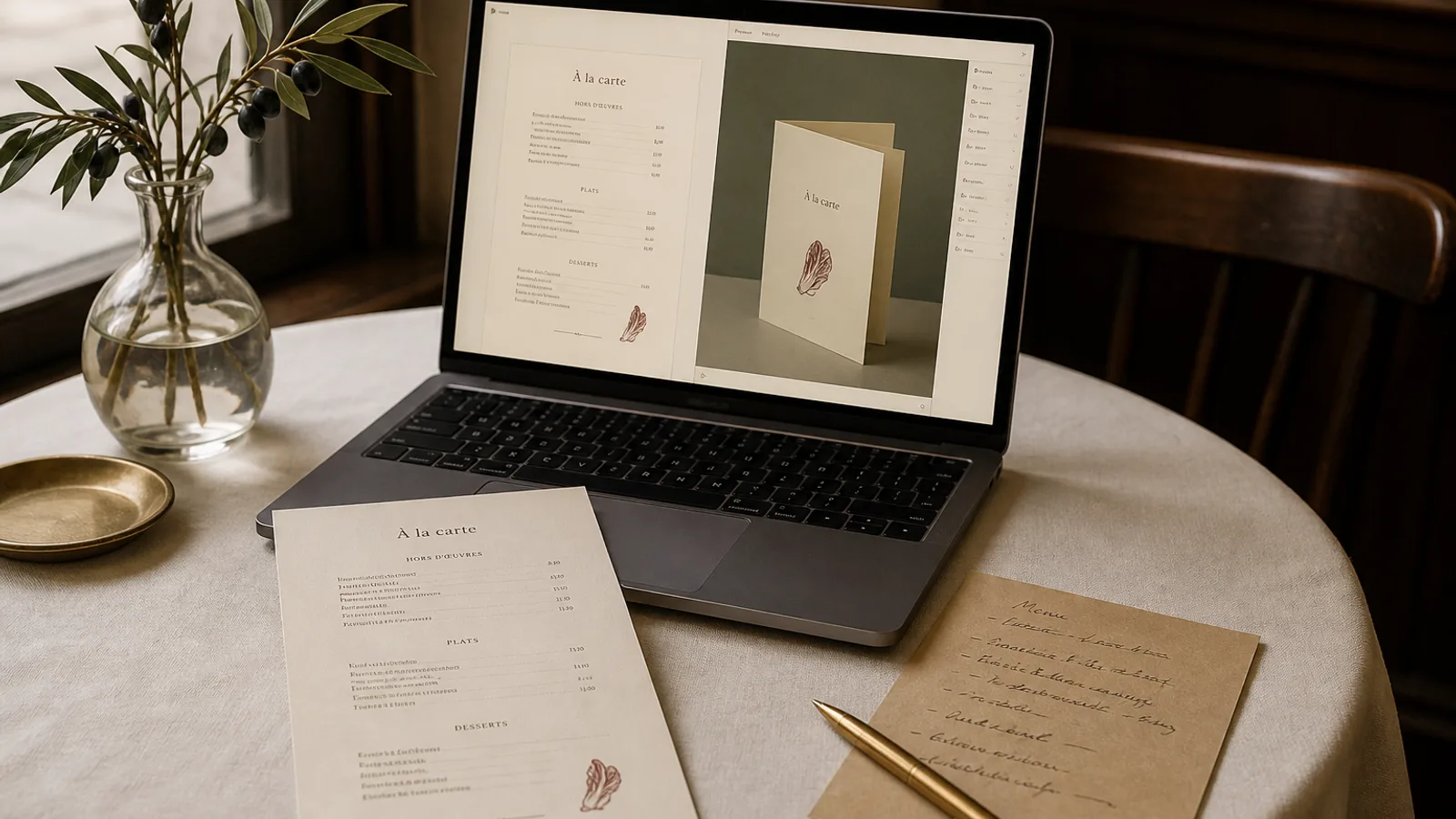
Five years ago, a restaurant that wanted a card that did not look like a Word export hired a designer, waited two weeks, and paid for a second round when the fish changed. Many still do, and should, when the room is a statement. What changed in 2026 is not that taste became optional. It is that the mechanical half of the job (margins, bleed, a hierarchy that holds, a PDF a press can print) no longer requires a studio day. Owners who understand that split stop paying for typesetting and start paying, when they pay, for judgement.
The part a tool can now hold
A competent 2026 tool will give you a format (A4 or A5, single sheet or bifold, one or two sides), a type hierarchy that does not invent a third face for the dessert prices, and an export with 3 mm bleed and crop marks at 300 dpi. It will keep your logo at a size that does not fight the first heading. It will let you switch format without rebuilding the card. That used to be the invoice. It is now the default, and a card that still arrives as an RGB PDF with type sitting on the trim is a card made in last decade's software.
It will not decide how many dishes you should print. It will not tell you that the formule belongs at the top. It will not taste the room. Those remain owner decisions. A tool that offers twelve styles is useful if you pick one and stay; it is harmful if you try three on the same Friday and print the loudest.
What you still have to decide, in an hour
Before you open anything, write four lines on paper: how many dishes, which format the tables can hold, one accent colour that already exists in the room, and which block must be readable from a standing guest (the lunch formule, the sets, the coffee ladder). That hour saves the afternoon of nudging. Owners who skip it end up with a handsome card that hides the offer the room lives on.
- Dish lines: name, two or three components, price. If you cannot say it in one breath, it is not a menu line yet.
- Allergen numbers as you type, not as a Sunday panic. Regulation 1169/2011 does not care that you designed this yourself.
- One proof on the actual table, under the actual lamps, before you order a run. The screen always lies a little about cream paper and about 11 pt.
Where a designer still earns the fee
Hire a designer when the card is part of a brand you are launching, when you need a custom illustration or a letterpress mark, when the list is a 120-bin wine book, or when two partners cannot agree and you need a third adult in the room. Do not hire a designer to move a price 2 mm or to change the plat du jour every Tuesday. That is how studios become expensive secretaries and owners become resentful. A good designer in 2026 will set the system and leave you a file you can refill; a bad one will lock the file and bill you for every fish.
Typography still has a floor. If you choose a script for forty dish names, or a light sans at 9 pt on a dark card, the tool will let you. The tool is not a critic. Learn the few rules that do not move: 11 pt minimum in a dining room, accents on capitals in French, euro after the figure, one serif and one grotesque, margins of 12 mm or more. Those rules are older than any model.
Print is still a craft, even when the file is free to make
Designing the card yourself does not make paper optional. 350 g matte with a soft-touch finish is still the object that survives a service; a home laser on 80 g is still a flyer. Bleed and crop marks are still how a press trims. Colour still wants CMYK aimed at a coated standard (Fogra39 / ISO Coated v2) if you use colour at all. The change is that you can now produce that file on a Tuesday morning without sending a briefing email on Monday.
Short runs are the point. If you can export a clean PDF in twenty minutes, you can reprint when the list moves instead of laminating a winter card into June. That is the real 2026 advantage: frequency, not a new aesthetic.
A honest test before you skip the studio
Set the card. Print one copy. Sit where a guest sits. If you can order in forty-five seconds, if the prices align, if the formule or the sets are the first thing you see, and if nothing collides with the fold, you do not need a designer this month. If you are still choosing between three heading faces, or the description of the sea bass has become a paragraph, you need a pause, not another generation.
In Menu Atelier that split is the product: you paste the dishes, pick a style (Bistro Classic, Trattoria Rustica, Modern Minimal, Art Deco Cocktail, Café Chalk, Fine Dining Editorial, Sushi Zen, Mediterranean), switch A4 and A5 in one click, check the card in 3D, and download a 300 dpi PDF with 3 mm bleed or order the run printed on 350 g matte board. Designing is free for 15 generations; the print bundle is 99 € once per menu. The judgement stays yours.