Telling your story on the menu: the about paragraph guests actually read
How to write the about line on a restaurant menu: length, placement, what to leave out, and why a forty-word paragraph beats a founder memoir on the inside cover.
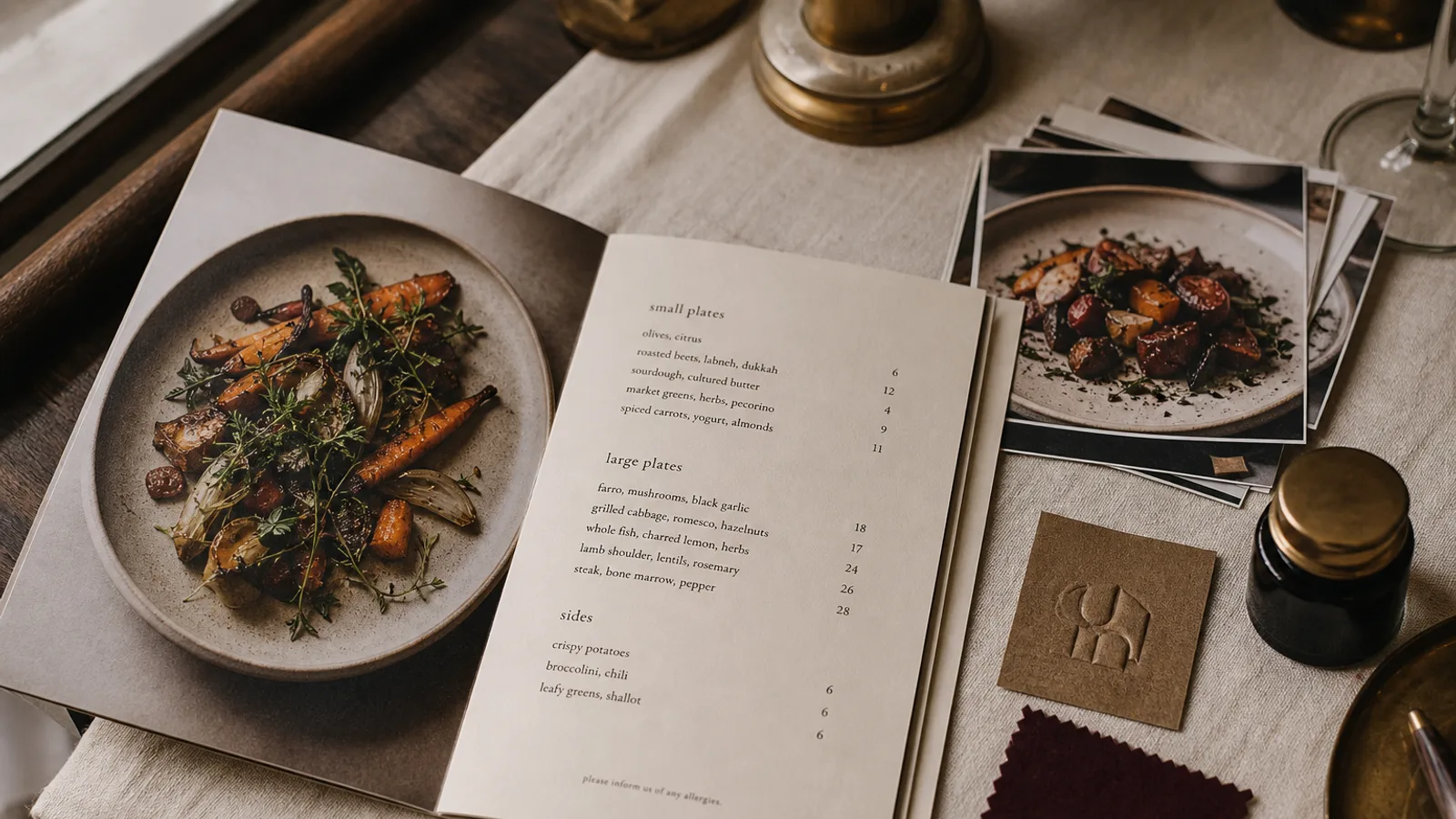
Most about paragraphs on menus are not read. They are skipped the way guests skip the first page of a novel they did not ask for. A block of 180 words on the inside cover, set in 8 pt italic, about a grandmother, a trip to Lyon, and a commitment to seasonality, costs you a panel and buys you nothing. The about that works is short enough to be read while the guest is still deciding whether to look at starters, specific enough that it could only be this room, and placed where the eye already goes. Forty to seventy words. One claim. No memoir.
What the paragraph is for
It is not a biography. It is a frame. A guest who has never been here needs one sentence of where they are (a corner bistro that cooks from the market, a seafood room on a harbour, a trattoria that still makes its own pasta) and, if you insist, one sentence of how you cook. That is enough to make the dish names make sense. Everything else belongs on the website, on a framed card in the lavatory, or in the mouth of the person who greets.
It is also not a manifesto. Words like passion, journey, authentic and farm-to-table have been on so many cartes that they now mean nothing. If you buy from one farm, name the farm. If you only cook fish landed that morning, say that, once. If you are a second generation and the room still has the original zinc, you may say so in a clause, not in a page.
Cornell's menu work, and every waiter who has watched a table go quiet, agrees: time on the carte is time not ordering. An about that takes forty seconds is a tax. An about that takes eight seconds can raise the room a register before the first dish is chosen.
Where it sits, and how long it is
Best: under the mark on the front of a bifold, or at the top of a single A4, 9.5 to 11 pt, 40 to 70 words, one paragraph. Second best: the inside left of a bifold if the front is only the mark, still short, still one paragraph. Worst: a full panel, or the back of the carte where nobody looks except for the Instagram handle.
A tasting card can take an even shorter line: eighteen words under the title, the chef's note for the evening, dated. Do not paste the house about onto a sequence that will change on Tuesday; the about will look like leftover stationery.
Type should match the dishes, a size smaller or the same in italic. Do not switch to a script for the story and a grotesque for the food unless you are designing a joke. Leading a little more open than the dish list; the paragraph is a breath, not a second column of plates.
- 40–70 words, one paragraph, under the mark or at the top of the first food face.
- Name a place, a product or a habit that is actually yours; cut the adjectives everyone uses.
- Tasting card: 18 words, dated; not the house memoir.
- Website, press kit and the greeting take the rest of the story.
What to cut without mercy
Awards, unless one is the reason people booked (a star, a historic room). Lists of suppliers that read like a manifesto. The year you opened, unless the year is the point (a room from 1924 can say 1924; a room from 2019 should not lead with 2019). A quote from a review. Guests did not come to read that they are in good hands; they came to order.
Translations want the same length, not a longer French version because French can hold more clauses. If you print in two languages, two short paragraphs, not one long bilingual braid. Italian rooms can mention the coperto here only if it is unusual; Spanish rooms can mention the menú del día on the lunch sheet, not in the evening about.
Allergens and service charges are not story. They belong in a quiet key at the foot. Mixing them into the about (we are happy to adapt any dish, a 12.5 percent service charge will be added) turns the paragraph into a terms sheet. Split them.
A few shapes that work
We cook what the market will give us that morning, on a wood fire, for a room of forty. The wine list is short and European. That is a bistro. The boats land at dawn; we buy from the same two families and we do not print a fish until it is on the pass. That is a seafood room. Sunday lunch is still a family table; the rest of the week we cook the same way for whoever walks in. That is a trattoria. None of those needs a grandmother, and each could only be one kind of house.
Write it last, after the dishes are set. The about should agree with the list. If the list is six steaks and a Caesar, do not write about a vegetable garden. If the list changes every week, do not write about a fixed tradition. Guests will believe the dishes, not the paragraph.
Write it once, then leave it alone
A good about does not need a seasonal rewrite. The dishes move; the frame stays. If you find yourself rewriting the paragraph every time the soup changes, you put the volatile part in the wrong block. Move the market line to the insert, and let the about be the room.
In Menu Atelier you describe the mood in a sentence when you start, and that sentence feeds the layout more than it feeds a printed memoir: the styles (Bistro Classic, Mediterranean, Fine Dining Editorial) already carry a voice. Put your forty words under the mark, see the card in 3D, and export the 300 dpi PDF with 3 mm bleed. The paragraph should be the quietest true thing on the paper. The cooking can be louder.