Naming dishes: house names, classics and the risk of being clever
When a classic name serves the guest, when a house name earns its keep, and how clever titles slow the order and hide allergens the kitchen already knows about.
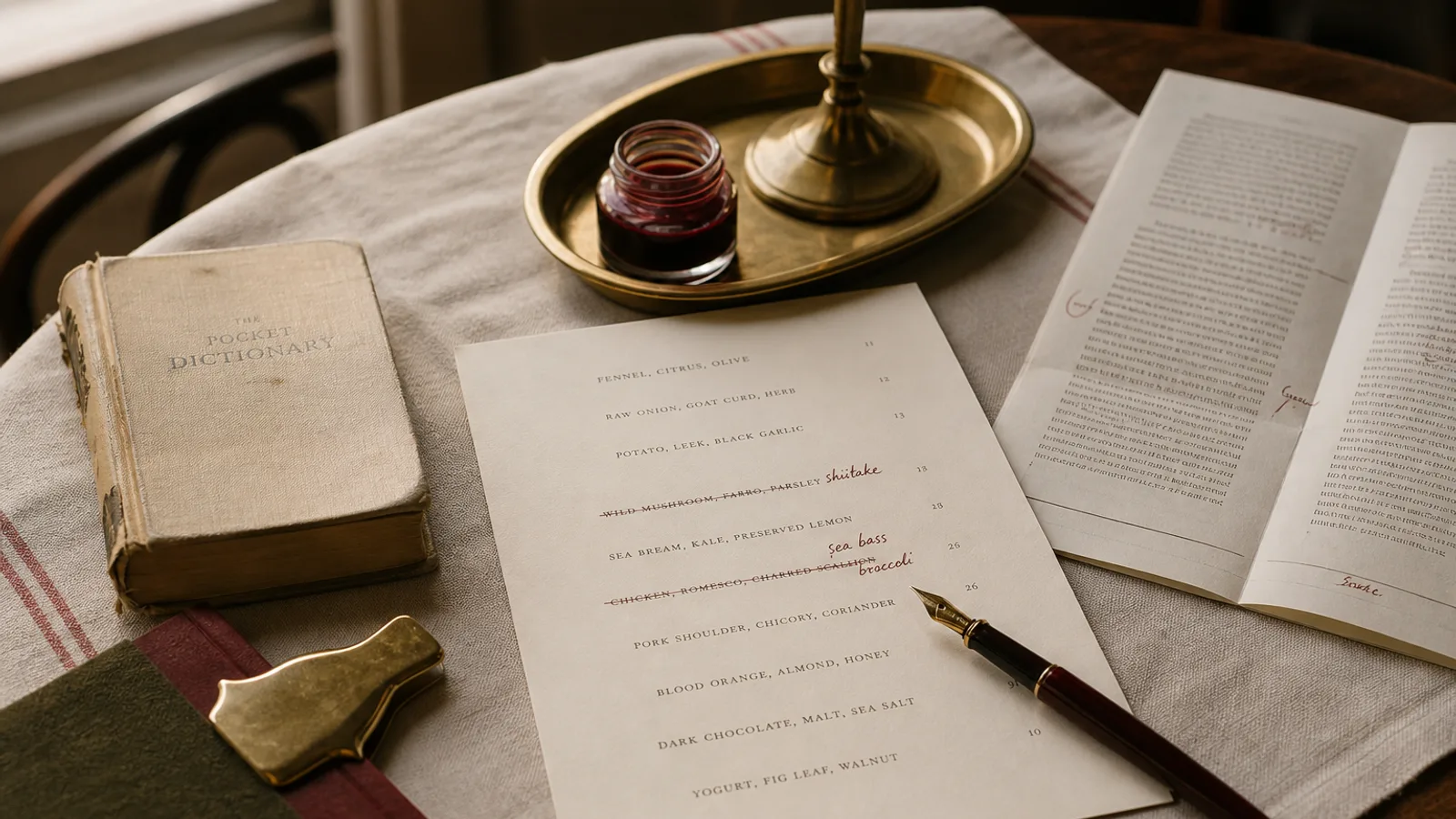
The name is the first thing a guest says out loud. If they cannot say it, or they do not know what they are asking for, you have already lost a round of service. Rooms swing between two mistakes: every plate gets a poem ("Midnight in the garden"), or every plate gets a legal description ("Beef, potato, butter, salt"). The useful middle is a name the waiter and the guest can share, plus a short line of facts underneath. This article draws the line between a classic, a house name, and a joke that does not belong on an A5.
Classics exist so people can order them
If you are serving a steak tartare, call it steak tartare. If the garnish is yours, that belongs in the description ("capers, smoked egg, rye"), not in a renamed title. Classics are a shared language. Changing "coq au vin" to "rooster in the red" does not make you original; it makes the tourist ask the table next door. Keep the classic when the dish is the classic. Save invention for when the plate is actually new.
Foreign classics on a local card need a decision. An Italian name in a Paris room is fine if the staff can pronounce it and the guest can guess the protein. "Ossobuco" works. "Casoncelli alla bergamasca" on a 32-line card will stall. Give the guest a way in: the classic name, then the meat or the stuffing in the line below.
House names that earn the extra word
A house name is useful when the dish is yours and you will still be serving it in two years. "Anna's soup" means something if Anna is on the pass and the regulars know it. It means nothing on a first visit unless the description does the work ("lentil, cumin, lemon"). Put the house name first only if it is short and sayable. Put the facts second, always.
A supplier's name ("Martin's lamb") is a house name of a kind. Use it when the farm is real and you will still have Martin in November. Drop it when the lamb is whoever answered the phone. Guests remember a name you then cannot keep.
- Keep the classic name when the dish is the classic; invent only when the plate is new
- House names stay short, sayable, and backed by a line of facts
- Never hide the protein, the heat, or a major allergen inside a joke
- If two people at the table cannot agree what the dish is, rename it
Clever is expensive at 8.30 pm
Puns, song titles, and in-jokes belong on a staff meal, not on a card a tourist is holding. "You've got to be kidding me" as a name for a chilli is a conversation you will have forty times a night. "The usual" as a name for a burger is cute until a guest thinks it is whatever they had last time. Wit that needs a footnote is not wit; it is a delay.
Numbers as names ("No. 7") work in a ramen or a tap room where the list is short and staff shout numbers. They fail on a 36-dish dinner card. Letters as names ("The BLT, but not") fail when the "not" is the information. If the cleverness is the only content, you do not have a name. You have a riddle.
Allergens hide in cute titles
"Forest floor" that is a mushroom and hazelnut crumb is a Regulation 1169/2011 problem as well as a service problem. The guest with a nut allergy will not decode your poetry. Put the nut in the name or in the first four words of the description, and key the number. The same for "romesco", "pesto", "satay", "green curry": if the title is a sauce, the allergen is in the title. Write it so a stranger can see it.
How it sits in type
A name at 11 to 12 pt, a description at 9.5 to 10 pt, a price at 11 pt tabular: that hierarchy only works if the name is short enough to sit on one line on A5. Count the characters. 28 to 40 is comfortable. 55 is a wrap, and a wrap under a price is how the 24 € disappears. If the name must be long (a regional classic), drop the description to one word or none, rather than stacking three lines of title.
Do not set house names in a script you do not use for anything else. One type family for names, one for descriptions. A second display face for "signature" dishes is how a card starts to look like a poster. If a dish is a signature, the kitchen will make it taste like one. The type does not need to shout.
Say it, then print it
Read the names aloud in the order they appear. Anything the night team cannot say the same way twice, change. Anything two guests would order differently, change. Classics when they are classics, house names when they will last, facts always underneath, jokes left in the locker room. That is a list people can use.
In Menu Atelier you paste the names you have decided, not a generated list of clever titles; the system sets them in the hierarchy of the style you chose, and when you switch from A4 to A5 you will see immediately which house names have become a second line. Shorten the name. Do not squeeze the tracking.