The printed menu comeback: why paper is back on the table
Why printed menus are returning after the QR years: what guests missed, what paper does for the room, and how to reprint without going backwards.
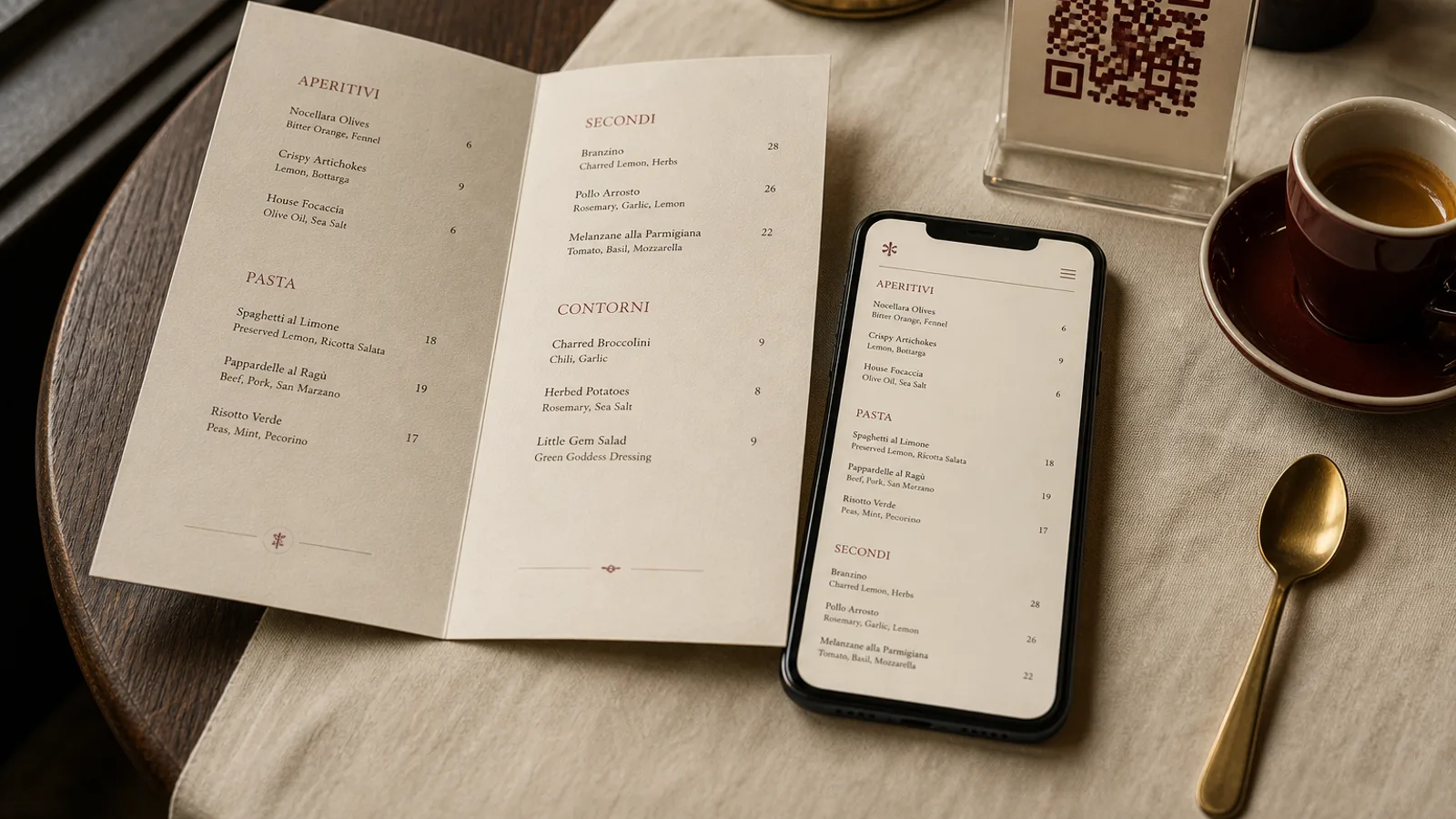
For three years a lot of rooms treated the printed card as a hygiene relic. The code stayed, the reprint budget disappeared, and the table learned to wait for a page to load. Then the rooms that put paper back noticed something dull and useful: people ordered faster, talked more, and asked fewer questions about what a dish was. The comeback is not nostalgia. It is the cheapest way to give a table a shared object again.
What vanished when the card vanished
A menu is not only a list. It is the first thing a guest holds that belongs to the house. Weight, fold, type and the small stain of last night’s service tell the room what kind of place this is before the first plate arrives. A QR code tells the room that the house outsourced that moment to the guest’s phone, including the cracked screen, the 12 px type and the hotel Wi-Fi. Guests did not write reviews about this. They just ordered the dish they could see without scrolling.
Staff felt it too. Explaining a QR to a table of six, fetching a paper copy for the guest who asked, and keeping a web page in step with the kitchen is more work than wiping a card. The rooms that dropped print to “save time” often spent that time on the floor, teaching people how to open a link.
What paper does that a screen will not
Paper has a trim size. An A5 bifold or a single A4 sheet has edges, a fold and a last page. The guest finishes the card. A phone page has no last page, so the guest stops at the first screen that looks complete. That is why QR rooms quietly sell the top of the list and lose the second half of the mains. You can fight this with anchors and sticky headers. You cannot fight it as cheaply as printing a card that ends.
Paper is also a lighting instrument. 11 pt on uncoated 300 or 350 g stock, dark type, generous margins, reads in a 40-lux dining room. A phone at full brightness fights the candles; a phone at half brightness loses the grey descriptions. You designed the room for faces, not for screens. Putting a glowing rectangle in every hand undoes the lighting plot you paid for.
Reprint without repeating 2019
The cards that failed before the pandemic failed for reasons that had nothing to do with viruses: too many dishes, 8 pt type, prices in a faint dotted leader, photographs that turned to mud on cheap gloss. Bringing paper back is a chance to print fewer items, larger type, and a card you are willing to hold under a guest’s nose. If the list still has 80 lines, the problem is the offer, not the substrate.
- Print the list you can cook tonight, not the list you wish you could cook in July.
- Keep a QR for the full wine book, the second language or the daily specials — as a companion, not a replacement.
- Choose 300–350 g uncoated or soft-touch matte; skip the laminate unless the card lives outdoors or in a very wet service.
- Put a month-and-year mark in 6 pt in the footer so old cards can be pulled the week you reprint.
Cost, honestly
A short run of A5 bifolds on 350 g matte, scored, delivered in the EU, sits in a different budget from a laminated A3 that you reprint twice a year at a copy shop. Figure tens of euros for a handful of cards if you print locally, or a structured print-and-ship price if you want the fold and the finish done for you. The expensive card is the one you are ashamed to put down, because you then hide it and go back to the code.
Paper as the default again
Put a card on the table. Keep the QR for the list that cannot stand still. Design the paper as if the phone might stay in the bag. That is the comeback: not a rejection of screens, but a refusal to make every guest produce their own menu. The house holds the object. The table shares it. The kitchen gets the orders it actually wanted to cook.
In Menu Atelier you lay the card out, switch from a single sheet to a bifold in one click, check the fold in 3D, and order the printed menus on 350 g matte with a soft-touch finish; the same file downloads as a 300 dpi PDF with 3 mm bleed if you prefer to print a proof yourself.