Sharing your menu on Instagram: crops, legibility and the story format
How to put a restaurant menu on Instagram so it can be read: crops that survive the feed, type that holds on a phone, and stories that do not crop the prices.
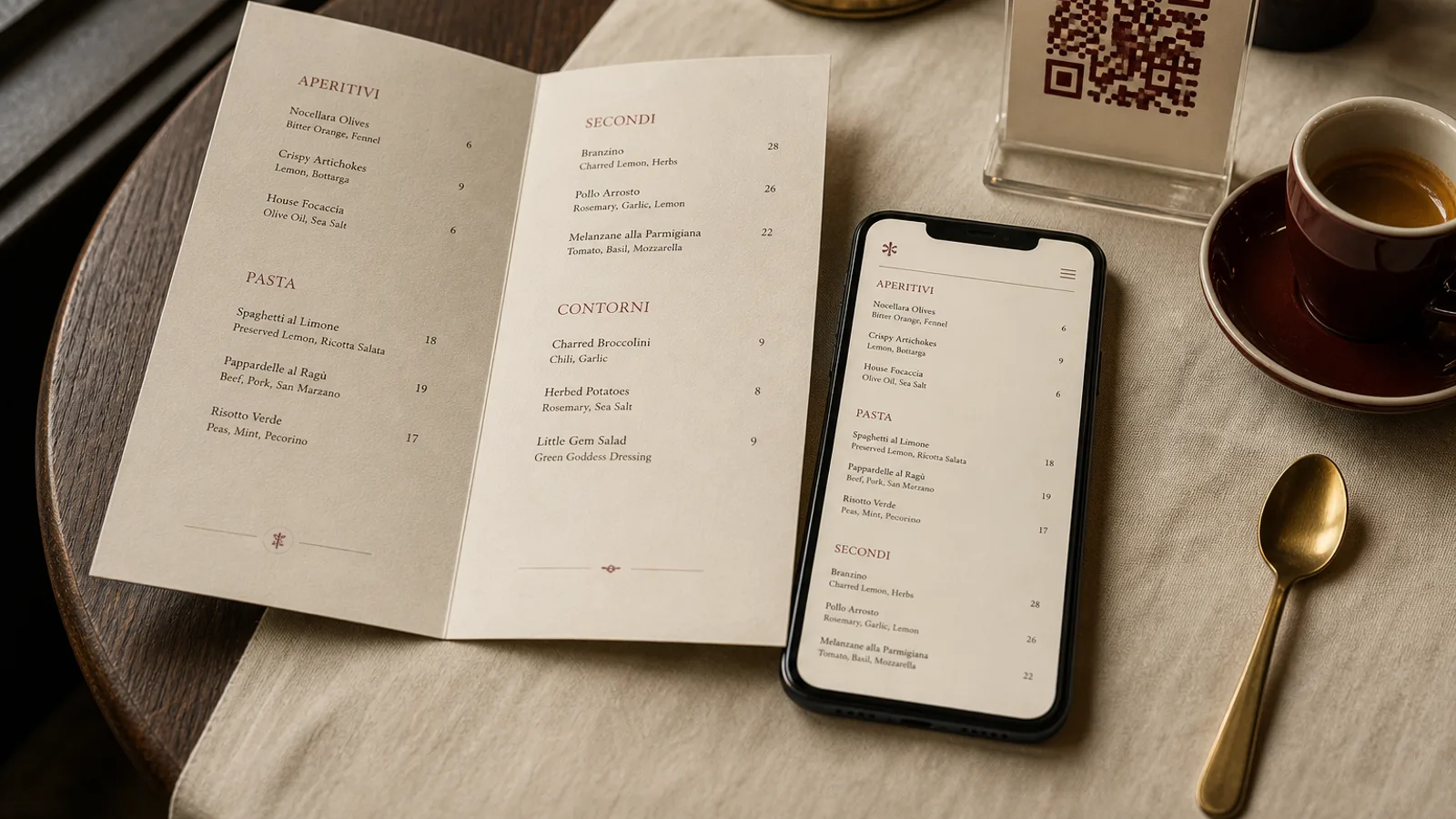
A photograph of a folded card on a marble table, shot from a polite angle, with a glass in the foreground, is a picture of atmosphere. It is not a menu. Half the dishes are in shadow, the prices sit in the gutter, and the type that worked at 11 pt on paper is 6 px on a phone in a bright street. If you want Instagram to sell tonight’s dinner, treat the post as a second layout, not as a souvenir of the printed card.
Crop for the feed, not for the dining room
The feed is a square or a 4:5 portrait. A landscape A4 bifold does not fit either. Do not post the whole open card and hope. Choose one section — starters, or the three dishes you want this week — and set it as a single column on a quiet field. Leave a margin inside the crop; Instagram’s interface eats the edges, and so do the rounded corners of a story. If a price sits in the last 8 percent of the frame, it will vanish under a username or a sticker.
A carousel of four tight crops beats one heroic wide shot. Slide one: the heading and the idea of the section. Slides two and three: the dishes, large. Slide four: hours, booking, the address. Guests swipe. They do not pinch a moody photograph until the sea bream becomes legible.
Type that survives a phone at noon
On a phone, assume 12 to 16 words per screen and a type size that you can read with the brightness down. That usually means redrawing the line, not photographing it. Export a face from the menu file, or reset the names in a simple layout: dark type, plain background, no script under 24 pt equivalent. Thin hairlines and pale grey descriptions die on a sunlit screen. If the printed card is a chalk or Art Deco style, keep the mood in the colour and the heading; do not keep the 8 pt garnish list.
Never post a photo of the card in restaurant light as the only version of the list. That file is useful as a story of the room, after the readable slides. Lead with the words. Atmosphere can follow.
Stories and Reels crop harder than the feed
Stories are 9:16. Safe type sits in the middle 70 percent of the height. The top is for the time and the close button; the bottom is for reply, stickers and the next story. A full-bleed scan of an A5 card will lose the header and the last prices. Build a vertical stack: heading, five dishes, a price column that does not sit on the right edge, a last line with the booking route. Hold each story at least four seconds if you use more than one; guests who cannot pause will miss a two-second flash of the mains.
- One section per frame; never the whole bifold in a single story.
- Prices in the same colour as the names, not in a faint dotted leader.
- A last frame with hours and how to book, not only a plate close-up.
- Alt text on feed posts: dish names, not “menu” or “food”.
What not to ask of a highlight
A Highlights album called “Menu” that contains last Easter’s card, a blurry special and a story that expired in spirit six months ago is worse than no album. Date the cover (“September 2026”) and replace the whole set when you reprint. A guest who books from an old highlight and sits down to a different list will not blame Instagram. They will blame the house.
A second layout, same dishes
Keep one list of names and prices. Design the printed card for the table. Design a few tight, high-contrast frames for the phone. Do not make the photograph of the first do the work of the second. A guest standing in a bright street at noon will not pinch a moody marble shot until the dish names appear. When the crops are honest, a guest who saw the sea bream in a story can order it without asking what it was. That is the only metric that matters.
In Menu Atelier you can switch the same dishes from an A4 sheet to an A5 bifold and export a PNG per face; use those faces as the source for a square or 9:16 crop, rather than photographing the printed card on the table and hoping the type survives the feed.