Tablet menus in restaurants: lessons from a decade of trials
What ten years of tablet menus taught restaurants: where they worked, where they failed, real costs per table, and how to decide between screens and printed menus.
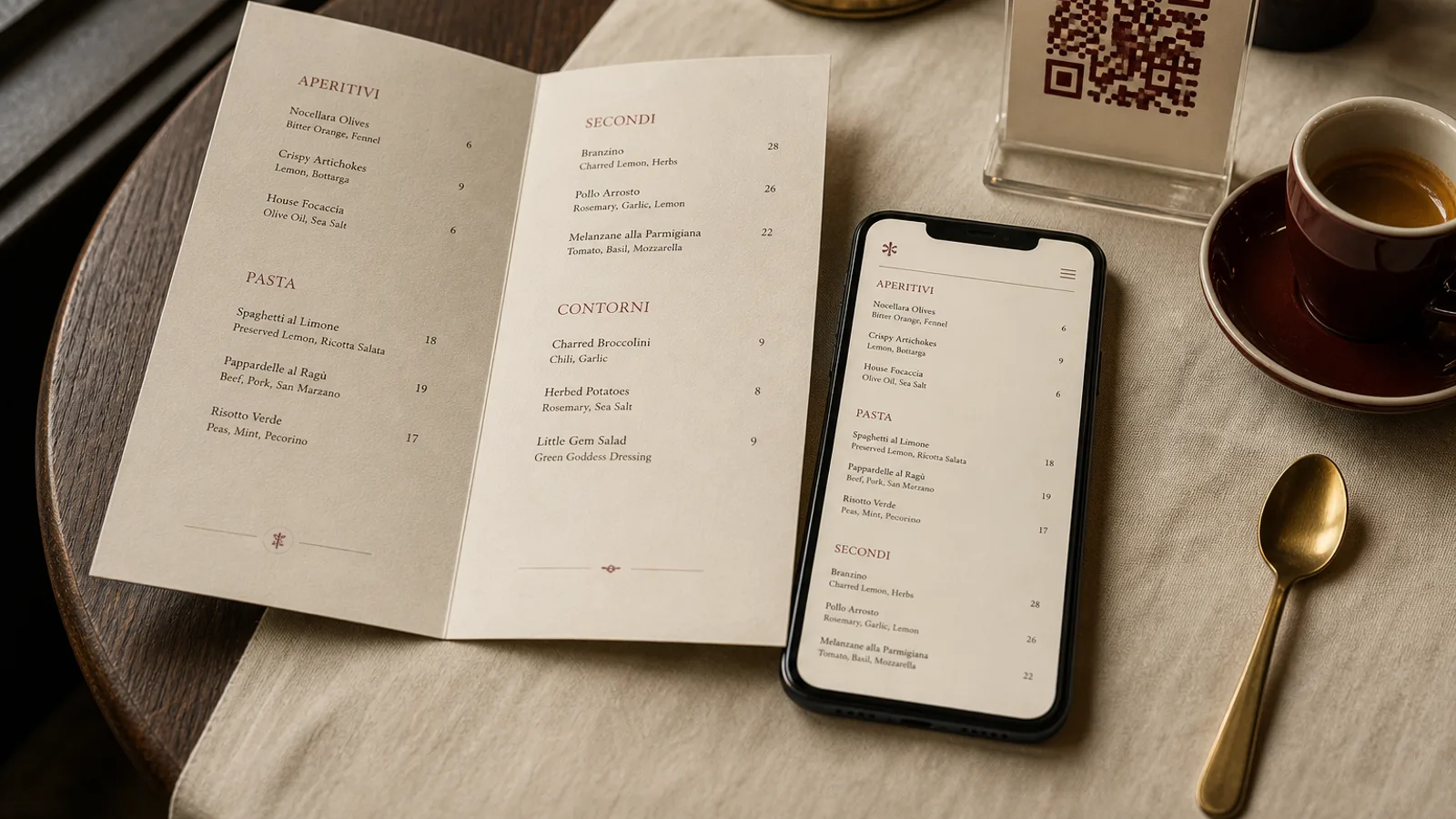
Around 2012 the tablet menu was going to replace paper. Chains installed them by the thousand, start-ups raised money on the idea, and design blogs declared the printed card dead. A decade later most of those tablets are in a drawer, a few venues use them brilliantly, and the printed menu is back on almost every table. This is a look at what actually happened, with numbers on cost and breakage, so you can decide whether a screen belongs on your tables or only in your kitchen.
Where tablets genuinely worked
The success stories share a pattern: high volume, long menus, and a guest who wants to order without waiting. Conveyor sushi and izakaya-style venues with 150 items, where a tablet lets a table of four order in rounds and see photos of every plate. Airport and casino restaurants where the guest is alone, time-pressed and happy to skip the server. Large casual-dining chains where the tablet doubled as a payment terminal and a games console for children, and the upsell prompts for a second drink or a dessert measurably lifted the average bill.
In those settings, the tablet was never really a menu. It was an ordering terminal that happened to display a menu, and it paid for itself through labour and average-bill effects, not through design.
Where they failed, and why
Independent restaurants with 30 to 50 dishes and a service culture found the opposite. The screen sat between the guest and the server; recommendations stopped, and the experience felt like using a kiosk. Guests fought over the single tablet at a table of six. Batteries died mid-service, charging racks took a shelf, and a 10-inch device on a 60 cm bistro table left no room for the bread.
There was also a quieter problem: the tablet menu looked like every other tablet menu. A printed card carries the restaurant's identity in its paper, type and format. A tablet carries a template from a vendor, and the vendors mostly went out of business, leaving venues with hardware they could no longer update.
The real costs, per table
Owners tend to compare a 300 € tablet with a 3 € printed menu and stop there. The full arithmetic looks different.
- Hardware: 250 to 450 € per tablet with a rugged case and stand, one per table plus 20 percent spares. Expect a three-year life at best in a restaurant environment.
- Software: 30 to 90 € per month per venue for the menu and ordering platform, sometimes per device.
- Breakage and loss: independent operators reported 10 to 20 percent of devices damaged or missing per year, mostly from drops and spilled drinks.
- Labour: someone charges, cleans and updates them every day. Ten minutes a day is 60 hours a year.
- Cleaning: a screen touched by a hundred hands a day needs a wipe between every seating; that is a real hygiene and time cost that paper menus share only in part.
- Printed menus for comparison: a run of 50 menus on 350 g board with a soft-touch finish costs 150 to 300 € and is replaced two to four times a year, so 600 to 1200 € a year for the whole room.
For a 15-table restaurant the tablet route costs roughly 6000 to 9000 € in the first year and 2000 to 3000 € a year thereafter, before staff time. Printed menus over the same period cost a fifth of that. The gap is only justified if the screen changes ordering behaviour enough to recover it, which in a full-service room it rarely does.
Legibility and hygiene, honestly assessed
A backlit screen has a legibility advantage in a dim room, where a printed menu in 9 pt on cream loses to a phone torch. But in a bright room or on a terrace, glare and fingerprints make a glossy tablet worse than matte paper. Guests over sixty also report that they read paper more comfortably than screens for anything longer than a few lines, and menus are read by people of all ages.
On hygiene, both media are touched by many hands; the difference is that a laminated or coated printed menu can be wiped with the same cloth as the table, and a menu on 350 g uncoated board simply gets replaced when it wears. Neither is a health risk if the routine exists; both are unpleasant if it does not.
What the tablet decade left behind
The lasting legacy of the tablet menu is not on the table but behind it. Kitchen display screens replaced paper tickets. Handheld ordering devices for servers, which are essentially tablets in the right hands, cut the walk to the till and are now standard. QR menus took the tablet's promise of instant updates and moved it to the guest's own phone, with mixed results that deserve their own discussion. And the photo-heavy, item-by-item structure of tablet menus became the template for delivery apps.
The printed menu, meanwhile, absorbed the lessons: shorter cards, larger type, clearer sections, allergen codes to comply with Regulation 1169/2011 without cluttering the page, and a faster reprint cycle so prices are never crossed out with a pen.
How to decide for your own room
- Count your items. Under 60, a printed card in A4 or A5 handles it with room to breathe; a tablet adds nothing.
- Look at your service model. If servers recommend and upsell, keep the screen out of the guest's hands; give servers a handheld instead.
- Check the light. Dim rooms favour screens or brighter paper and bigger type; bright rooms and terraces favour matte paper.
- Do the three-year arithmetic above with your own table count.
- If you still want a screen, pilot it on three tables for a month and measure average bill, table turn and breakage before buying twenty.
Most independent restaurants end where the decade ended: a well-made printed menu on the table, a QR fallback for guests who prefer their phone, and screens for the kitchen and the servers. If that is your conclusion, the printed card deserves the care the tablet never got. In Menu Atelier you design it once, preview it in 3D, switch between A4 and A5 or single sheet and bifold in one click, and either download the print-ready bundle or have us print it on 350 g matte board with a soft-touch finish and deliver it across the EU in five to eight working days.