Translating a restaurant menu: what to translate, what to keep
A working method for translating a restaurant menu: which dish names stay in the original, how to explain rather than translate, false friends and how to brief a translator.
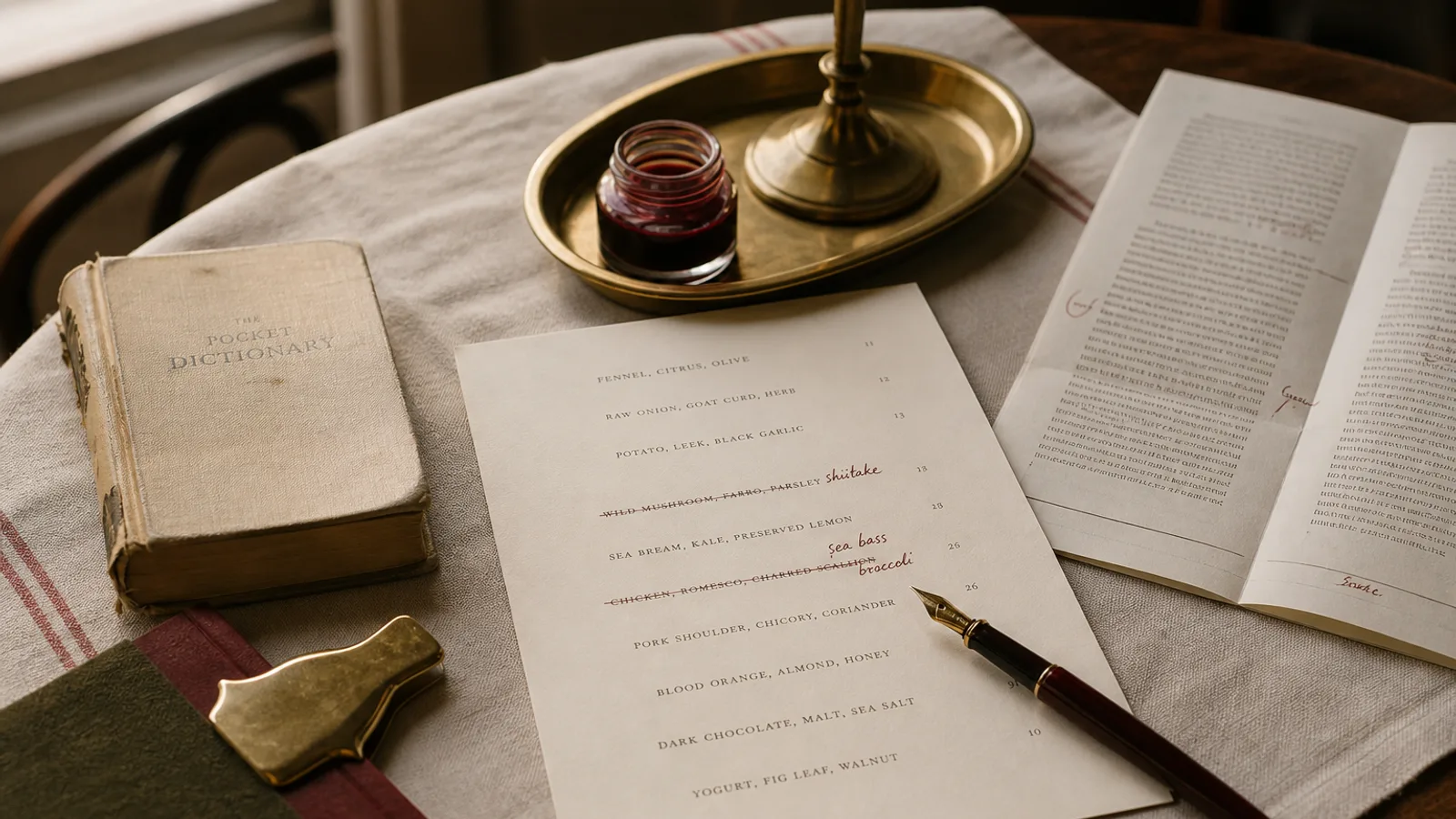
The worst menu translations are not the funny ones. "Octopus to the party" gets a laugh and a photo; the real damage is done by a competent-sounding English menu that turns a pan con tomate into "bread with tomato", a blanquette into "veal stew" and a saltimbocca into "jump in the mouth", stripping every dish of the reason a traveller came to eat it. Translation is not the goal. Comprehension is, and the two are often at odds. Here is a working method you can apply to your own card this week, whether you hand it to a professional or do the first draft yourself.
Start by deciding what is a name and what is a description
Every dish line has up to three parts: a name, a description and a price. Names are proper nouns. Descriptions are explanations. The most common mistake is translating the name when you should have kept it and added a description, or translating the description word for word when you should have rewritten it for a reader who does not know your pantry.
Keep the original name when the dish is a recognised preparation with an identity: risotto alla milanese, bouillabaisse, gazpacho, cassoulet, vitello tonnato, tortilla española, choucroute. Even a guest who has never heard the word learns something useful: this is a specific thing, not a generic stew. Then explain it underneath, in the reader's language, in one plain line.
Translate the name when it is generic and descriptive in the original: "grilled sea bream with lemon" or "roast chicken with potatoes" gains nothing from staying in French or Italian. Translate it fully and skip the description if the name already says it all.
Explain, do not transliterate
A good description in a second language answers three questions in order: what is the main ingredient, how is it cooked, what comes with it. "Slow-braised veal shoulder in a white sauce with mushrooms and rice" tells a visitor everything blanquette de veau does not. It does not need to be elegant. It needs to remove doubt.
Some ingredients have no equivalent and should not be forced into one. Guanciale is not bacon. Crème fraîche is not sour cream. Pimentón de la Vera is not paprika, or not only. Keep the word, then give the guest the nearest reference in a couple of words: "guanciale (cured pork cheek)". The parenthesis is your friend on a translated menu, far more than on the original.
Watch the false friends that every kitchen produces. In French, "entrée" is a starter; in American English it is the main course. "Lard" in French is bacon; in English it is rendered pork fat. "Peperoni" in Italian are bell peppers; a tourist reads pepperoni sausage. "Tortilla" means an omelette in Spain and a flatbread in Mexico. When a word exists in both languages with different meanings, translate around it.
What tourists actually need to know
Beyond the dishes, a translated menu must carry the parts of the card that a local takes for granted and a visitor does not. These are short but they prevent the awkward conversations at the till.
- How pricing works: whether the cover charge (il coperto in Italy) or bread and service are included, whether the lunch formula requires two or three courses, whether prices are per person for sharing dishes.
- Portion logic: that antipasti are meant to be shared, that a primo is a pasta course and not a main, that tapas come as small plates and raciones as larger ones.
- Timing: if the kitchen closes at 14:30, or if a dish takes 25 minutes, say so in the translated version, because a visitor cannot ask a neighbour.
- Allergen and dietary information: the 14 allergens of Regulation 1169/2011 must be understandable in every language you print, and the legend must be translated even if the icons stay the same.
Tone travels badly
The playful voice that works in your own language rarely survives translation. A pun on a regional word becomes a puzzle; a chef's in-joke reads as an error. The safest tone for a second-language menu is a notch more neutral than the original: warm, precise, without wordplay. If your brand depends on humour, keep it in the section headings and the chef's note, where a mistranslation costs nothing, and keep the dish descriptions clean.
Resist the marketing adjectives too. "Succulent", "delicious" and "mouth-watering" mark a menu as translated by someone who was told to make it sound appealing. Precision is more appetising than praise in any language: "line-caught", "48-hour marinated", "from the wood oven" say more than any superlative.
Briefing a translator, or checking your own work
A professional translator with food experience will charge roughly 0.10 to 0.18 € per word in Western Europe, which for a 40-dish menu with descriptions comes to 60 to 150 € per language. It is one of the cheapest things you will ever buy for your restaurant and it lasts for years. But a translator can only be as good as the brief.
- Send the menu with a one-line explanation of every dish that has a name rather than a description, in your own words, as you would explain it to a guest at the table.
- Mark which names must stay in the original language, and which are yours to rename freely.
- Give the target audience: British and American tourists are not the same reader, and a menu for a ski resort is not a menu for a business district.
- Ask for the translation to be delivered in the same order and structure as your file, line for line, so it can be laid out without guessing which description belongs to which dish.
- Have a native speaker who knows food read it once on paper, at the size it will be printed, before it goes to press.
If you use machine translation for a first draft, treat it as a first draft. It is now good at the structure of a sentence and still poor at the pantry: it will call a courgette flower a "zucchini flower" for British readers and a "pumpkin flower" when it gets confused. Every ingredient name needs a human eye.
One menu, several readers
A translated menu is an act of hospitality before it is a document. The guest who reads it is already slightly lost; every line that removes a doubt makes the evening better and the order more confident. Keep the names that carry identity, explain them plainly, translate the generic ones fully, carry the practical information a local never needs, and let the tone cool a notch.
In Menu Atelier each dish can carry its name and description in French, English, Italian and Spanish; you type or paste the translations once and every generated layout, from A4 single sheet to A5 bifold, can be exported in any of the four languages with the same design, the same prices and the same allergen legend.